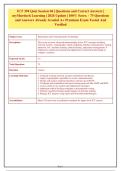
ICT 394 Quiz Session 04 | Questions and Correct Answers |
myMurdoch Learning | 2026 Update | 100% Score. - 75 Questions
and Answers Already Graded A+ Premium Exam Tested And
Verified
Subject Area Information and Communication Technology
Description This exam assesses advanced understanding of key ICT concepts including
network security, cryptography, cloud computing, database normalization, routing
protocols, IoT, machine learning, ethical hacking, and project management. It
emphasizes analytical reasoning and application of theoretical knowledge to
complex scenarios.
Expected Grade A+
Total Questions 75
Duration 3 hours
Learning Outcomes 1. Critically evaluate network security mechanisms and threats.
2. Apply cryptographic algorithms to secure communications.
3. Design and analyze relational database schemas up to BCNF.
4. Configure and troubleshoot advanced routing protocols like OSPF and BGP.
5. Assess cloud service models and deployment strategies.
6. Implement ethical hacking techniques for penetration testing.
7. Interpret machine learning model outputs for decision-making.
8. Manage ICT projects using Agile and Waterfall methodologies.
Accreditation Meets US university accreditation standards for upper-level ICT courses.
Page 1
,Question 1 of 75
In a distributed system employing a local key distribution center (KDC), a user A wants to establish
a secure session with user B. After receiving the session key K_{AB} encrypted with A's master key,
the KDC sends a ticket to A encrypted with B's master key containing K_{AB}. What additional step
is necessary to prevent a replay attack on the ticket?
A. Include a nonce encrypted with K_{AB} in the ticket.
B. Include a timestamp in the ticket encrypted with B's master key.
C. Require A to present the ticket to B before B decrypts it.
D. Encrypt the ticket with a temporary key derived from both master keys.
The correct answer is:
Correct Action: Include a timestamp in the ticket encrypted with B's master key.
Rationales
• Include a timestamp in the ticket encrypted with B's master key. (Correct):
This is the correct action. Including a timestamp or sequence number in the ticket (encrypted with B's master key) allows B
to verify freshness and detect replay attacks. Options A and D do not ensure freshness without additional verification.
Option C is a procedural step but does not cryptographically prevent replay.
• Include a nonce encrypted with K_{AB} in the ticket. (Incorrect):
This option is not appropriate. Options A and D do not ensure freshness without additional verification. Option C is a
procedural step but does not cryptographically prevent replay
• Require A to present the ticket to B before B decrypts it. (Incorrect):
This option is not appropriate. Options A and D do not ensure freshness without additional verification. Option C is a
procedural step but does not cryptographically prevent replay
• Encrypt the ticket with a temporary key derived from both master keys. (Incorrect):
This option is not appropriate. Options A and D do not ensure freshness without additional verification. Option C is a
procedural step but does not cryptographically prevent replay
Page 2
,Question 2 of 75
Consider a relational schema R(A, B, C, D, E) with functional dependencies: AB -> C, C -> D, D ->
E, and E -> A. Which of the following is true about the highest normal form of R?
A. R is in 2NF but not 3NF.
B. R is in 3NF but not BCNF.
C. R is in BCNF.
D. R is in 1NF but not 2NF.
The correct answer is:
Correct Action: R is in 1NF but not 2NF.
Rationales
• R is in 1NF but not 2NF. (Correct):
This is the correct action. The candidate keys are AB and CB. The functional dependency C->D causes a partial
dependency on candidate key CB (since C is a proper subset), violating 2NF. Thus, R is not in 2NF, and its highest normal
form is 1NF.
• R is in 2NF but not 3NF. (Incorrect):
This option is not appropriate. The functional dependency C->D causes a partial dependency on candidate key CB (since C
is a proper subset), violating 2NF. Thus, R is not in 2NF, and its highest normal form is 1NF
• R is in 3NF but not BCNF. (Incorrect):
This option is not appropriate. The functional dependency C->D causes a partial dependency on candidate key CB (since C
is a proper subset), violating 2NF. Thus, R is not in 2NF, and its highest normal form is 1NF
• R is in BCNF. (Incorrect):
This option is not appropriate. The functional dependency C->D causes a partial dependency on candidate key CB (since C
is a proper subset), violating 2NF. Thus, R is not in 2NF, and its highest normal form is 1NF
Page 3
, Question 3 of 75
During a penetration test, you gain shell access to a Linux server and need to escalate privileges. The
kernel version is 4.15.0-20-generic, and after running 'uname -a' you find the system has a known
vulnerability CVE-2017-1000112. Which of the following best describes the exploitation vector for
this vulnerability?
A. A buffer overflow in the ptrace system call allowing code injection into kernel space.
B. An integer overflow in the UDP fragment offload leading to a heap-based out-of-bounds write.
C. A race condition in the AF_PACKET socket handling causing a use-after-free in the skb destructor.
D. A missing permission check in the ioctl call for USB devices enabling arbitrary read/write to memory.
The correct answer is:
Correct Action: A race condition in the AF_PACKET socket handling causing a use-after-free in the skb
destructor.
Rationales
• A race condition in the AF_PACKET socket handling causing a use-after-free in the skb destructor. (Correct):
This is the correct action. CVE-2017-1000112 is a race condition in the AF_PACKET socket implementation (packet: only
of use when using 'dev->hard_header' and 'dev->addr_len' but actually a use-after-free). Option C accurately describes it as
a race condition in AF_PACKET socket handling. Options A, B, D describe other CVEs that are not this one.
• A buffer overflow in the ptrace system call allowing code injection into kernel space. (Incorrect):
This option is not appropriate. Option C accurately describes it as a race condition in AF_PACKET socket handling.
Options A, B, D describe other CVEs that are not this one
• An integer overflow in the UDP fragment offload leading to a heap-based out-of-bounds write. (Incorrect):
This option is not appropriate. Option C accurately describes it as a race condition in AF_PACKET socket handling.
Options A, B, D describe other CVEs that are not this one
• A missing permission check in the ioctl call for USB devices enabling arbitrary read/write to memory.
(Incorrect):
This option is not appropriate. Option C accurately describes it as a race condition in AF_PACKET socket handling.
Options A, B, D describe other CVEs that are not this one
Page 4
myMurdoch Learning | 2026 Update | 100% Score. - 75 Questions
and Answers Already Graded A+ Premium Exam Tested And
Verified
Subject Area Information and Communication Technology
Description This exam assesses advanced understanding of key ICT concepts including
network security, cryptography, cloud computing, database normalization, routing
protocols, IoT, machine learning, ethical hacking, and project management. It
emphasizes analytical reasoning and application of theoretical knowledge to
complex scenarios.
Expected Grade A+
Total Questions 75
Duration 3 hours
Learning Outcomes 1. Critically evaluate network security mechanisms and threats.
2. Apply cryptographic algorithms to secure communications.
3. Design and analyze relational database schemas up to BCNF.
4. Configure and troubleshoot advanced routing protocols like OSPF and BGP.
5. Assess cloud service models and deployment strategies.
6. Implement ethical hacking techniques for penetration testing.
7. Interpret machine learning model outputs for decision-making.
8. Manage ICT projects using Agile and Waterfall methodologies.
Accreditation Meets US university accreditation standards for upper-level ICT courses.
Page 1
,Question 1 of 75
In a distributed system employing a local key distribution center (KDC), a user A wants to establish
a secure session with user B. After receiving the session key K_{AB} encrypted with A's master key,
the KDC sends a ticket to A encrypted with B's master key containing K_{AB}. What additional step
is necessary to prevent a replay attack on the ticket?
A. Include a nonce encrypted with K_{AB} in the ticket.
B. Include a timestamp in the ticket encrypted with B's master key.
C. Require A to present the ticket to B before B decrypts it.
D. Encrypt the ticket with a temporary key derived from both master keys.
The correct answer is:
Correct Action: Include a timestamp in the ticket encrypted with B's master key.
Rationales
• Include a timestamp in the ticket encrypted with B's master key. (Correct):
This is the correct action. Including a timestamp or sequence number in the ticket (encrypted with B's master key) allows B
to verify freshness and detect replay attacks. Options A and D do not ensure freshness without additional verification.
Option C is a procedural step but does not cryptographically prevent replay.
• Include a nonce encrypted with K_{AB} in the ticket. (Incorrect):
This option is not appropriate. Options A and D do not ensure freshness without additional verification. Option C is a
procedural step but does not cryptographically prevent replay
• Require A to present the ticket to B before B decrypts it. (Incorrect):
This option is not appropriate. Options A and D do not ensure freshness without additional verification. Option C is a
procedural step but does not cryptographically prevent replay
• Encrypt the ticket with a temporary key derived from both master keys. (Incorrect):
This option is not appropriate. Options A and D do not ensure freshness without additional verification. Option C is a
procedural step but does not cryptographically prevent replay
Page 2
,Question 2 of 75
Consider a relational schema R(A, B, C, D, E) with functional dependencies: AB -> C, C -> D, D ->
E, and E -> A. Which of the following is true about the highest normal form of R?
A. R is in 2NF but not 3NF.
B. R is in 3NF but not BCNF.
C. R is in BCNF.
D. R is in 1NF but not 2NF.
The correct answer is:
Correct Action: R is in 1NF but not 2NF.
Rationales
• R is in 1NF but not 2NF. (Correct):
This is the correct action. The candidate keys are AB and CB. The functional dependency C->D causes a partial
dependency on candidate key CB (since C is a proper subset), violating 2NF. Thus, R is not in 2NF, and its highest normal
form is 1NF.
• R is in 2NF but not 3NF. (Incorrect):
This option is not appropriate. The functional dependency C->D causes a partial dependency on candidate key CB (since C
is a proper subset), violating 2NF. Thus, R is not in 2NF, and its highest normal form is 1NF
• R is in 3NF but not BCNF. (Incorrect):
This option is not appropriate. The functional dependency C->D causes a partial dependency on candidate key CB (since C
is a proper subset), violating 2NF. Thus, R is not in 2NF, and its highest normal form is 1NF
• R is in BCNF. (Incorrect):
This option is not appropriate. The functional dependency C->D causes a partial dependency on candidate key CB (since C
is a proper subset), violating 2NF. Thus, R is not in 2NF, and its highest normal form is 1NF
Page 3
, Question 3 of 75
During a penetration test, you gain shell access to a Linux server and need to escalate privileges. The
kernel version is 4.15.0-20-generic, and after running 'uname -a' you find the system has a known
vulnerability CVE-2017-1000112. Which of the following best describes the exploitation vector for
this vulnerability?
A. A buffer overflow in the ptrace system call allowing code injection into kernel space.
B. An integer overflow in the UDP fragment offload leading to a heap-based out-of-bounds write.
C. A race condition in the AF_PACKET socket handling causing a use-after-free in the skb destructor.
D. A missing permission check in the ioctl call for USB devices enabling arbitrary read/write to memory.
The correct answer is:
Correct Action: A race condition in the AF_PACKET socket handling causing a use-after-free in the skb
destructor.
Rationales
• A race condition in the AF_PACKET socket handling causing a use-after-free in the skb destructor. (Correct):
This is the correct action. CVE-2017-1000112 is a race condition in the AF_PACKET socket implementation (packet: only
of use when using 'dev->hard_header' and 'dev->addr_len' but actually a use-after-free). Option C accurately describes it as
a race condition in AF_PACKET socket handling. Options A, B, D describe other CVEs that are not this one.
• A buffer overflow in the ptrace system call allowing code injection into kernel space. (Incorrect):
This option is not appropriate. Option C accurately describes it as a race condition in AF_PACKET socket handling.
Options A, B, D describe other CVEs that are not this one
• An integer overflow in the UDP fragment offload leading to a heap-based out-of-bounds write. (Incorrect):
This option is not appropriate. Option C accurately describes it as a race condition in AF_PACKET socket handling.
Options A, B, D describe other CVEs that are not this one
• A missing permission check in the ioctl call for USB devices enabling arbitrary read/write to memory.
(Incorrect):
This option is not appropriate. Option C accurately describes it as a race condition in AF_PACKET socket handling.
Options A, B, D describe other CVEs that are not this one
Page 4