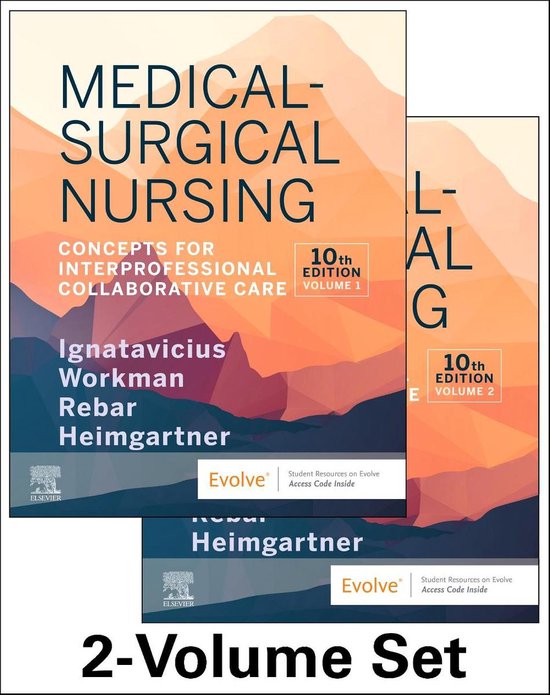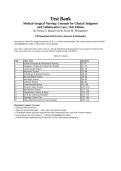
Test Bank
Medical-Surgical Nursing: Concepts for Clinical Judgment
and Collaborative Care, 11th Edition
By Donna D. Ignatavicius & Nicole M. Heimgartner
150 Questions with Correct Answers & Rationales
Instructions: Choose the single best answer (A, B, C, or D) for each question. The correct answer is shown in bold
and highlighted in yellow, followed by a brief rationale.
Note: This is original test-bank content written at a clinical-judgment/nursing-management level, organized around the major
body-system units and core concepts covered in Medical-Surgical Nursing, 11th Edition.
Table of Contents
Unit Topic Area Questions
1 Essential Concepts & Perioperative Nursing Q1–10
2 Emergency, Trauma & Critical Care Nursing Q11–20
3 Cardiovascular System Q21–34
4 Respiratory System Q35–48
5 Hematologic & Immune Systems Q49–58
6 Musculoskeletal System Q59–68
7 Neurologic System Q69–82
8 Endocrine System Q83–92
9 Gastrointestinal System Q93–106
10 Renal & Urinary System Q107–116
11 Reproductive System Q117–122
12 Integumentary System & Burns Q123–130
13 Eye & Ear (Sensory) Disorders Q131–136
14 Oncology: Cancer Care Q137–144
15 Older Adult & End-of-Life Care Concepts Q145–150
Document Contents Overview:
• Title page and instructions
• Table of contents (this page) — topic areas with question ranges
• 150 multiple-choice questions organized by body-system/topic unit, each with 4 answer options
• Correct answer for each question — bolded and highlighted in yellow
• A brief rationale explaining why the answer is correct, following each question
,Essential Concepts & Perioperative Nursing (Q1–10)
1. What is the primary purpose of clinical judgment models in medical-surgical nursing practice?
A) To replace the nursing process entirely
B) To guide systematic recognition of cues, analysis, and prioritized action to ensure safe patient care
C) To eliminate the need for patient assessment
D) To standardize care regardless of patient context
Rationale: Clinical judgment models (e.g., the NCSBN Clinical Judgment Measurement Model) guide nurses
through recognizing cues, analyzing information, prioritizing hypotheses, and taking appropriate action to
ensure safe, individualized care.
2. What physiologic changes commonly affect drug metabolism in older adults?
A) Increased hepatic and renal function
B) Decreased hepatic and renal function, increasing risk of drug toxicity
C) No change in drug metabolism with aging
D) Increased gastric emptying only
Rationale: Aging is associated with decreased hepatic and renal function, reducing drug metabolism and
clearance, which increases the risk of drug accumulation and toxicity.
3. What is the nurse's priority action when a patient reports pain rated 8/10 on a numeric scale?
A) Assess the pain further (location, quality, onset) and intervene promptly per the pain management
plan
B) Wait until the next scheduled assessment
C) Dismiss the report since pain is subjective
D) Automatically assume drug-seeking behavior
Rationale: Self-reported pain is the most reliable indicator of pain; the nurse should further assess and
intervene promptly according to the individualized pain management plan.
4. What is the purpose of a pre-operative time-out?
A) To verify correct patient, procedure, and surgical site immediately before incision
B) To allow the surgical team a coffee break
C) To review billing information
D) To replace the need for informed consent
Rationale: The pre-operative time-out is a final safety verification of patient identity, procedure, and surgical
site immediately before the procedure begins.
5. What is the nurse's priority assessment in the immediate post-anesthesia care unit (PACU)?
A) Airway, breathing, and level of consciousness
B) Nutritional status
C) Discharge teaching
D) Skin integrity only
Rationale: Airway patency, breathing adequacy, and level of consciousness are top priorities immediately
following anesthesia due to risk of respiratory depression.
6. What pre-operative teaching reduces the risk of postoperative atelectasis?
A) Incentive spirometry and deep breathing/coughing exercises
B) Strict bed rest with no movement
C) Withholding all pain medication
D) Avoiding any leg exercises
, Rationale: Incentive spirometry and deep breathing/coughing exercises promote lung expansion and help
prevent atelectasis after surgery.
7. What is 'malignant hyperthermia,' a rare but life-threatening anesthesia complication?
A) A hypermetabolic reaction to certain anesthetic agents causing severe hyperthermia, muscle rigidity,
and tachycardia
B) A mild, self-limiting fever after surgery
C) An allergic skin rash only
D) A normal response to general anesthesia
Rationale: Malignant hyperthermia is a rare, life-threatening hypermetabolic reaction triggered by certain
anesthetics, causing severe hyperthermia, muscle rigidity, and tachycardia, requiring immediate treatment with
dantrolene.
8. What nursing consideration is unique when caring for transgender or non-binary patients in the medical-surgical
setting?
A) Use the patient's correct name and pronouns and provide care sensitive to their specific health needs
B) Assume all care needs are identical to cisgender patients with no individualized approach
C) Avoid documenting gender identity information
D) Refuse to ask about the patient's preferred name
Rationale: Providing affirming, respectful care — including correct name/pronoun use and attention to specific
health needs — supports safe, patient-centered care for transgender and non-binary patients.
9. What is the focus of rehabilitation nursing for patients with chronic or disabling conditions?
A) Maximizing functional ability, independence, and quality of life
B) Achieving a complete cure in all cases
C) Focusing solely on the acute phase of illness
D) Eliminating the need for any assistive devices
Rationale: Rehabilitation nursing focuses on helping patients maximize function, independence, and quality of
life despite chronic or disabling conditions.
10. What is a key principle of end-of-life palliative care?
A) Focus on comfort, symptom management, and quality of life rather than curative treatment
B) Withholding all pain medication to avoid dependence
C) Pursuing aggressive curative treatment regardless of patient wishes
D) Excluding family from care discussions
Rationale: Palliative and end-of-life care prioritizes comfort, symptom management, and quality of life,
respecting patient/family wishes and goals of care.
Emergency, Trauma & Critical Care Nursing (Q11–20)
11. In emergency triage, what does the primary survey (ABCDE) prioritize first?
A) Airway with cervical spine protection
B) Disability/neurologic status
C) Exposure
D) Circulation only
Rationale: The primary survey follows the ABCDE sequence, beginning with Airway (with cervical spine
protection), then Breathing, Circulation, Disability, and Exposure.
12. What is the priority nursing action for a trauma patient with a suspected tension pneumothorax and severe
respiratory distress?
A) Prepare for immediate needle decompression/chest tube insertion
Medical-Surgical Nursing: Concepts for Clinical Judgment
and Collaborative Care, 11th Edition
By Donna D. Ignatavicius & Nicole M. Heimgartner
150 Questions with Correct Answers & Rationales
Instructions: Choose the single best answer (A, B, C, or D) for each question. The correct answer is shown in bold
and highlighted in yellow, followed by a brief rationale.
Note: This is original test-bank content written at a clinical-judgment/nursing-management level, organized around the major
body-system units and core concepts covered in Medical-Surgical Nursing, 11th Edition.
Table of Contents
Unit Topic Area Questions
1 Essential Concepts & Perioperative Nursing Q1–10
2 Emergency, Trauma & Critical Care Nursing Q11–20
3 Cardiovascular System Q21–34
4 Respiratory System Q35–48
5 Hematologic & Immune Systems Q49–58
6 Musculoskeletal System Q59–68
7 Neurologic System Q69–82
8 Endocrine System Q83–92
9 Gastrointestinal System Q93–106
10 Renal & Urinary System Q107–116
11 Reproductive System Q117–122
12 Integumentary System & Burns Q123–130
13 Eye & Ear (Sensory) Disorders Q131–136
14 Oncology: Cancer Care Q137–144
15 Older Adult & End-of-Life Care Concepts Q145–150
Document Contents Overview:
• Title page and instructions
• Table of contents (this page) — topic areas with question ranges
• 150 multiple-choice questions organized by body-system/topic unit, each with 4 answer options
• Correct answer for each question — bolded and highlighted in yellow
• A brief rationale explaining why the answer is correct, following each question
,Essential Concepts & Perioperative Nursing (Q1–10)
1. What is the primary purpose of clinical judgment models in medical-surgical nursing practice?
A) To replace the nursing process entirely
B) To guide systematic recognition of cues, analysis, and prioritized action to ensure safe patient care
C) To eliminate the need for patient assessment
D) To standardize care regardless of patient context
Rationale: Clinical judgment models (e.g., the NCSBN Clinical Judgment Measurement Model) guide nurses
through recognizing cues, analyzing information, prioritizing hypotheses, and taking appropriate action to
ensure safe, individualized care.
2. What physiologic changes commonly affect drug metabolism in older adults?
A) Increased hepatic and renal function
B) Decreased hepatic and renal function, increasing risk of drug toxicity
C) No change in drug metabolism with aging
D) Increased gastric emptying only
Rationale: Aging is associated with decreased hepatic and renal function, reducing drug metabolism and
clearance, which increases the risk of drug accumulation and toxicity.
3. What is the nurse's priority action when a patient reports pain rated 8/10 on a numeric scale?
A) Assess the pain further (location, quality, onset) and intervene promptly per the pain management
plan
B) Wait until the next scheduled assessment
C) Dismiss the report since pain is subjective
D) Automatically assume drug-seeking behavior
Rationale: Self-reported pain is the most reliable indicator of pain; the nurse should further assess and
intervene promptly according to the individualized pain management plan.
4. What is the purpose of a pre-operative time-out?
A) To verify correct patient, procedure, and surgical site immediately before incision
B) To allow the surgical team a coffee break
C) To review billing information
D) To replace the need for informed consent
Rationale: The pre-operative time-out is a final safety verification of patient identity, procedure, and surgical
site immediately before the procedure begins.
5. What is the nurse's priority assessment in the immediate post-anesthesia care unit (PACU)?
A) Airway, breathing, and level of consciousness
B) Nutritional status
C) Discharge teaching
D) Skin integrity only
Rationale: Airway patency, breathing adequacy, and level of consciousness are top priorities immediately
following anesthesia due to risk of respiratory depression.
6. What pre-operative teaching reduces the risk of postoperative atelectasis?
A) Incentive spirometry and deep breathing/coughing exercises
B) Strict bed rest with no movement
C) Withholding all pain medication
D) Avoiding any leg exercises
, Rationale: Incentive spirometry and deep breathing/coughing exercises promote lung expansion and help
prevent atelectasis after surgery.
7. What is 'malignant hyperthermia,' a rare but life-threatening anesthesia complication?
A) A hypermetabolic reaction to certain anesthetic agents causing severe hyperthermia, muscle rigidity,
and tachycardia
B) A mild, self-limiting fever after surgery
C) An allergic skin rash only
D) A normal response to general anesthesia
Rationale: Malignant hyperthermia is a rare, life-threatening hypermetabolic reaction triggered by certain
anesthetics, causing severe hyperthermia, muscle rigidity, and tachycardia, requiring immediate treatment with
dantrolene.
8. What nursing consideration is unique when caring for transgender or non-binary patients in the medical-surgical
setting?
A) Use the patient's correct name and pronouns and provide care sensitive to their specific health needs
B) Assume all care needs are identical to cisgender patients with no individualized approach
C) Avoid documenting gender identity information
D) Refuse to ask about the patient's preferred name
Rationale: Providing affirming, respectful care — including correct name/pronoun use and attention to specific
health needs — supports safe, patient-centered care for transgender and non-binary patients.
9. What is the focus of rehabilitation nursing for patients with chronic or disabling conditions?
A) Maximizing functional ability, independence, and quality of life
B) Achieving a complete cure in all cases
C) Focusing solely on the acute phase of illness
D) Eliminating the need for any assistive devices
Rationale: Rehabilitation nursing focuses on helping patients maximize function, independence, and quality of
life despite chronic or disabling conditions.
10. What is a key principle of end-of-life palliative care?
A) Focus on comfort, symptom management, and quality of life rather than curative treatment
B) Withholding all pain medication to avoid dependence
C) Pursuing aggressive curative treatment regardless of patient wishes
D) Excluding family from care discussions
Rationale: Palliative and end-of-life care prioritizes comfort, symptom management, and quality of life,
respecting patient/family wishes and goals of care.
Emergency, Trauma & Critical Care Nursing (Q11–20)
11. In emergency triage, what does the primary survey (ABCDE) prioritize first?
A) Airway with cervical spine protection
B) Disability/neurologic status
C) Exposure
D) Circulation only
Rationale: The primary survey follows the ABCDE sequence, beginning with Airway (with cervical spine
protection), then Breathing, Circulation, Disability, and Exposure.
12. What is the priority nursing action for a trauma patient with a suspected tension pneumothorax and severe
respiratory distress?
A) Prepare for immediate needle decompression/chest tube insertion