

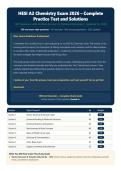
HESI A2 Chemistry Exam 2026 – Complete
Practice Test and Solutions
300 Questions with Verified Answers & Detailed Rationales | Updated for 2026
300 real exam-style questions · Full rationales · Why wrong explanations · 2026 updated
Dear Future Healthcare Professional,
I remember the countless hours I spent preparing for my HESI A2 Chemistry exam. The anxiety of not
knowing what to expect, the frustration of finding incomplete study materials, and the determination
to succeed. After weeks of dedicated preparation, I created this comprehensive practice guide using
the exact strategies that helped me pass with flying colors.
This study guide contains the most frequently tested concepts, challenging questions that mirror the
real exam, and detailed rationales that help you understand the "why" behind each answer. I have
carefully selected and refined these questions based on what I saw on my own exam and what my
peers reported seeing on theirs.
I believe in you. Trust the process, trust your preparation, and trust yourself. You've got this!
Good luck!
HESI A2 Chemistry – Complete Study Guide
Verified Solutions | 2026 Updated | Graded A+
Section Topics Covered Qs Weight
Section 1 Atomic Structure & Periodic Table 40 13%
Section 2 Chemical Bonding & Molecular Structure 40 13%
Section 3 Chemical Reactions & Equations 40 13%
Section 4 Stoichiometry & Mole Concepts 40 13%
Section 5 States of Matter & Gas Laws 40 13%
Section 6 Solutions & Concentrations 40 13%
Section 7 Acids, Bases & pH 30 10%
Section 8 Organic Chemistry & Biochemistry 30 10%
What You Will Find Inside This Study Guide
Atomic Structure & Periodic Table (40 Qs - 13%): Atomic theory, subatomic particles, electron configuration, periodic
trends, and element classification.
, Chemical Bonding & Molecular Structure (40 Qs - 13%): Ionic, covalent, and metallic bonds, Lewis structures, molecular
geometry, and polarity.
Chemical Reactions & Equations (40 Qs - 13%): Reaction types, balancing equations, oxidation-reduction, precipitation,
and acid-base reactions.
Stoichiometry & Mole Concepts (40 Qs - 13%): Molar mass, Avogadro's number, mole calculations, limiting reactants,
and percent yield.
States of Matter & Gas Laws (40 Qs - 13%): Kinetic molecular theory, ideal gas law, Boyle's law, Charles's law, and phase
changes.
Solutions & Concentrations (40 Qs - 13%): Molarity, molality, dilution, solubility, colligative properties, and solution
preparation.
Acids, Bases & pH (30 Qs - 10%): pH scale, acid-base theories, titration, buffers, and pH calculations.
Organic Chemistry & Biochemistry (30 Qs - 10%): Functional groups, hydrocarbons, polymers, carbohydrates, lipids,
proteins, and nucleic acids.
Section 1: Atomic Structure & Periodic Table (40 questions)
Q1. An atom has 17 protons, 18 neutrons, and 17 electrons. What is its atomic number?
A 17
B 18
C 35
D 52
E 34
Correct answer: A. 17
Rationale: The atomic number is the number of protons in the nucleus of an atom. This atom has 17 protons, so its
atomic number is 17.
Why wrong:
B: 18 is incorrect
C: 35 is incorrect
D: 52 is incorrect
E: 34 is incorrect
Reference: HESI A2 Chemistry Study Guide · Elsevier HESI Admission Assessment Exam Review, 6th Edition.
,Q2. An atom has 20 protons and 20 neutrons. What is its mass number?
A 40
B 20
C 60
D 80
E 30
Correct answer: A. 40
Rationale: The mass number is the sum of protons and neutrons. 20 protons + 20 neutrons = 40.
Why wrong:
B: 20 is incorrect
C: 60 is incorrect
D: 80 is incorrect
E: 30 is incorrect
Reference: HESI A2 Chemistry Study Guide · Elsevier HESI Admission Assessment Exam Review, 6th Edition.
Q3. What element has the electron configuration 1s² 2s² 2p⁶ 3s² 3p⁶ 4s²?
A Calcium (Ca)
B Potassium (K)
C Scandium (Sc)
D Titanium (Ti)
E Vanadium (V)
Correct answer: A. Calcium (Ca)
Rationale: The electron configuration ends in 4s², which corresponds to Calcium (atomic number 20). It has 2
electrons in the 4s orbital, making it a Group 2 element.
Why wrong:
B: Potassium (K) is incorrect
C: Scandium (Sc) is incorrect
D: Titanium (Ti) is incorrect
E: Vanadium (V) is incorrect
Reference: HESI A2 Chemistry Study Guide · Elsevier HESI Admission Assessment Exam Review, 6th Edition.
, Q4. Which element has the highest electronegativity?
A Fluorine
B Oxygen
C Chlorine
D Nitrogen
E Bromine
Correct answer: A. Fluorine
Rationale: Fluorine has the highest electronegativity (4.0 on the Pauling scale) among all elements.
Electronegativity increases across a period and decreases down a group.
Why wrong:
B: Oxygen is incorrect
C: Chlorine is incorrect
D: Nitrogen is incorrect
E: Bromine is incorrect
Reference: HESI A2 Chemistry Study Guide · Elsevier HESI Admission Assessment Exam Review, 6th Edition.
Q5. A patient with a heavy metal toxicity has been exposed to lead. Which isotope of lead has a mass
number of 207?
A ²⁰⁷Pb
B ²⁰⁸Pb
C ²⁰⁶Pb
D ²⁰⁴Pb
E ²⁰²Pb
Correct answer: A. ²⁰⁷Pb
Rationale: The isotope notation shows the mass number as a superscript. ²⁰⁷Pb has a mass number of 207. Lead
has an atomic number of 82.
Why wrong:
B: ²⁰⁸Pb is incorrect
C: ²⁰⁶Pb is incorrect
D: ²⁰⁴Pb is incorrect
E: ²⁰²Pb is incorrect
Reference: HESI A2 Chemistry Study Guide · Elsevier HESI Admission Assessment Exam Review, 6th Edition.
Practice Test and Solutions
300 Questions with Verified Answers & Detailed Rationales | Updated for 2026
300 real exam-style questions · Full rationales · Why wrong explanations · 2026 updated
Dear Future Healthcare Professional,
I remember the countless hours I spent preparing for my HESI A2 Chemistry exam. The anxiety of not
knowing what to expect, the frustration of finding incomplete study materials, and the determination
to succeed. After weeks of dedicated preparation, I created this comprehensive practice guide using
the exact strategies that helped me pass with flying colors.
This study guide contains the most frequently tested concepts, challenging questions that mirror the
real exam, and detailed rationales that help you understand the "why" behind each answer. I have
carefully selected and refined these questions based on what I saw on my own exam and what my
peers reported seeing on theirs.
I believe in you. Trust the process, trust your preparation, and trust yourself. You've got this!
Good luck!
HESI A2 Chemistry – Complete Study Guide
Verified Solutions | 2026 Updated | Graded A+
Section Topics Covered Qs Weight
Section 1 Atomic Structure & Periodic Table 40 13%
Section 2 Chemical Bonding & Molecular Structure 40 13%
Section 3 Chemical Reactions & Equations 40 13%
Section 4 Stoichiometry & Mole Concepts 40 13%
Section 5 States of Matter & Gas Laws 40 13%
Section 6 Solutions & Concentrations 40 13%
Section 7 Acids, Bases & pH 30 10%
Section 8 Organic Chemistry & Biochemistry 30 10%
What You Will Find Inside This Study Guide
Atomic Structure & Periodic Table (40 Qs - 13%): Atomic theory, subatomic particles, electron configuration, periodic
trends, and element classification.
, Chemical Bonding & Molecular Structure (40 Qs - 13%): Ionic, covalent, and metallic bonds, Lewis structures, molecular
geometry, and polarity.
Chemical Reactions & Equations (40 Qs - 13%): Reaction types, balancing equations, oxidation-reduction, precipitation,
and acid-base reactions.
Stoichiometry & Mole Concepts (40 Qs - 13%): Molar mass, Avogadro's number, mole calculations, limiting reactants,
and percent yield.
States of Matter & Gas Laws (40 Qs - 13%): Kinetic molecular theory, ideal gas law, Boyle's law, Charles's law, and phase
changes.
Solutions & Concentrations (40 Qs - 13%): Molarity, molality, dilution, solubility, colligative properties, and solution
preparation.
Acids, Bases & pH (30 Qs - 10%): pH scale, acid-base theories, titration, buffers, and pH calculations.
Organic Chemistry & Biochemistry (30 Qs - 10%): Functional groups, hydrocarbons, polymers, carbohydrates, lipids,
proteins, and nucleic acids.
Section 1: Atomic Structure & Periodic Table (40 questions)
Q1. An atom has 17 protons, 18 neutrons, and 17 electrons. What is its atomic number?
A 17
B 18
C 35
D 52
E 34
Correct answer: A. 17
Rationale: The atomic number is the number of protons in the nucleus of an atom. This atom has 17 protons, so its
atomic number is 17.
Why wrong:
B: 18 is incorrect
C: 35 is incorrect
D: 52 is incorrect
E: 34 is incorrect
Reference: HESI A2 Chemistry Study Guide · Elsevier HESI Admission Assessment Exam Review, 6th Edition.
,Q2. An atom has 20 protons and 20 neutrons. What is its mass number?
A 40
B 20
C 60
D 80
E 30
Correct answer: A. 40
Rationale: The mass number is the sum of protons and neutrons. 20 protons + 20 neutrons = 40.
Why wrong:
B: 20 is incorrect
C: 60 is incorrect
D: 80 is incorrect
E: 30 is incorrect
Reference: HESI A2 Chemistry Study Guide · Elsevier HESI Admission Assessment Exam Review, 6th Edition.
Q3. What element has the electron configuration 1s² 2s² 2p⁶ 3s² 3p⁶ 4s²?
A Calcium (Ca)
B Potassium (K)
C Scandium (Sc)
D Titanium (Ti)
E Vanadium (V)
Correct answer: A. Calcium (Ca)
Rationale: The electron configuration ends in 4s², which corresponds to Calcium (atomic number 20). It has 2
electrons in the 4s orbital, making it a Group 2 element.
Why wrong:
B: Potassium (K) is incorrect
C: Scandium (Sc) is incorrect
D: Titanium (Ti) is incorrect
E: Vanadium (V) is incorrect
Reference: HESI A2 Chemistry Study Guide · Elsevier HESI Admission Assessment Exam Review, 6th Edition.
, Q4. Which element has the highest electronegativity?
A Fluorine
B Oxygen
C Chlorine
D Nitrogen
E Bromine
Correct answer: A. Fluorine
Rationale: Fluorine has the highest electronegativity (4.0 on the Pauling scale) among all elements.
Electronegativity increases across a period and decreases down a group.
Why wrong:
B: Oxygen is incorrect
C: Chlorine is incorrect
D: Nitrogen is incorrect
E: Bromine is incorrect
Reference: HESI A2 Chemistry Study Guide · Elsevier HESI Admission Assessment Exam Review, 6th Edition.
Q5. A patient with a heavy metal toxicity has been exposed to lead. Which isotope of lead has a mass
number of 207?
A ²⁰⁷Pb
B ²⁰⁸Pb
C ²⁰⁶Pb
D ²⁰⁴Pb
E ²⁰²Pb
Correct answer: A. ²⁰⁷Pb
Rationale: The isotope notation shows the mass number as a superscript. ²⁰⁷Pb has a mass number of 207. Lead
has an atomic number of 82.
Why wrong:
B: ²⁰⁸Pb is incorrect
C: ²⁰⁶Pb is incorrect
D: ²⁰⁴Pb is incorrect
E: ²⁰²Pb is incorrect
Reference: HESI A2 Chemistry Study Guide · Elsevier HESI Admission Assessment Exam Review, 6th Edition.

