

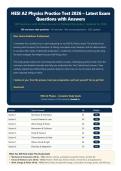
HESI A2 Physics Practice Test 2026 – Latest Exam
Questions with Answers
300 Questions with Verified Answers & Detailed Rationales | Updated for 2026
300 real exam-style questions · Full rationales · Why wrong explanations · 2026 updated
Dear Future Healthcare Professional,
I remember the countless hours I spent preparing for my HESI A2 Physics exam. The anxiety of not
knowing what to expect, the frustration of finding incomplete study materials, and the determination
to succeed. After weeks of dedicated preparation, I created this comprehensive practice guide using
the exact strategies that helped me pass with flying colors.
This study guide contains the most frequently tested concepts, challenging questions that mirror the
real exam, and detailed rationales that help you understand the "why" behind each answer. I have
carefully selected and refined these questions based on what I saw on my own exam and what my
peers reported seeing on theirs.
I believe in you. Trust the process, trust your preparation, and trust yourself. You've got this!
Good luck!
HESI A2 Physics – Complete Study Guide
Verified Solutions | 2026 Updated | Graded A+
Section Topics Covered Qs Weight
Section 1 Mechanics & Kinematics 40 13%
Section 2 Forces & Newton's Laws 40 13%
Section 3 Work, Energy & Power 40 13%
Section 4 Momentum & Collisions 30 10%
Section 5 Fluids & Pressure 40 13%
Section 6 Thermodynamics & Heat 40 13%
Section 7 Waves, Sound & Light 40 13%
Section 8 Electricity & Magnetism 30 10%
What You Will Find Inside This Study Guide
Mechanics & Kinematics (40 Qs - 13%): Motion, velocity, acceleration, projectile motion, and free fall.
Forces & Newton's Laws (40 Qs - 13%): Newton's three laws, friction, tension, normal force, and applications.
Work, Energy & Power (40 Qs - 13%): Work, kinetic and potential energy, conservation of energy, power, and efficiency.
, Momentum & Collisions (30 Qs - 10%): Impulse, conservation of momentum, elastic and inelastic collisions.
Fluids & Pressure (40 Qs - 13%): Pascal's principle, Archimedes' principle, Bernoulli's principle, buoyancy, and flow.
Thermodynamics & Heat (40 Qs - 13%): Temperature, heat transfer, specific heat, latent heat, and laws of
thermodynamics.
Waves, Sound & Light (40 Qs - 13%): Wave properties, sound characteristics, electromagnetic spectrum, and optics.
Electricity & Magnetism (30 Qs - 10%): Electric circuits, Ohm's law, resistance, power, and magnetic fields.
Section 1: Mechanics & Kinematics (40 questions)
Q1. A patient in a hospital bed is being transported down a hallway at a constant speed of 2 m/s. If
the hallway is 50 meters long, how long will it take to reach the end of the hallway?
A 25 seconds
B 100 seconds
C 10 seconds
D 50 seconds
E 5 seconds
Correct answer: A. 25 seconds
Rationale: Using the equation distance = speed × time, t = d/v = 50/2 = 25 seconds. This is a direct application of
the relationship between speed, distance, and time.
Why wrong:
B: 100 seconds is incorrect
C: 10 seconds is incorrect
D: 50 seconds is incorrect
E: 5 seconds is incorrect
Reference: HESI A2 Physics Study Guide · Elsevier HESI Admission Assessment Exam Review, 6th Edition.
Q2. A physical therapist asks a patient to throw a ball upward with an initial velocity of 15 m/s. At the
ball's highest point, what is its velocity?
A 0 m/s
B 15 m/s
C 9.8 m/s
D 30 m/s
E 5 m/s
Correct answer: A. 0 m/s
Rationale: At the highest point of projectile motion, the vertical velocity is zero. The ball stops momentarily before
falling back down due to gravity.
Why wrong:
B: 15 m/s is incorrect
C: 9.8 m/s is incorrect
D: 30 m/s is incorrect
E: 5 m/s is incorrect
Reference: HESI A2 Physics Study Guide · Elsevier HESI Admission Assessment Exam Review, 6th Edition.
,Q3. A patient falls from a standing position and accelerates at 9.8 m/s². After 1.5 seconds, what is the
patient's velocity just before impact?
A 14.7 m/s
B 9.8 m/s
C 19.6 m/s
D 4.9 m/s
E 29.4 m/s
Correct answer: A. 14.7 m/s
Rationale: Using v = v₀ + at (with v₀ = 0), v = 9.8 × 1.5 = 14.7 m/s. This applies the kinematic equation for free
fall under gravity.
Why wrong:
B: 9.8 m/s is incorrect
C: 19.6 m/s is incorrect
D: 4.9 m/s is incorrect
E: 29.4 m/s is incorrect
Reference: HESI A2 Physics Study Guide · Elsevier HESI Admission Assessment Exam Review, 6th Edition.
Q4. A nurse pushes a cart with a constant acceleration of 2 m/s². If the cart starts from rest, what is its
velocity after 4 seconds?
A 8 m/s
B 4 m/s
C 16 m/s
D 2 m/s
E 12 m/s
Correct answer: A. 8 m/s
Rationale: Using v = v₀ + at = 0 + 2 × 4 = 8 m/s. The acceleration is constant, so velocity increases linearly with
time.
Why wrong:
B: 4 m/s is incorrect
C: 16 m/s is incorrect
D: 2 m/s is incorrect
E: 12 m/s is incorrect
Reference: HESI A2 Physics Study Guide · Elsevier HESI Admission Assessment Exam Review, 6th Edition.
, Q5. A projectile is launched from the ground with an initial velocity of 30 m/s at an angle of 60°
above the horizontal. What is the horizontal component of velocity?
A 15 m/s
B 25.98 m/s
C 30 m/s
D 20 m/s
E 10 m/s
Correct answer: A. 15 m/s
Rationale: vx = v₀cosθ = 30 × cos(60°) = 30 × 0.5 = 15 m/s. The horizontal component of velocity remains
constant in projectile motion (ignoring air resistance).
Why wrong:
B: 25.98 m/s is incorrect
C: 30 m/s is incorrect
D: 20 m/s is incorrect
E: 10 m/s is incorrect
Reference: HESI A2 Physics Study Guide · Elsevier HESI Admission Assessment Exam Review, 6th Edition.
Q6. What is the final velocity of an object that starts from rest and accelerates at 4 m/s² for 5
seconds?
A 20 m/s
B 10 m/s
C 30 m/s
D 25 m/s
E 15 m/s
Correct answer: A. 20 m/s
Rationale: Using v = v₀ + at = 0 + 4 × 5 = 20 m/s. This is a direct application of the acceleration-velocity
relationship.
Why wrong:
B: 10 m/s is incorrect
C: 30 m/s is incorrect
D: 25 m/s is incorrect
E: 15 m/s is incorrect
Reference: HESI A2 Physics Study Guide · Elsevier HESI Admission Assessment Exam Review, 6th Edition.
Questions with Answers
300 Questions with Verified Answers & Detailed Rationales | Updated for 2026
300 real exam-style questions · Full rationales · Why wrong explanations · 2026 updated
Dear Future Healthcare Professional,
I remember the countless hours I spent preparing for my HESI A2 Physics exam. The anxiety of not
knowing what to expect, the frustration of finding incomplete study materials, and the determination
to succeed. After weeks of dedicated preparation, I created this comprehensive practice guide using
the exact strategies that helped me pass with flying colors.
This study guide contains the most frequently tested concepts, challenging questions that mirror the
real exam, and detailed rationales that help you understand the "why" behind each answer. I have
carefully selected and refined these questions based on what I saw on my own exam and what my
peers reported seeing on theirs.
I believe in you. Trust the process, trust your preparation, and trust yourself. You've got this!
Good luck!
HESI A2 Physics – Complete Study Guide
Verified Solutions | 2026 Updated | Graded A+
Section Topics Covered Qs Weight
Section 1 Mechanics & Kinematics 40 13%
Section 2 Forces & Newton's Laws 40 13%
Section 3 Work, Energy & Power 40 13%
Section 4 Momentum & Collisions 30 10%
Section 5 Fluids & Pressure 40 13%
Section 6 Thermodynamics & Heat 40 13%
Section 7 Waves, Sound & Light 40 13%
Section 8 Electricity & Magnetism 30 10%
What You Will Find Inside This Study Guide
Mechanics & Kinematics (40 Qs - 13%): Motion, velocity, acceleration, projectile motion, and free fall.
Forces & Newton's Laws (40 Qs - 13%): Newton's three laws, friction, tension, normal force, and applications.
Work, Energy & Power (40 Qs - 13%): Work, kinetic and potential energy, conservation of energy, power, and efficiency.
, Momentum & Collisions (30 Qs - 10%): Impulse, conservation of momentum, elastic and inelastic collisions.
Fluids & Pressure (40 Qs - 13%): Pascal's principle, Archimedes' principle, Bernoulli's principle, buoyancy, and flow.
Thermodynamics & Heat (40 Qs - 13%): Temperature, heat transfer, specific heat, latent heat, and laws of
thermodynamics.
Waves, Sound & Light (40 Qs - 13%): Wave properties, sound characteristics, electromagnetic spectrum, and optics.
Electricity & Magnetism (30 Qs - 10%): Electric circuits, Ohm's law, resistance, power, and magnetic fields.
Section 1: Mechanics & Kinematics (40 questions)
Q1. A patient in a hospital bed is being transported down a hallway at a constant speed of 2 m/s. If
the hallway is 50 meters long, how long will it take to reach the end of the hallway?
A 25 seconds
B 100 seconds
C 10 seconds
D 50 seconds
E 5 seconds
Correct answer: A. 25 seconds
Rationale: Using the equation distance = speed × time, t = d/v = 50/2 = 25 seconds. This is a direct application of
the relationship between speed, distance, and time.
Why wrong:
B: 100 seconds is incorrect
C: 10 seconds is incorrect
D: 50 seconds is incorrect
E: 5 seconds is incorrect
Reference: HESI A2 Physics Study Guide · Elsevier HESI Admission Assessment Exam Review, 6th Edition.
Q2. A physical therapist asks a patient to throw a ball upward with an initial velocity of 15 m/s. At the
ball's highest point, what is its velocity?
A 0 m/s
B 15 m/s
C 9.8 m/s
D 30 m/s
E 5 m/s
Correct answer: A. 0 m/s
Rationale: At the highest point of projectile motion, the vertical velocity is zero. The ball stops momentarily before
falling back down due to gravity.
Why wrong:
B: 15 m/s is incorrect
C: 9.8 m/s is incorrect
D: 30 m/s is incorrect
E: 5 m/s is incorrect
Reference: HESI A2 Physics Study Guide · Elsevier HESI Admission Assessment Exam Review, 6th Edition.
,Q3. A patient falls from a standing position and accelerates at 9.8 m/s². After 1.5 seconds, what is the
patient's velocity just before impact?
A 14.7 m/s
B 9.8 m/s
C 19.6 m/s
D 4.9 m/s
E 29.4 m/s
Correct answer: A. 14.7 m/s
Rationale: Using v = v₀ + at (with v₀ = 0), v = 9.8 × 1.5 = 14.7 m/s. This applies the kinematic equation for free
fall under gravity.
Why wrong:
B: 9.8 m/s is incorrect
C: 19.6 m/s is incorrect
D: 4.9 m/s is incorrect
E: 29.4 m/s is incorrect
Reference: HESI A2 Physics Study Guide · Elsevier HESI Admission Assessment Exam Review, 6th Edition.
Q4. A nurse pushes a cart with a constant acceleration of 2 m/s². If the cart starts from rest, what is its
velocity after 4 seconds?
A 8 m/s
B 4 m/s
C 16 m/s
D 2 m/s
E 12 m/s
Correct answer: A. 8 m/s
Rationale: Using v = v₀ + at = 0 + 2 × 4 = 8 m/s. The acceleration is constant, so velocity increases linearly with
time.
Why wrong:
B: 4 m/s is incorrect
C: 16 m/s is incorrect
D: 2 m/s is incorrect
E: 12 m/s is incorrect
Reference: HESI A2 Physics Study Guide · Elsevier HESI Admission Assessment Exam Review, 6th Edition.
, Q5. A projectile is launched from the ground with an initial velocity of 30 m/s at an angle of 60°
above the horizontal. What is the horizontal component of velocity?
A 15 m/s
B 25.98 m/s
C 30 m/s
D 20 m/s
E 10 m/s
Correct answer: A. 15 m/s
Rationale: vx = v₀cosθ = 30 × cos(60°) = 30 × 0.5 = 15 m/s. The horizontal component of velocity remains
constant in projectile motion (ignoring air resistance).
Why wrong:
B: 25.98 m/s is incorrect
C: 30 m/s is incorrect
D: 20 m/s is incorrect
E: 10 m/s is incorrect
Reference: HESI A2 Physics Study Guide · Elsevier HESI Admission Assessment Exam Review, 6th Edition.
Q6. What is the final velocity of an object that starts from rest and accelerates at 4 m/s² for 5
seconds?
A 20 m/s
B 10 m/s
C 30 m/s
D 25 m/s
E 15 m/s
Correct answer: A. 20 m/s
Rationale: Using v = v₀ + at = 0 + 4 × 5 = 20 m/s. This is a direct application of the acceleration-velocity
relationship.
Why wrong:
B: 10 m/s is incorrect
C: 30 m/s is incorrect
D: 25 m/s is incorrect
E: 15 m/s is incorrect
Reference: HESI A2 Physics Study Guide · Elsevier HESI Admission Assessment Exam Review, 6th Edition.

