

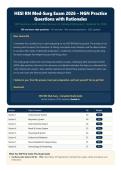
HESI RN Med-Surg Exam 2026 – NGN Practice
Questions with Rationales
300 Questions with Verified Answers & Detailed Rationales | Updated for 2026
300 real exam-style questions · Full rationales · Why wrong explanations · 2026 updated
Dear Future RN,
I remember the countless hours I spent preparing for my HESI RN Med-Surg exam. The anxiety of not
knowing what to expect, the frustration of finding incomplete study materials, and the determination
to succeed. After weeks of dedicated preparation, I created this comprehensive practice guide using
the exact strategies that helped me pass with flying colors.
This study guide contains the most frequently tested concepts, challenging Next Generation NCLEX
(NGN) style questions that mirror the real exam, and detailed rationales that help you understand the
"why" behind each answer. I have carefully selected and refined these questions based on what I saw
on my own exam and what my peers reported seeing on theirs.
I believe in you. Trust the process, trust your preparation, and trust yourself. You've got this!
Good luck!
HESI RN Med-Surg – Complete Study Guide
Verified Solutions | 2026 Updated | Graded A+
Section Topics Covered Qs Weight
Section 1 Cardiovascular System 40 13%
Section 2 Respiratory System 40 13%
Section 3 Gastrointestinal System 40 13%
Section 4 Renal & Urinary System 35 12%
Section 5 Neurological System 40 13%
Section 6 Endocrine & Metabolic 35 12%
Section 7 Musculoskeletal & Integumentary 35 12%
Section 8 Immunology & Hematology 35 12%
What You Will Find Inside This Study Guide
Cardiovascular System (40 Qs - 13%): Heart failure, MI, hypertension, dysrhythmias, angina, cardiac procedures, and
medications.
, Respiratory System (40 Qs - 13%): COPD, asthma, pneumonia, pulmonary embolism, ARDS, respiratory failure, and
oxygen therapy.
Gastrointestinal System (40 Qs - 13%): GI bleeding, ulcers, pancreatitis, hepatitis, cirrhosis, GERD, and inflammatory
bowel disease.
Renal & Urinary System (35 Qs - 12%): Acute kidney injury, chronic kidney disease, dialysis, UTIs, and fluid-electrolyte
balance.
Neurological System (40 Qs - 13%): Stroke, seizures, head injury, meningitis, Parkinson's, Alzheimer's, and spinal cord
injuries.
Endocrine & Metabolic (35 Qs - 12%): Diabetes, thyroid disorders, adrenal disorders, metabolic syndrome, and
electrolyte imbalances.
Musculoskeletal & Integumentary (35 Qs - 12%): Fractures, arthritis, wound care, pressure injuries, burns, and skin
conditions.
Immunology & Hematology (35 Qs - 12%): Anemias, bleeding disorders, HIV/AIDS, autoimmune disorders, and
transplant complications.
Section 1: Cardiovascular System (40 questions)
Q1. A 68-year-old patient with a history of heart failure is admitted with worsening dyspnea and
edema. Which assessment finding would be most concerning?
A Jugular venous distension of 4 cm
B Weight gain of 2 kg in 24 hours
C Bilateral crackles in the lung bases
D Resting heart rate of 88 bpm
E Blood pressure of 142/88 mmHg
Correct answer: B. Weight gain of 2 kg in 24 hours
Rationale: A weight gain of 2 kg (4.4 lbs) in 24 hours indicates significant fluid retention and worsening heart
failure. This is a critical sign requiring immediate intervention.
Why wrong:
A: Jugular venous distension of 4 cm is incorrect
C: Bilateral crackles in the lung bases is incorrect
D: Resting heart rate of 88 bpm is incorrect
E: Blood pressure of 142/88 mmHg is incorrect
Reference: HESI RN Med-Surg Study Guide · Elsevier HESI Exit Exam Review · Lewis's Medical-Surgical Nursing.
,Q2. A patient with myocardial infarction is receiving thrombolytic therapy. Which assessment finding
indicates a potential complication of this therapy?
A Chest pain resolving
B ST segment elevation decreasing
C Sudden severe headache
D Heart rate decreasing from 110 to 85 bpm
E Oxygen saturation increasing to 96%
Correct answer: C. Sudden severe headache
Rationale: Sudden severe headache may indicate intracranial hemorrhage, a serious complication of thrombolytic
therapy. This requires immediate assessment and intervention.
Why wrong:
A: Chest pain resolving is incorrect
B: ST segment elevation decreasing is incorrect
D: Heart rate decreasing from 110 to 85 bpm is incorrect
E: Oxygen saturation increasing to 96% is incorrect
Reference: HESI RN Med-Surg Study Guide · Elsevier HESI Exit Exam Review · Lewis's Medical-Surgical Nursing.
Q3. A patient with chronic heart failure is prescribed digoxin. Which electrolyte imbalance increases
the risk of digoxin toxicity?
A Hypokalemia
B Hyperkalemia
C Hyponatremia
D Hypercalcemia
E Hypomagnesemia
Correct answer: A. Hypokalemia
Rationale: Hypokalemia (low potassium) increases the risk of digoxin toxicity. The nurse should monitor potassium
levels and report values below 3.5 mEq/L.
Why wrong:
B: Hyperkalemia is incorrect
C: Hyponatremia is incorrect
D: Hypercalcemia is incorrect
E: Hypomagnesemia is incorrect
Reference: HESI RN Med-Surg Study Guide · Elsevier HESI Exit Exam Review · Lewis's Medical-Surgical Nursing.
, Q4. A 72-year-old patient with atrial fibrillation is prescribed warfarin. Which laboratory value should
the nurse monitor to evaluate the effectiveness of this medication?
A INR
B aPTT
C PTT
D BUN
E Creatinine
Correct answer: A. INR
Rationale: INR (International Normalized Ratio) is the standard test for monitoring warfarin therapy. The
therapeutic range for atrial fibrillation is typically 2.0-3.0.
Why wrong:
B: aPTT is incorrect
C: PTT is incorrect
D: BUN is incorrect
E: Creatinine is incorrect
Reference: HESI RN Med-Surg Study Guide · Elsevier HESI Exit Exam Review · Lewis's Medical-Surgical Nursing.
Q5. A patient with acute coronary syndrome is experiencing chest pain unrelieved by nitroglycerin.
Which medication should the nurse prepare to administer?
A Morphine sulfate
B Digoxin
C Labetalol
D Diltiazem
E Nifedipine
Correct answer: A. Morphine sulfate
Rationale: Morphine sulfate is administered to relieve severe chest pain in acute coronary syndrome. It reduces
preload, decreases myocardial oxygen demand, and relieves pain.
Why wrong:
B: Digoxin is incorrect
C: Labetalol is incorrect
D: Diltiazem is incorrect
E: Nifedipine is incorrect
Reference: HESI RN Med-Surg Study Guide · Elsevier HESI Exit Exam Review · Lewis's Medical-Surgical Nursing.
Questions with Rationales
300 Questions with Verified Answers & Detailed Rationales | Updated for 2026
300 real exam-style questions · Full rationales · Why wrong explanations · 2026 updated
Dear Future RN,
I remember the countless hours I spent preparing for my HESI RN Med-Surg exam. The anxiety of not
knowing what to expect, the frustration of finding incomplete study materials, and the determination
to succeed. After weeks of dedicated preparation, I created this comprehensive practice guide using
the exact strategies that helped me pass with flying colors.
This study guide contains the most frequently tested concepts, challenging Next Generation NCLEX
(NGN) style questions that mirror the real exam, and detailed rationales that help you understand the
"why" behind each answer. I have carefully selected and refined these questions based on what I saw
on my own exam and what my peers reported seeing on theirs.
I believe in you. Trust the process, trust your preparation, and trust yourself. You've got this!
Good luck!
HESI RN Med-Surg – Complete Study Guide
Verified Solutions | 2026 Updated | Graded A+
Section Topics Covered Qs Weight
Section 1 Cardiovascular System 40 13%
Section 2 Respiratory System 40 13%
Section 3 Gastrointestinal System 40 13%
Section 4 Renal & Urinary System 35 12%
Section 5 Neurological System 40 13%
Section 6 Endocrine & Metabolic 35 12%
Section 7 Musculoskeletal & Integumentary 35 12%
Section 8 Immunology & Hematology 35 12%
What You Will Find Inside This Study Guide
Cardiovascular System (40 Qs - 13%): Heart failure, MI, hypertension, dysrhythmias, angina, cardiac procedures, and
medications.
, Respiratory System (40 Qs - 13%): COPD, asthma, pneumonia, pulmonary embolism, ARDS, respiratory failure, and
oxygen therapy.
Gastrointestinal System (40 Qs - 13%): GI bleeding, ulcers, pancreatitis, hepatitis, cirrhosis, GERD, and inflammatory
bowel disease.
Renal & Urinary System (35 Qs - 12%): Acute kidney injury, chronic kidney disease, dialysis, UTIs, and fluid-electrolyte
balance.
Neurological System (40 Qs - 13%): Stroke, seizures, head injury, meningitis, Parkinson's, Alzheimer's, and spinal cord
injuries.
Endocrine & Metabolic (35 Qs - 12%): Diabetes, thyroid disorders, adrenal disorders, metabolic syndrome, and
electrolyte imbalances.
Musculoskeletal & Integumentary (35 Qs - 12%): Fractures, arthritis, wound care, pressure injuries, burns, and skin
conditions.
Immunology & Hematology (35 Qs - 12%): Anemias, bleeding disorders, HIV/AIDS, autoimmune disorders, and
transplant complications.
Section 1: Cardiovascular System (40 questions)
Q1. A 68-year-old patient with a history of heart failure is admitted with worsening dyspnea and
edema. Which assessment finding would be most concerning?
A Jugular venous distension of 4 cm
B Weight gain of 2 kg in 24 hours
C Bilateral crackles in the lung bases
D Resting heart rate of 88 bpm
E Blood pressure of 142/88 mmHg
Correct answer: B. Weight gain of 2 kg in 24 hours
Rationale: A weight gain of 2 kg (4.4 lbs) in 24 hours indicates significant fluid retention and worsening heart
failure. This is a critical sign requiring immediate intervention.
Why wrong:
A: Jugular venous distension of 4 cm is incorrect
C: Bilateral crackles in the lung bases is incorrect
D: Resting heart rate of 88 bpm is incorrect
E: Blood pressure of 142/88 mmHg is incorrect
Reference: HESI RN Med-Surg Study Guide · Elsevier HESI Exit Exam Review · Lewis's Medical-Surgical Nursing.
,Q2. A patient with myocardial infarction is receiving thrombolytic therapy. Which assessment finding
indicates a potential complication of this therapy?
A Chest pain resolving
B ST segment elevation decreasing
C Sudden severe headache
D Heart rate decreasing from 110 to 85 bpm
E Oxygen saturation increasing to 96%
Correct answer: C. Sudden severe headache
Rationale: Sudden severe headache may indicate intracranial hemorrhage, a serious complication of thrombolytic
therapy. This requires immediate assessment and intervention.
Why wrong:
A: Chest pain resolving is incorrect
B: ST segment elevation decreasing is incorrect
D: Heart rate decreasing from 110 to 85 bpm is incorrect
E: Oxygen saturation increasing to 96% is incorrect
Reference: HESI RN Med-Surg Study Guide · Elsevier HESI Exit Exam Review · Lewis's Medical-Surgical Nursing.
Q3. A patient with chronic heart failure is prescribed digoxin. Which electrolyte imbalance increases
the risk of digoxin toxicity?
A Hypokalemia
B Hyperkalemia
C Hyponatremia
D Hypercalcemia
E Hypomagnesemia
Correct answer: A. Hypokalemia
Rationale: Hypokalemia (low potassium) increases the risk of digoxin toxicity. The nurse should monitor potassium
levels and report values below 3.5 mEq/L.
Why wrong:
B: Hyperkalemia is incorrect
C: Hyponatremia is incorrect
D: Hypercalcemia is incorrect
E: Hypomagnesemia is incorrect
Reference: HESI RN Med-Surg Study Guide · Elsevier HESI Exit Exam Review · Lewis's Medical-Surgical Nursing.
, Q4. A 72-year-old patient with atrial fibrillation is prescribed warfarin. Which laboratory value should
the nurse monitor to evaluate the effectiveness of this medication?
A INR
B aPTT
C PTT
D BUN
E Creatinine
Correct answer: A. INR
Rationale: INR (International Normalized Ratio) is the standard test for monitoring warfarin therapy. The
therapeutic range for atrial fibrillation is typically 2.0-3.0.
Why wrong:
B: aPTT is incorrect
C: PTT is incorrect
D: BUN is incorrect
E: Creatinine is incorrect
Reference: HESI RN Med-Surg Study Guide · Elsevier HESI Exit Exam Review · Lewis's Medical-Surgical Nursing.
Q5. A patient with acute coronary syndrome is experiencing chest pain unrelieved by nitroglycerin.
Which medication should the nurse prepare to administer?
A Morphine sulfate
B Digoxin
C Labetalol
D Diltiazem
E Nifedipine
Correct answer: A. Morphine sulfate
Rationale: Morphine sulfate is administered to relieve severe chest pain in acute coronary syndrome. It reduces
preload, decreases myocardial oxygen demand, and relieves pain.
Why wrong:
B: Digoxin is incorrect
C: Labetalol is incorrect
D: Diltiazem is incorrect
E: Nifedipine is incorrect
Reference: HESI RN Med-Surg Study Guide · Elsevier HESI Exit Exam Review · Lewis's Medical-Surgical Nursing.

