

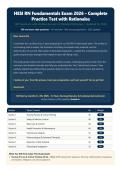
HESI RN Fundamentals Exam 2026 – Complete
Practice Test with Rationales
300 Questions with Verified Answers & Detailed Rationales | Updated for 2026
300 real exam-style questions · Full rationales · Why wrong explanations · 2026 updated
Dear Future RN,
I remember the countless hours I spent preparing for my HESI RN Fundamentals exam. The anxiety of
not knowing what to expect, the frustration of finding incomplete study materials, and the
determination to succeed. After weeks of dedicated preparation, I created this comprehensive practice
guide using the exact strategies that helped me pass with flying colors.
This study guide contains the most frequently tested concepts, challenging questions that mirror the
real exam, and detailed rationales that help you understand the "why" behind each answer. I have
carefully selected and refined these questions based on what I saw on my own exam and what my
peers reported seeing on theirs.
I believe in you. Trust the process, trust your preparation, and trust yourself. You've got this!
Good luck!
Written by Jennifer R., RN, MSN – 12 Years Nursing Educator & Fundamentals Instructor
Verified Solutions | 2026 Updated | Graded A+
Section Topics Covered Qs Weight
Section 1 Nursing Process & Critical Thinking 40 13%
Section 2 Safety & Infection Control 40 13%
Section 3 Basic Care & Comfort 40 13%
Section 4 Health Promotion & Maintenance 40 13%
Section 5 Psychosocial Integrity 35 12%
Section 6 Pharmacological & Parenteral Therapies 40 13%
Section 7 Reduction of Risk Potential 35 12%
Section 8 Physiological Adaptation 30 11%
What You Will Find Inside This Study Guide
Nursing Process & Critical Thinking (40 Qs - 13%): ADPIE (Assessment, Diagnosis, Planning, Implementation, Evaluation),
prioritization, delegation, and clinical judgment.
, Safety & Infection Control (40 Qs - 13%): Standard precautions, transmission-based precautions, fall prevention, restraint
use, and patient safety.
Basic Care & Comfort (40 Qs - 13%): Hygiene, mobility, nutrition, elimination, sleep, and comfort measures.
Health Promotion & Maintenance (40 Qs - 13%): Health screening, immunizations, patient education, growth and
development, and health beliefs.
Psychosocial Integrity (35 Qs - 12%): Coping mechanisms, stress management, therapeutic communication, grief, and
cultural considerations.
Pharmacological & Parenteral Therapies (40 Qs - 13%): Medication administration, dosage calculations, side effects, and
parenteral therapies.
Reduction of Risk Potential (35 Qs - 12%): Vital signs, diagnostic tests, laboratory values, and monitoring for
complications.
Physiological Adaptation (30 Qs - 11%): Fluid and electrolyte balance, wound healing, pain management, and
acute/chronic conditions.
Section 1: Nursing Process & Critical Thinking (40 questions)
Q1. A patient is admitted with chest pain and shortness of breath. Which step of the nursing process
should the nurse perform first?
A Assessment
B Diagnosis
C Planning
D Implementation
E Evaluation
Correct answer: A. Assessment
Rationale: The nursing process begins with assessment. The nurse must first gather data about the patient's
condition, including a focused assessment of chest pain and respiratory status, before proceeding with other steps.
Why wrong:
B: Diagnosis is incorrect
C: Planning is incorrect
D: Implementation is incorrect
E: Evaluation is incorrect
Reference: HESI RN Fundamentals Study Guide · Potter & Perry's Fundamentals of Nursing · Taylor's Fundamentals of
Nursing.
,Q2. A nurse is prioritizing care for four patients. Which patient should the nurse assess first?
A A patient with stable angina
B A patient with a new onset of confusion
C A patient with a scheduled wound dressing change
D A patient requesting pain medication
E A patient with a newly prescribed medication
Correct answer: B. A patient with a new onset of confusion
Rationale: The patient with a new onset of confusion should be assessed first because this is a change in
neurological status that could indicate a serious condition, such as a stroke or infection. Priority is given to unstable
patients.
Why wrong:
A: A patient with stable angina is incorrect
C: A patient with a scheduled wound dressing change is incorrect
D: A patient requesting pain medication is incorrect
E: A patient with a newly prescribed medication is incorrect
Reference: HESI RN Fundamentals Study Guide · Potter & Perry's Fundamentals of Nursing · Taylor's Fundamentals of
Nursing.
Q3. A nurse is delegating tasks to an unlicensed assistive personnel (UAP). Which task is appropriate
to delegate?
A Assisting a patient with ambulation
B Administering oral medications
C Assessing a wound
D Creating a care plan
E Teaching a patient about medications
Correct answer: A. Assisting a patient with ambulation
Rationale: Assisting with ambulation is a safe task to delegate to a UAP. Assessment, medication administration,
care planning, and patient teaching require nursing judgment and should be performed by the RN.
Why wrong:
B: Administering oral medications is incorrect
C: Assessing a wound is incorrect
D: Creating a care plan is incorrect
E: Teaching a patient about medications is incorrect
Reference: HESI RN Fundamentals Study Guide · Potter & Perry's Fundamentals of Nursing · Taylor's Fundamentals of
Nursing.
, Q4. A patient is discharged with a new diagnosis of heart failure. Which intervention is most
important for the nurse to include in the discharge teaching?
A Weighing daily and reporting a 2-pound weight gain in 24 hours
B Reducing salt intake
C Taking medications as prescribed
D Monitoring for shortness of breath
E All of the above
Correct answer: E. All of the above
Rationale: All of these are important discharge teaching points for a patient with heart failure. Daily weight
monitoring, salt restriction, medication adherence, and symptom monitoring are critical to prevent exacerbations.
Why wrong:
A: Weighing daily and reporting a 2-pound weight gain in 24 hours is incorrect
B: Reducing salt intake is incorrect
C: Taking medications as prescribed is incorrect
D: Monitoring for shortness of breath is incorrect
Reference: HESI RN Fundamentals Study Guide · Potter & Perry's Fundamentals of Nursing · Taylor's Fundamentals of
Nursing.
Q5. A nurse is evaluating a patient's response to pain medication. Which assessment finding indicates
the medication was effective?
A The patient reports pain has decreased from 8/10 to 3/10
B The patient is sleeping
C The patient's vital signs are stable
D The patient is smiling
E All of the above
Correct answer: A. The patient reports pain has decreased from 8/10 to 3/10
Rationale: A decrease in the patient's self-reported pain from 8/10 to 3/10 is the most direct indicator that the
pain medication was effective. The other findings may indicate improvement but are not as specific.
Why wrong:
B: The patient is sleeping is incorrect
C: The patient's vital signs are stable is incorrect
D: The patient is smiling is incorrect
E: All of the above is incorrect
Reference: HESI RN Fundamentals Study Guide · Potter & Perry's Fundamentals of Nursing · Taylor's Fundamentals of
Nursing.
Practice Test with Rationales
300 Questions with Verified Answers & Detailed Rationales | Updated for 2026
300 real exam-style questions · Full rationales · Why wrong explanations · 2026 updated
Dear Future RN,
I remember the countless hours I spent preparing for my HESI RN Fundamentals exam. The anxiety of
not knowing what to expect, the frustration of finding incomplete study materials, and the
determination to succeed. After weeks of dedicated preparation, I created this comprehensive practice
guide using the exact strategies that helped me pass with flying colors.
This study guide contains the most frequently tested concepts, challenging questions that mirror the
real exam, and detailed rationales that help you understand the "why" behind each answer. I have
carefully selected and refined these questions based on what I saw on my own exam and what my
peers reported seeing on theirs.
I believe in you. Trust the process, trust your preparation, and trust yourself. You've got this!
Good luck!
Written by Jennifer R., RN, MSN – 12 Years Nursing Educator & Fundamentals Instructor
Verified Solutions | 2026 Updated | Graded A+
Section Topics Covered Qs Weight
Section 1 Nursing Process & Critical Thinking 40 13%
Section 2 Safety & Infection Control 40 13%
Section 3 Basic Care & Comfort 40 13%
Section 4 Health Promotion & Maintenance 40 13%
Section 5 Psychosocial Integrity 35 12%
Section 6 Pharmacological & Parenteral Therapies 40 13%
Section 7 Reduction of Risk Potential 35 12%
Section 8 Physiological Adaptation 30 11%
What You Will Find Inside This Study Guide
Nursing Process & Critical Thinking (40 Qs - 13%): ADPIE (Assessment, Diagnosis, Planning, Implementation, Evaluation),
prioritization, delegation, and clinical judgment.
, Safety & Infection Control (40 Qs - 13%): Standard precautions, transmission-based precautions, fall prevention, restraint
use, and patient safety.
Basic Care & Comfort (40 Qs - 13%): Hygiene, mobility, nutrition, elimination, sleep, and comfort measures.
Health Promotion & Maintenance (40 Qs - 13%): Health screening, immunizations, patient education, growth and
development, and health beliefs.
Psychosocial Integrity (35 Qs - 12%): Coping mechanisms, stress management, therapeutic communication, grief, and
cultural considerations.
Pharmacological & Parenteral Therapies (40 Qs - 13%): Medication administration, dosage calculations, side effects, and
parenteral therapies.
Reduction of Risk Potential (35 Qs - 12%): Vital signs, diagnostic tests, laboratory values, and monitoring for
complications.
Physiological Adaptation (30 Qs - 11%): Fluid and electrolyte balance, wound healing, pain management, and
acute/chronic conditions.
Section 1: Nursing Process & Critical Thinking (40 questions)
Q1. A patient is admitted with chest pain and shortness of breath. Which step of the nursing process
should the nurse perform first?
A Assessment
B Diagnosis
C Planning
D Implementation
E Evaluation
Correct answer: A. Assessment
Rationale: The nursing process begins with assessment. The nurse must first gather data about the patient's
condition, including a focused assessment of chest pain and respiratory status, before proceeding with other steps.
Why wrong:
B: Diagnosis is incorrect
C: Planning is incorrect
D: Implementation is incorrect
E: Evaluation is incorrect
Reference: HESI RN Fundamentals Study Guide · Potter & Perry's Fundamentals of Nursing · Taylor's Fundamentals of
Nursing.
,Q2. A nurse is prioritizing care for four patients. Which patient should the nurse assess first?
A A patient with stable angina
B A patient with a new onset of confusion
C A patient with a scheduled wound dressing change
D A patient requesting pain medication
E A patient with a newly prescribed medication
Correct answer: B. A patient with a new onset of confusion
Rationale: The patient with a new onset of confusion should be assessed first because this is a change in
neurological status that could indicate a serious condition, such as a stroke or infection. Priority is given to unstable
patients.
Why wrong:
A: A patient with stable angina is incorrect
C: A patient with a scheduled wound dressing change is incorrect
D: A patient requesting pain medication is incorrect
E: A patient with a newly prescribed medication is incorrect
Reference: HESI RN Fundamentals Study Guide · Potter & Perry's Fundamentals of Nursing · Taylor's Fundamentals of
Nursing.
Q3. A nurse is delegating tasks to an unlicensed assistive personnel (UAP). Which task is appropriate
to delegate?
A Assisting a patient with ambulation
B Administering oral medications
C Assessing a wound
D Creating a care plan
E Teaching a patient about medications
Correct answer: A. Assisting a patient with ambulation
Rationale: Assisting with ambulation is a safe task to delegate to a UAP. Assessment, medication administration,
care planning, and patient teaching require nursing judgment and should be performed by the RN.
Why wrong:
B: Administering oral medications is incorrect
C: Assessing a wound is incorrect
D: Creating a care plan is incorrect
E: Teaching a patient about medications is incorrect
Reference: HESI RN Fundamentals Study Guide · Potter & Perry's Fundamentals of Nursing · Taylor's Fundamentals of
Nursing.
, Q4. A patient is discharged with a new diagnosis of heart failure. Which intervention is most
important for the nurse to include in the discharge teaching?
A Weighing daily and reporting a 2-pound weight gain in 24 hours
B Reducing salt intake
C Taking medications as prescribed
D Monitoring for shortness of breath
E All of the above
Correct answer: E. All of the above
Rationale: All of these are important discharge teaching points for a patient with heart failure. Daily weight
monitoring, salt restriction, medication adherence, and symptom monitoring are critical to prevent exacerbations.
Why wrong:
A: Weighing daily and reporting a 2-pound weight gain in 24 hours is incorrect
B: Reducing salt intake is incorrect
C: Taking medications as prescribed is incorrect
D: Monitoring for shortness of breath is incorrect
Reference: HESI RN Fundamentals Study Guide · Potter & Perry's Fundamentals of Nursing · Taylor's Fundamentals of
Nursing.
Q5. A nurse is evaluating a patient's response to pain medication. Which assessment finding indicates
the medication was effective?
A The patient reports pain has decreased from 8/10 to 3/10
B The patient is sleeping
C The patient's vital signs are stable
D The patient is smiling
E All of the above
Correct answer: A. The patient reports pain has decreased from 8/10 to 3/10
Rationale: A decrease in the patient's self-reported pain from 8/10 to 3/10 is the most direct indicator that the
pain medication was effective. The other findings may indicate improvement but are not as specific.
Why wrong:
B: The patient is sleeping is incorrect
C: The patient's vital signs are stable is incorrect
D: The patient is smiling is incorrect
E: All of the above is incorrect
Reference: HESI RN Fundamentals Study Guide · Potter & Perry's Fundamentals of Nursing · Taylor's Fundamentals of
Nursing.

