

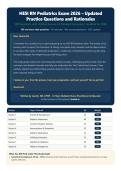
HESI RN Pediatrics Exam 2026 – Updated
Practice Questions and Rationales
300 Questions with Verified Answers & Detailed Rationales | Updated for 2026
300 real exam-style questions · Full rationales · Why wrong explanations · 2026 updated
Dear Future RN,
I remember the countless hours I spent preparing for my HESI RN Pediatrics exam. The anxiety of not
knowing what to expect, the frustration of finding incomplete study materials, and the determination
to succeed. After weeks of dedicated preparation, I created this comprehensive practice guide using
the exact strategies that helped me pass with flying colors.
This study guide contains the most frequently tested concepts, challenging questions that mirror the
real exam, and detailed rationales that help you understand the "why" behind each answer. I have
carefully selected and refined these questions based on what I saw on my own exam and what my
peers reported seeing on theirs.
I believe in you. Trust the process, trust your preparation, and trust yourself. You've got this!
Good luck!
Written by Lisa M., RN, CPNP – 12 Years Pediatric Nurse Practitioner & Educator
Verified Solutions | 2026 Updated | Graded A+
Section Topics Covered Qs Weight
Section 1 Growth & Development 45 15%
Section 2 Pediatric Assessment 40 13%
Section 3 Common Pediatric Illnesses 45 15%
Section 4 Immunizations & Prevention 35 12%
Section 5 Pediatric Medications 35 12%
Section 6 Childhood Disorders 35 12%
Section 7 Nutrition & Hydration 30 10%
Section 8 Pediatric Emergencies 35 11%
What You Will Find Inside This Study Guide
Growth & Development (45 Qs - 15%): Developmental milestones, growth charts, developmental theories, and age-
specific behaviors.
, Pediatric Assessment (40 Qs - 13%): Physical assessment, vital signs, pain assessment, and age-appropriate
communication techniques.
Common Pediatric Illnesses (45 Qs - 15%): Respiratory infections, GI disorders, skin conditions, and common infectious
diseases.
Immunizations & Prevention (35 Qs - 12%): Vaccine schedules, contraindications, parental education, and vaccine-
preventable diseases.
Pediatric Medications (35 Qs - 12%): Dosage calculations, medication administration, side effects, and safety
considerations in children.
Childhood Disorders (35 Qs - 12%): Asthma, diabetes, seizures, ADHD, autism, and chronic conditions.
Nutrition & Hydration (30 Qs - 10%): Infant feeding, nutritional needs by age, obesity prevention, and dehydration
management.
Pediatric Emergencies (35 Qs - 11%): Respiratory distress, shock, trauma, allergic reactions, and emergency interventions.
Section 1: Growth & Development (45 questions)
Q1. A 2-month-old infant is brought to the clinic for a well-child visit. Which developmental
milestone should the nurse expect the infant to have achieved?
A Social smile
B Sits without support
C Bears weight on legs
D Transfers objects from hand to hand
E Says single words
Correct answer: A. Social smile
Rationale: A social smile is a developmental milestone typically achieved by 2 months of age. Sitting without
support occurs around 8 months, bearing weight on legs around 6-7 months, transferring objects around 7-8
months, and saying single words around 12 months.
Why wrong:
B: Sits without support is incorrect
C: Bears weight on legs is incorrect
D: Transfers objects from hand to hand is incorrect
E: Says single words is incorrect
Reference: HESI RN Pediatrics Study Guide · Wong's Nursing Care of Infants and Children · AAP Guidelines.
,Q2. A 4-year-old child is in the hospital. The parents are concerned about the child's imaginary friend.
What is the nurse's best response?
A Imaginary friends are a normal part of development at this age
B This may indicate a psychological problem
C The child should be evaluated by a child psychologist
D The child should be discouraged from talking about imaginary friends
E This is a sign of social isolation
Correct answer: A. Imaginary friends are a normal part of development at this age
Rationale: Imaginary friends are common and normal in preschool-age children (3-5 years). They help children
explore social situations, develop language, and express creativity.
Why wrong:
B: This may indicate a psychological problem is incorrect
C: The child should be evaluated by a child psychologist is incorrect
D: The child should be discouraged from talking about imaginary friends is incorrect
E: This is a sign of social isolation is incorrect
Reference: HESI RN Pediatrics Study Guide · Wong's Nursing Care of Infants and Children · AAP Guidelines.
Q3. A 12-month-old infant is brought to the clinic. Which fine motor skill should the nurse expect the
infant to have achieved?
A Pincer grasp
B Puts objects into a container
C Uses a spoon
D Draws a circle
E Stacks 4 blocks
Correct answer: A. Pincer grasp
Rationale: A pincer grasp (using thumb and index finger to pick up small objects) is typically achieved by 9-12
months. Putting objects into a container occurs around 12-15 months, using a spoon around 18-24 months,
drawing a circle around 3 years, and stacking 4 blocks around 2 years.
Why wrong:
B: Puts objects into a container is incorrect
C: Uses a spoon is incorrect
D: Draws a circle is incorrect
E: Stacks 4 blocks is incorrect
Reference: HESI RN Pediatrics Study Guide · Wong's Nursing Care of Infants and Children · AAP Guidelines.
, Q4. A 15-year-old adolescent is hospitalized. The nurse should understand that this age group is most
concerned with which of the following?
A Body image and peer acceptance
B Separation anxiety
C Stranger anxiety
D Developmental regression
E School performance
Correct answer: A. Body image and peer acceptance
Rationale: Adolescents are primarily concerned with body image, peer acceptance, and identity formation.
Separation anxiety is common in infants, stranger anxiety in 6-8 month olds, and developmental regression can
occur in hospitalized toddlers.
Why wrong:
B: Separation anxiety is incorrect
C: Stranger anxiety is incorrect
D: Developmental regression is incorrect
E: School performance is incorrect
Reference: HESI RN Pediatrics Study Guide · Wong's Nursing Care of Infants and Children · AAP Guidelines.
Q5. A 6-month-old infant is brought to the clinic for a well-child visit. What developmental milestone
should the nurse expect?
A Sits briefly without support
B Creeps and crawls
C Walks with assistance
D Imitates scribbling
E Turns pages of a book
Correct answer: A. Sits briefly without support
Rationale: Sitting briefly without support is typically achieved around 6 months. Creeping and crawling occur
around 9 months, walking with assistance around 12-15 months, imitating scribbling around 18 months, and
turning pages of a book around 12-18 months.
Why wrong:
B: Creeps and crawls is incorrect
C: Walks with assistance is incorrect
D: Imitates scribbling is incorrect
E: Turns pages of a book is incorrect
Reference: HESI RN Pediatrics Study Guide · Wong's Nursing Care of Infants and Children · AAP Guidelines.
Practice Questions and Rationales
300 Questions with Verified Answers & Detailed Rationales | Updated for 2026
300 real exam-style questions · Full rationales · Why wrong explanations · 2026 updated
Dear Future RN,
I remember the countless hours I spent preparing for my HESI RN Pediatrics exam. The anxiety of not
knowing what to expect, the frustration of finding incomplete study materials, and the determination
to succeed. After weeks of dedicated preparation, I created this comprehensive practice guide using
the exact strategies that helped me pass with flying colors.
This study guide contains the most frequently tested concepts, challenging questions that mirror the
real exam, and detailed rationales that help you understand the "why" behind each answer. I have
carefully selected and refined these questions based on what I saw on my own exam and what my
peers reported seeing on theirs.
I believe in you. Trust the process, trust your preparation, and trust yourself. You've got this!
Good luck!
Written by Lisa M., RN, CPNP – 12 Years Pediatric Nurse Practitioner & Educator
Verified Solutions | 2026 Updated | Graded A+
Section Topics Covered Qs Weight
Section 1 Growth & Development 45 15%
Section 2 Pediatric Assessment 40 13%
Section 3 Common Pediatric Illnesses 45 15%
Section 4 Immunizations & Prevention 35 12%
Section 5 Pediatric Medications 35 12%
Section 6 Childhood Disorders 35 12%
Section 7 Nutrition & Hydration 30 10%
Section 8 Pediatric Emergencies 35 11%
What You Will Find Inside This Study Guide
Growth & Development (45 Qs - 15%): Developmental milestones, growth charts, developmental theories, and age-
specific behaviors.
, Pediatric Assessment (40 Qs - 13%): Physical assessment, vital signs, pain assessment, and age-appropriate
communication techniques.
Common Pediatric Illnesses (45 Qs - 15%): Respiratory infections, GI disorders, skin conditions, and common infectious
diseases.
Immunizations & Prevention (35 Qs - 12%): Vaccine schedules, contraindications, parental education, and vaccine-
preventable diseases.
Pediatric Medications (35 Qs - 12%): Dosage calculations, medication administration, side effects, and safety
considerations in children.
Childhood Disorders (35 Qs - 12%): Asthma, diabetes, seizures, ADHD, autism, and chronic conditions.
Nutrition & Hydration (30 Qs - 10%): Infant feeding, nutritional needs by age, obesity prevention, and dehydration
management.
Pediatric Emergencies (35 Qs - 11%): Respiratory distress, shock, trauma, allergic reactions, and emergency interventions.
Section 1: Growth & Development (45 questions)
Q1. A 2-month-old infant is brought to the clinic for a well-child visit. Which developmental
milestone should the nurse expect the infant to have achieved?
A Social smile
B Sits without support
C Bears weight on legs
D Transfers objects from hand to hand
E Says single words
Correct answer: A. Social smile
Rationale: A social smile is a developmental milestone typically achieved by 2 months of age. Sitting without
support occurs around 8 months, bearing weight on legs around 6-7 months, transferring objects around 7-8
months, and saying single words around 12 months.
Why wrong:
B: Sits without support is incorrect
C: Bears weight on legs is incorrect
D: Transfers objects from hand to hand is incorrect
E: Says single words is incorrect
Reference: HESI RN Pediatrics Study Guide · Wong's Nursing Care of Infants and Children · AAP Guidelines.
,Q2. A 4-year-old child is in the hospital. The parents are concerned about the child's imaginary friend.
What is the nurse's best response?
A Imaginary friends are a normal part of development at this age
B This may indicate a psychological problem
C The child should be evaluated by a child psychologist
D The child should be discouraged from talking about imaginary friends
E This is a sign of social isolation
Correct answer: A. Imaginary friends are a normal part of development at this age
Rationale: Imaginary friends are common and normal in preschool-age children (3-5 years). They help children
explore social situations, develop language, and express creativity.
Why wrong:
B: This may indicate a psychological problem is incorrect
C: The child should be evaluated by a child psychologist is incorrect
D: The child should be discouraged from talking about imaginary friends is incorrect
E: This is a sign of social isolation is incorrect
Reference: HESI RN Pediatrics Study Guide · Wong's Nursing Care of Infants and Children · AAP Guidelines.
Q3. A 12-month-old infant is brought to the clinic. Which fine motor skill should the nurse expect the
infant to have achieved?
A Pincer grasp
B Puts objects into a container
C Uses a spoon
D Draws a circle
E Stacks 4 blocks
Correct answer: A. Pincer grasp
Rationale: A pincer grasp (using thumb and index finger to pick up small objects) is typically achieved by 9-12
months. Putting objects into a container occurs around 12-15 months, using a spoon around 18-24 months,
drawing a circle around 3 years, and stacking 4 blocks around 2 years.
Why wrong:
B: Puts objects into a container is incorrect
C: Uses a spoon is incorrect
D: Draws a circle is incorrect
E: Stacks 4 blocks is incorrect
Reference: HESI RN Pediatrics Study Guide · Wong's Nursing Care of Infants and Children · AAP Guidelines.
, Q4. A 15-year-old adolescent is hospitalized. The nurse should understand that this age group is most
concerned with which of the following?
A Body image and peer acceptance
B Separation anxiety
C Stranger anxiety
D Developmental regression
E School performance
Correct answer: A. Body image and peer acceptance
Rationale: Adolescents are primarily concerned with body image, peer acceptance, and identity formation.
Separation anxiety is common in infants, stranger anxiety in 6-8 month olds, and developmental regression can
occur in hospitalized toddlers.
Why wrong:
B: Separation anxiety is incorrect
C: Stranger anxiety is incorrect
D: Developmental regression is incorrect
E: School performance is incorrect
Reference: HESI RN Pediatrics Study Guide · Wong's Nursing Care of Infants and Children · AAP Guidelines.
Q5. A 6-month-old infant is brought to the clinic for a well-child visit. What developmental milestone
should the nurse expect?
A Sits briefly without support
B Creeps and crawls
C Walks with assistance
D Imitates scribbling
E Turns pages of a book
Correct answer: A. Sits briefly without support
Rationale: Sitting briefly without support is typically achieved around 6 months. Creeping and crawling occur
around 9 months, walking with assistance around 12-15 months, imitating scribbling around 18 months, and
turning pages of a book around 12-18 months.
Why wrong:
B: Creeps and crawls is incorrect
C: Walks with assistance is incorrect
D: Imitates scribbling is incorrect
E: Turns pages of a book is incorrect
Reference: HESI RN Pediatrics Study Guide · Wong's Nursing Care of Infants and Children · AAP Guidelines.

