

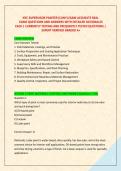
NYC SUPERVISOR PAINTER (CUNY) EXAM ACCURATE REAL
EXAM QUESTIONS AND ANSWERS WITH DETAILED RATIONALES
EACH | CURRENTLY TESTING AND FREQUENTLY TESTED QUESTIONS |
EXPERT VERIFIED GRADED A+
EXAM OVERVIEW
Core Domains Tested:
1. Paint Materials, Coatings, and Finishes
2. Surface Preparation and Coating Application Techniques
3. Tools, Equipment, and Maintenance Practices
4. Workplace Safety and Hazard Control
5. Supervisory Skills and Workforce Management
6. Blueprints, Specifications, and Work Planning
7. Building Maintenance, Repair, and Surface Restoration
8. Environmental and Hazardous Materials Management
9. Quality Control, Inspection, and Project Documentation
SECTION 1: PAINT MATERIALS, COATINGS, AND FINISHES (Questions 1–50)
Question 1
Which type of paint is most commonly used for interior walls due to its low odor
and quick drying time?
A) Oil-based paint
B) Enamel paint
C) Lacquer
D) Latex paint
Correct Answer: D
Rationale: Latex paint is water‑based, dries quickly, has low odor, and is the most
common choice for interior wall applications. Oil‑based paints have strong odors
and slow drying; enamel is a type of finish, not a base; lacquer is used for specialty
applications.
1
,Question 2
What is the primary advantage of oil‑based (alkyd) paints over latex paints?
A) Lower VOC content
B) Faster drying time
C) Superior durability and adhesion on high‑traffic surfaces
D) Easier cleanup with water
Correct Answer: C
Rationale: Oil‑based paints provide superior hardness, durability, and adhesion,
making them ideal for high‑traffic areas and trim. They have higher solvent
content, dry slower, and require mineral spirits for cleanup.
Question 3
What does the term "VOC" stand for in paint terminology?
A) Volatile Organic Compound
B) Very Opaque Coating
C) Viscous Oil Component
D) Vinyl Oxide Coating
Correct Answer: A
Rationale: VOCs are Volatile Organic Compounds that evaporate as the paint dries
and can contribute to air quality concerns. Regulatory limits on VOCs are common
in many jurisdictions to protect health and the environment.
Question 4
In most regulated jurisdictions, what is the typical VOC limit for flat interior
paints?
2
,A) 50 g/L
B) 100 g/L
C) 150 g/L
D) 200 g/L
Correct Answer: B
Rationale: Widely adopted standards set 100 grams per liter as the maximum for
flat paints, with slightly higher allowances for non‑flat finishes such as eggshell or
semi‑gloss.
Question 5
Which paint finish has the highest gloss level?
A) Flat
B) Eggshell
C) Semi‑gloss
D) High‑gloss
Correct Answer: D
Rationale: High‑gloss finishes have the highest sheen and reflectivity, making
them highly durable and easy to clean. Flat has no sheen; eggshell and semi‑gloss
offer progressively more sheen but less than high‑gloss.
Question 6
What is the primary function of a primer coat?
A) To provide the final color
B) To seal the surface and promote adhesion of the topcoat
C) To add gloss to the finish
D) To reduce the cost of painting
3
, Correct Answer: B
Rationale: Primer seals porous surfaces, provides a uniform base, improves
coverage, and ensures the topcoat adheres properly. It is not intended to provide
the final color or gloss.
Question 7
Which type of primer is best for covering water stains on a ceiling?
A) Latex primer
B) Shellac‑based primer
C) Oil‑based primer
D) Epoxy primer
Correct Answer: B
Rationale: Shellac‑based primers are highly effective at sealing water stains,
smoke damage, and tannin bleed because they form a hard, impermeable barrier
that prevents stains from bleeding through.
Question 8
What is the difference between a binder and a pigment in paint?
A) Binder provides color; pigment holds the binder together
B) Binder holds the pigment particles together and adheres to the surface;
pigment provides color and hiding
C) There is no difference
D) Binder is used only in oil paints
Correct Answer: B
Rationale: The binder is the film‑forming component that glues the pigment
particles to each other and to the surface. Pigment provides the color and opacity.
4
EXAM QUESTIONS AND ANSWERS WITH DETAILED RATIONALES
EACH | CURRENTLY TESTING AND FREQUENTLY TESTED QUESTIONS |
EXPERT VERIFIED GRADED A+
EXAM OVERVIEW
Core Domains Tested:
1. Paint Materials, Coatings, and Finishes
2. Surface Preparation and Coating Application Techniques
3. Tools, Equipment, and Maintenance Practices
4. Workplace Safety and Hazard Control
5. Supervisory Skills and Workforce Management
6. Blueprints, Specifications, and Work Planning
7. Building Maintenance, Repair, and Surface Restoration
8. Environmental and Hazardous Materials Management
9. Quality Control, Inspection, and Project Documentation
SECTION 1: PAINT MATERIALS, COATINGS, AND FINISHES (Questions 1–50)
Question 1
Which type of paint is most commonly used for interior walls due to its low odor
and quick drying time?
A) Oil-based paint
B) Enamel paint
C) Lacquer
D) Latex paint
Correct Answer: D
Rationale: Latex paint is water‑based, dries quickly, has low odor, and is the most
common choice for interior wall applications. Oil‑based paints have strong odors
and slow drying; enamel is a type of finish, not a base; lacquer is used for specialty
applications.
1
,Question 2
What is the primary advantage of oil‑based (alkyd) paints over latex paints?
A) Lower VOC content
B) Faster drying time
C) Superior durability and adhesion on high‑traffic surfaces
D) Easier cleanup with water
Correct Answer: C
Rationale: Oil‑based paints provide superior hardness, durability, and adhesion,
making them ideal for high‑traffic areas and trim. They have higher solvent
content, dry slower, and require mineral spirits for cleanup.
Question 3
What does the term "VOC" stand for in paint terminology?
A) Volatile Organic Compound
B) Very Opaque Coating
C) Viscous Oil Component
D) Vinyl Oxide Coating
Correct Answer: A
Rationale: VOCs are Volatile Organic Compounds that evaporate as the paint dries
and can contribute to air quality concerns. Regulatory limits on VOCs are common
in many jurisdictions to protect health and the environment.
Question 4
In most regulated jurisdictions, what is the typical VOC limit for flat interior
paints?
2
,A) 50 g/L
B) 100 g/L
C) 150 g/L
D) 200 g/L
Correct Answer: B
Rationale: Widely adopted standards set 100 grams per liter as the maximum for
flat paints, with slightly higher allowances for non‑flat finishes such as eggshell or
semi‑gloss.
Question 5
Which paint finish has the highest gloss level?
A) Flat
B) Eggshell
C) Semi‑gloss
D) High‑gloss
Correct Answer: D
Rationale: High‑gloss finishes have the highest sheen and reflectivity, making
them highly durable and easy to clean. Flat has no sheen; eggshell and semi‑gloss
offer progressively more sheen but less than high‑gloss.
Question 6
What is the primary function of a primer coat?
A) To provide the final color
B) To seal the surface and promote adhesion of the topcoat
C) To add gloss to the finish
D) To reduce the cost of painting
3
, Correct Answer: B
Rationale: Primer seals porous surfaces, provides a uniform base, improves
coverage, and ensures the topcoat adheres properly. It is not intended to provide
the final color or gloss.
Question 7
Which type of primer is best for covering water stains on a ceiling?
A) Latex primer
B) Shellac‑based primer
C) Oil‑based primer
D) Epoxy primer
Correct Answer: B
Rationale: Shellac‑based primers are highly effective at sealing water stains,
smoke damage, and tannin bleed because they form a hard, impermeable barrier
that prevents stains from bleeding through.
Question 8
What is the difference between a binder and a pigment in paint?
A) Binder provides color; pigment holds the binder together
B) Binder holds the pigment particles together and adheres to the surface;
pigment provides color and hiding
C) There is no difference
D) Binder is used only in oil paints
Correct Answer: B
Rationale: The binder is the film‑forming component that glues the pigment
particles to each other and to the surface. Pigment provides the color and opacity.
4

