

women who last menstruated I yo ago
Cyclical HRT =
who have uters and have
Continuous combined HRT = women
ceased menstruating I
>
year ago
fractures t
of osteoporosis
-
Risk +
Contraceptives - time until effective:
• instant: IUD
• 2 days: POP
• 7 days: COCP, injection, implant, IUS
After giving birth, women require contraception after day 21
Lactational amenorrhoea = reliable method of contraception
if amenorrhoeic, baby <6 months, and breastfeeding
exclusively day-night
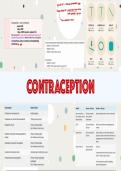
CONTRACEPTION
, IMPLANATABLE CONTRACEPTIVES INJECTABLE CONTRACEPTIVE
3 Not recommended in women > 50 due to its
effect
on ↓ bone mineral density
Implanon and Nexplanon Depo Provera
• Inserted in the non-dominant arm • Contains medroxyprogesterone acetate 150mg
• Main mechanism = prevents ovulation, thickens cervical mucus • IM injection every 12 weeks
• Lasts 3 years • Mechanism = inhibits ovulation, cervical mucus
• Can be immediately inserted post termination thickening and endometrial thinning
• Can be used in past history of thromboembolism, migraine
Disadvantages
Disadvantages • Injection cannot be reversed once given
• Need for a trained professional to insert and remove device • Potential delayed return to fertility - up to 12 months
• Additional contraceptive needed for first 7 days if not inserted
on day 1 to 5 of a menstrual cycle Side effects
• Irregular bleeding
Side effects • Weight gain
• Irregular/heavy bleeding - managed with COCP for 3 months • Increased risk of osteoporosis
• Headache
• Nausea Contraindications = breast cancer
• Interactions = anti-epileptics, rifampicin • Not recommended for routine use in women over the
age of 50
Contraindications
• Ischaemic heart disease
• Stroke
• Breast cancer
• Liver cancer
• Liver cirrhosis
• Not recommended in women after the age of 50 - reduces bone
mineral density
Cyclical HRT =
who have uters and have
Continuous combined HRT = women
ceased menstruating I
>
year ago
fractures t
of osteoporosis
-
Risk +
Contraceptives - time until effective:
• instant: IUD
• 2 days: POP
• 7 days: COCP, injection, implant, IUS
After giving birth, women require contraception after day 21
Lactational amenorrhoea = reliable method of contraception
if amenorrhoeic, baby <6 months, and breastfeeding
exclusively day-night
CONTRACEPTION
, IMPLANATABLE CONTRACEPTIVES INJECTABLE CONTRACEPTIVE
3 Not recommended in women > 50 due to its
effect
on ↓ bone mineral density
Implanon and Nexplanon Depo Provera
• Inserted in the non-dominant arm • Contains medroxyprogesterone acetate 150mg
• Main mechanism = prevents ovulation, thickens cervical mucus • IM injection every 12 weeks
• Lasts 3 years • Mechanism = inhibits ovulation, cervical mucus
• Can be immediately inserted post termination thickening and endometrial thinning
• Can be used in past history of thromboembolism, migraine
Disadvantages
Disadvantages • Injection cannot be reversed once given
• Need for a trained professional to insert and remove device • Potential delayed return to fertility - up to 12 months
• Additional contraceptive needed for first 7 days if not inserted
on day 1 to 5 of a menstrual cycle Side effects
• Irregular bleeding
Side effects • Weight gain
• Irregular/heavy bleeding - managed with COCP for 3 months • Increased risk of osteoporosis
• Headache
• Nausea Contraindications = breast cancer
• Interactions = anti-epileptics, rifampicin • Not recommended for routine use in women over the
age of 50
Contraindications
• Ischaemic heart disease
• Stroke
• Breast cancer
• Liver cancer
• Liver cirrhosis
• Not recommended in women after the age of 50 - reduces bone
mineral density

