

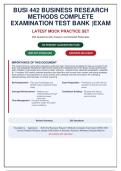
BUSI 442 BUSINESS RESEARCH
METHODS COMPLETE
EXAMINATION TEST BANK |EXAM
LATEST MOCK PRACTICE SET
250 Questions with Answers and Detailed Rationales
100 PERCENT GUARANTEED PASS
INSTANT DOWNLOAD ANSWERS INCLUDED
IMPORTANCE OF THIS DOCUMENT
This comprehensive examination preparation guide has been meticulously developed to help you succeed in the
BUSI 442 BUSINESS RESEARCH METHODS COMPLETE EXAMINATION TEST BANK |EXAM QUESTIONS
AND CORRECT DETAILED SOLUTIONS LATEST UPDATE - 2026 EDITION VERIFIED ANSWERS | GRADED
A+. It contains 250 carefully selected questions that reflect the most current exam content and testing strategies.
Each question is accompanied by a correct answer and a detailed rationale that explains the underlying
pathophysiology, pharmacology, or clinical reasoning.
Self-Assessment – Test your knowledge and Exam Preparation – Familiarize yourself with the
identify areas requiring further question format and content
study areas
Concept Reinforcement – Deepen your Confidence Building – Develop test-taking
understanding through strategies and reduce
evidence-based exam anxiety
rationales
Time Management – Practice answering
questions under simulated
exam conditions
Review Summary 250 Questions
Foundations - Application - BUSI 442 Business Research Methods Complete Examination BANK AND
Correct Detailed Solutions Update 2026 Edition A Business Research Methods Graduate Mba/ms
All answers with rationales
,Table of Contents
Section A - Introduction TO Business Section B - Research Design AND
Research Methodology
Questions 1 to 63 Questions 64 to 126
Section C - DATA Collection Methods Section D - Sampling Techniques
Questions 127 to 189 Questions 190 to 250
,Section A - Introduction TO Business Research
Q1.
In a study examining the effect of leadership style on employee innovation, the researcher
measures leadership style using a self-report questionnaire and innovation using
supervisor ratings. Which of the following poses the greatest threat to internal validity if
the researcher uses a cross-sectional design?
A. Maturation effects as employees develop B. Common method variance from
over time same-source data
C. Selection bias due to non-random D. History effects from concurrent
assignment organizational changes
Correct: B - Common method variance from same-source data
Rationale:Common method variance (CMV) occurs when both predictor and outcome are
measured from the same source (self-report), inflating correlations. Cross-sectional designs
are particularly vulnerable to CMV because temporal separation is absent. Maturation and
history are threats in longitudinal designs, not cross-sectional. Selection bias is relevant for
causal claims but less immediate than CMV when both variables come from the same
respondent.
Q2.
A researcher plans to study the relationship between corporate social responsibility (CSR)
and financial performance using archival data from 500 firms over 10 years. The CSR data
are publicly available only for the last 3 years. Which research design is most appropriate
given this constraint?
A. Cross-sectional design using only the B. Longitudinal panel design with 3-year
most recent year of data CSR data and 10-year financial data
C. Time-series design using aggregated D. Quasi-experimental design with a
annual industry averages matched comparison group
Correct: B - Longitudinal panel design with 3-year CSR data and 10-year financial data
Rationale:A longitudinal panel design allows the researcher to use the available 3-year CSR
data while still leveraging the full 10-year financial data to control for firm-specific trends.
Cross-sectional designs (A) ignore temporal dynamics. Time-series (C) loses firm-level
variation. Quasi-experimental (D) is not feasible without a clear treatment assignment. Panel
data with unbalanced time periods is common and acceptable in archival research.
Page 3
, Section A - Introduction TO Business Research
Q3.
A survey measures job satisfaction using a 5-point Likert scale (1=very dissatisfied,
5=very satisfied). The researcher reports a mean of 3.2 and a standard deviation of 0.8.
Assuming the scale approximates an interval level, which of the following is the correct
interpretation of the standard deviation?
A. 68% of respondents scored between 2.4 B. The average distance of individual scores
and 4.0 from the mean is 0.8 points
C. The variance of the sample is 0.64, which D. The distribution is positively skewed
is less than the mean because the mean is above the midpoint
Correct: B - The average distance of individual scores from the mean is 0.8 points
Rationale:Standard deviation is defined as the average absolute deviation from the mean
(more precisely, the square root of the average squared deviation). Option B correctly
describes this concept. Option A assumes normality, which is not guaranteed. Option C is true
(variance = 0.64) but does not interpret the standard deviation. Option D confuses skewness
with central tendency; a mean above the midpoint does not imply skewness.
Q4.
In a factorial ANOVA with two factors (A and B), the interaction effect is significant (p <
0.05). Which of the following must be true?
A. The main effects of A and B are also B. The effect of factor A depends on the
significant level of factor B
C. At least one of the main effects is not D. The overall model explains more
significant variance than the sum of main effects
Correct: B - The effect of factor A depends on the level of factor B
Rationale:A significant interaction means the effect of one factor is not constant across levels
of the other factor. This is the definition: the effect of A depends on B. Main effects may or
may not be significant (A and C are false). Option D is true for any interaction but is not a
required condition; it's a mathematical property of ANOVA partitioning.
Q5.
A researcher uses stratified random sampling to study employee engagement across
departments. The company has 200 employees: 50 in R&D, 80 in Marketing, and 70 in
Operations. The researcher wants a total sample of 60. Using proportional allocation, how
many employees should be sampled from Marketing?
A. 20 B. 24
C. 30 D. 16
Page 4
METHODS COMPLETE
EXAMINATION TEST BANK |EXAM
LATEST MOCK PRACTICE SET
250 Questions with Answers and Detailed Rationales
100 PERCENT GUARANTEED PASS
INSTANT DOWNLOAD ANSWERS INCLUDED
IMPORTANCE OF THIS DOCUMENT
This comprehensive examination preparation guide has been meticulously developed to help you succeed in the
BUSI 442 BUSINESS RESEARCH METHODS COMPLETE EXAMINATION TEST BANK |EXAM QUESTIONS
AND CORRECT DETAILED SOLUTIONS LATEST UPDATE - 2026 EDITION VERIFIED ANSWERS | GRADED
A+. It contains 250 carefully selected questions that reflect the most current exam content and testing strategies.
Each question is accompanied by a correct answer and a detailed rationale that explains the underlying
pathophysiology, pharmacology, or clinical reasoning.
Self-Assessment – Test your knowledge and Exam Preparation – Familiarize yourself with the
identify areas requiring further question format and content
study areas
Concept Reinforcement – Deepen your Confidence Building – Develop test-taking
understanding through strategies and reduce
evidence-based exam anxiety
rationales
Time Management – Practice answering
questions under simulated
exam conditions
Review Summary 250 Questions
Foundations - Application - BUSI 442 Business Research Methods Complete Examination BANK AND
Correct Detailed Solutions Update 2026 Edition A Business Research Methods Graduate Mba/ms
All answers with rationales
,Table of Contents
Section A - Introduction TO Business Section B - Research Design AND
Research Methodology
Questions 1 to 63 Questions 64 to 126
Section C - DATA Collection Methods Section D - Sampling Techniques
Questions 127 to 189 Questions 190 to 250
,Section A - Introduction TO Business Research
Q1.
In a study examining the effect of leadership style on employee innovation, the researcher
measures leadership style using a self-report questionnaire and innovation using
supervisor ratings. Which of the following poses the greatest threat to internal validity if
the researcher uses a cross-sectional design?
A. Maturation effects as employees develop B. Common method variance from
over time same-source data
C. Selection bias due to non-random D. History effects from concurrent
assignment organizational changes
Correct: B - Common method variance from same-source data
Rationale:Common method variance (CMV) occurs when both predictor and outcome are
measured from the same source (self-report), inflating correlations. Cross-sectional designs
are particularly vulnerable to CMV because temporal separation is absent. Maturation and
history are threats in longitudinal designs, not cross-sectional. Selection bias is relevant for
causal claims but less immediate than CMV when both variables come from the same
respondent.
Q2.
A researcher plans to study the relationship between corporate social responsibility (CSR)
and financial performance using archival data from 500 firms over 10 years. The CSR data
are publicly available only for the last 3 years. Which research design is most appropriate
given this constraint?
A. Cross-sectional design using only the B. Longitudinal panel design with 3-year
most recent year of data CSR data and 10-year financial data
C. Time-series design using aggregated D. Quasi-experimental design with a
annual industry averages matched comparison group
Correct: B - Longitudinal panel design with 3-year CSR data and 10-year financial data
Rationale:A longitudinal panel design allows the researcher to use the available 3-year CSR
data while still leveraging the full 10-year financial data to control for firm-specific trends.
Cross-sectional designs (A) ignore temporal dynamics. Time-series (C) loses firm-level
variation. Quasi-experimental (D) is not feasible without a clear treatment assignment. Panel
data with unbalanced time periods is common and acceptable in archival research.
Page 3
, Section A - Introduction TO Business Research
Q3.
A survey measures job satisfaction using a 5-point Likert scale (1=very dissatisfied,
5=very satisfied). The researcher reports a mean of 3.2 and a standard deviation of 0.8.
Assuming the scale approximates an interval level, which of the following is the correct
interpretation of the standard deviation?
A. 68% of respondents scored between 2.4 B. The average distance of individual scores
and 4.0 from the mean is 0.8 points
C. The variance of the sample is 0.64, which D. The distribution is positively skewed
is less than the mean because the mean is above the midpoint
Correct: B - The average distance of individual scores from the mean is 0.8 points
Rationale:Standard deviation is defined as the average absolute deviation from the mean
(more precisely, the square root of the average squared deviation). Option B correctly
describes this concept. Option A assumes normality, which is not guaranteed. Option C is true
(variance = 0.64) but does not interpret the standard deviation. Option D confuses skewness
with central tendency; a mean above the midpoint does not imply skewness.
Q4.
In a factorial ANOVA with two factors (A and B), the interaction effect is significant (p <
0.05). Which of the following must be true?
A. The main effects of A and B are also B. The effect of factor A depends on the
significant level of factor B
C. At least one of the main effects is not D. The overall model explains more
significant variance than the sum of main effects
Correct: B - The effect of factor A depends on the level of factor B
Rationale:A significant interaction means the effect of one factor is not constant across levels
of the other factor. This is the definition: the effect of A depends on B. Main effects may or
may not be significant (A and C are false). Option D is true for any interaction but is not a
required condition; it's a mathematical property of ANOVA partitioning.
Q5.
A researcher uses stratified random sampling to study employee engagement across
departments. The company has 200 employees: 50 in R&D, 80 in Marketing, and 70 in
Operations. The researcher wants a total sample of 60. Using proportional allocation, how
many employees should be sampled from Marketing?
A. 20 B. 24
C. 30 D. 16
Page 4

