

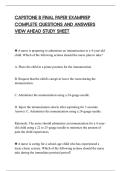
CAPSTONE B FINAL PAPER EXAMPREP
COMPLETE QUESTIONS AND ANSWERS
VIEW AHEAD STUDY SHEET
◉ A nurse is preparing to administer an immunization to a 4-year-old
child. Which of the following actions should the nurse plan to take?
A. Place the child in a prone position for the immunization.
B. Request that the child's caregiver leave the room during the
immunization.
C. Administer the immunization using a 24-gauge needle.
D. Inject the immunization slowly after aspirating for 3 seconds.
Answer: C. Administer the immunization using a 24-gauge needle.
Rationale: The nurse should administer an immunization for a 4-year-
old child using a 22 to 25-gauge needle to minimize the amount of
pain the child experiences.
◉ A nurse is caring for a school-age child who has experienced a
tonic-clonic seizure. Which of the following actions should the nurse
take during the immediate postictal period?
,A. Place the child in a side-lying position.
B. Delay documentation until the child is fully alert.
C. Give the child a high-carbohydrate snack.
D. Administer an oral sedative to the child. Answer: A. Place the child
in a side-lying position.
Rationale: The nurse should place the child in a side-lying position to
prevent aspiration.
◉ NGN* A nurse on a pediatric unit is admitting a preschooler. After
reviewing the information in the medical record the nurse should
identify that the child is at risk for developing which of the following
conditions?
Dropdown 1:
Splenomegaly
Acute post-streptococcal glomerulonephritis (APSGN)
Dysrhythmias
Dropdown 2:
Positive mononucleosis rapid test
,Urinary output
Cardiovascular assessment Answer: 1. Splenomegaly
Rationale: The child's positive mononucleosis rapid test result
indicates the presence of infectious mono, a condition caused by the
Epstein-Barr virus. Therefore, the nurse should identify that the child
is at risk for developing splenomegaly, a common complication of
infectious mono.
2. Positive mono rapid test
Rationale: The child's positive mononucleosis rapid test result
indicates the presence of infectious mono, a condition caused by the
Epstein-Barr virus. Therefore, the nurse should identify that the child
is at risk for developing splenomegaly, a common complication of
infectious mono.
◉ A nurse is assessing an infant who has a ventricular septal defect.
Which of the following findings should the nurse expect?
A. Loud, harsh murmur
B. Dysrhythmias
C. Weak femoral pulses
, D. High blood pressure Answer: A. Loud, harsh murmur
Rationale: The nurse should expect to hear a loud, harsh murmur with
a ventricular septal defect due to the left-to-right shunting of blood,
which contributes to hypertrophy of the infant's heart muscle.
◉ A nurse is providing discharge teaching the guardians of a toddler
with a lower leg cast applied 24 hours ago. The nurse should instruct
the guardians to report which of the following findings to the
provider?
A. Capillary refill time < 2 seconds.
B. Restricted ability to move the toes.
C. Swelling of the casted foot when the leg is dependent.
D. Pedal pulse +3 bilateral. Answer: B. Restricted ability to move the
toes.
Rationale: The nurse should inform the guardians that the restricted
ability of the toddler to move their toes is an indication of
neuromuscular compromise and requires immediate notification to the
provider. Permanent muscle and tissue damage can occur in just a few
hours.
COMPLETE QUESTIONS AND ANSWERS
VIEW AHEAD STUDY SHEET
◉ A nurse is preparing to administer an immunization to a 4-year-old
child. Which of the following actions should the nurse plan to take?
A. Place the child in a prone position for the immunization.
B. Request that the child's caregiver leave the room during the
immunization.
C. Administer the immunization using a 24-gauge needle.
D. Inject the immunization slowly after aspirating for 3 seconds.
Answer: C. Administer the immunization using a 24-gauge needle.
Rationale: The nurse should administer an immunization for a 4-year-
old child using a 22 to 25-gauge needle to minimize the amount of
pain the child experiences.
◉ A nurse is caring for a school-age child who has experienced a
tonic-clonic seizure. Which of the following actions should the nurse
take during the immediate postictal period?
,A. Place the child in a side-lying position.
B. Delay documentation until the child is fully alert.
C. Give the child a high-carbohydrate snack.
D. Administer an oral sedative to the child. Answer: A. Place the child
in a side-lying position.
Rationale: The nurse should place the child in a side-lying position to
prevent aspiration.
◉ NGN* A nurse on a pediatric unit is admitting a preschooler. After
reviewing the information in the medical record the nurse should
identify that the child is at risk for developing which of the following
conditions?
Dropdown 1:
Splenomegaly
Acute post-streptococcal glomerulonephritis (APSGN)
Dysrhythmias
Dropdown 2:
Positive mononucleosis rapid test
,Urinary output
Cardiovascular assessment Answer: 1. Splenomegaly
Rationale: The child's positive mononucleosis rapid test result
indicates the presence of infectious mono, a condition caused by the
Epstein-Barr virus. Therefore, the nurse should identify that the child
is at risk for developing splenomegaly, a common complication of
infectious mono.
2. Positive mono rapid test
Rationale: The child's positive mononucleosis rapid test result
indicates the presence of infectious mono, a condition caused by the
Epstein-Barr virus. Therefore, the nurse should identify that the child
is at risk for developing splenomegaly, a common complication of
infectious mono.
◉ A nurse is assessing an infant who has a ventricular septal defect.
Which of the following findings should the nurse expect?
A. Loud, harsh murmur
B. Dysrhythmias
C. Weak femoral pulses
, D. High blood pressure Answer: A. Loud, harsh murmur
Rationale: The nurse should expect to hear a loud, harsh murmur with
a ventricular septal defect due to the left-to-right shunting of blood,
which contributes to hypertrophy of the infant's heart muscle.
◉ A nurse is providing discharge teaching the guardians of a toddler
with a lower leg cast applied 24 hours ago. The nurse should instruct
the guardians to report which of the following findings to the
provider?
A. Capillary refill time < 2 seconds.
B. Restricted ability to move the toes.
C. Swelling of the casted foot when the leg is dependent.
D. Pedal pulse +3 bilateral. Answer: B. Restricted ability to move the
toes.
Rationale: The nurse should inform the guardians that the restricted
ability of the toddler to move their toes is an indication of
neuromuscular compromise and requires immediate notification to the
provider. Permanent muscle and tissue damage can occur in just a few
hours.

