

it
Question Type: Multiple Choice
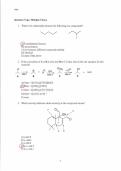
1. What is the relationship between the following two compounds?
constitutional isomers
B) stereoisomers
C) not isomers; different compounds entirely
D) identical
E) none of the above
2. If the conversion of A to B is slow and B to C is fast, what is the rate equation for this
reaction?
Cl 2 (©] OH
|
)\ K‘T /®\ * C|@ —szo /‘\ __’+C /l\ + HCl
A P B step 2 & step 3 D
A) Rate = k[(CH3)2CHCI][H20]
(B)Rate = K{(CH3)2CHCI]
C) Rate = k[(CH3)2CH] t[H20]
D) Rate = £[(CH3) 2CH] +
E) none
3. Which arrow(s) indicates chiral center(s) in the compound shown?
a Oy "
~0
d L
A)aandb
B)c,ande
candd
a, ¢, and d
E)b,c,and e
, HiHH
Midterm Exam 3
CHEM 2100
April 1%, 2026
Total Points: 100
Please carefully read these instructions.
+ Please fill out your last name, first name, and student number on the student answer
sheet.
* There are a total of 22 questions. You need to answer any 20 to get full credit,
and answering all of them gives you extra credit.
* You can write on the question set; however, it will not be graded.
» The periodic table and pKa table have been included at the end.
+ Calculators and cell phones are not allowed.
» There is ZERO TOLERANCE FOR CHEATING.
Question Type: Multiple Choice
1. What is the relationship between the following two compounds?
constitutional isomers
B) stereoisomers
C) not isomers; different compounds entirely
D) identical
E) none of the above
2. If the conversion of A to B is slow and B to C is fast, what is the rate equation for this
reaction?
Cl 2 (©] OH
|
)\ K‘T /®\ * C|@ —szo /‘\ __’+C /l\ + HCl
A P B step 2 & step 3 D
A) Rate = k[(CH3)2CHCI][H20]
(B)Rate = K{(CH3)2CHCI]
C) Rate = k[(CH3)2CH] t[H20]
D) Rate = £[(CH3) 2CH] +
E) none
3. Which arrow(s) indicates chiral center(s) in the compound shown?
a Oy "
~0
d L
A)aandb
B)c,ande
candd
a, ¢, and d
E)b,c,and e
, HiHH
Midterm Exam 3
CHEM 2100
April 1%, 2026
Total Points: 100
Please carefully read these instructions.
+ Please fill out your last name, first name, and student number on the student answer
sheet.
* There are a total of 22 questions. You need to answer any 20 to get full credit,
and answering all of them gives you extra credit.
* You can write on the question set; however, it will not be graded.
» The periodic table and pKa table have been included at the end.
+ Calculators and cell phones are not allowed.
» There is ZERO TOLERANCE FOR CHEATING.

