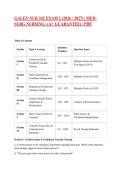
GALEN NUR 242 EXAM 2 () | MED-
SURG NURSING | (A+ GUARANTEE) | PDF
Table of Contents
Question
Section Topic Coverage Question Types
Numbers
Cardiovascular &
Section Multiple-Choice & Select All
Peripheral Vascular Q1 – Q25
I That Apply (SATA)
Nursing
Section Fluid, Electrolyte &
Q26 – Q50 Multiple-Choice & SATA
II Acid-Base Management
Section Respiratory & Endocrine
Q51 – Q75 Multiple-Choice & SATA
III Nursing Concepts
Scenario-Based Clinical
Section
Application & Q76 – Q90 Complex Clinical Scenarios
IV
Prioritization
Section Short-Answer & Review Short-Answer &
Q91 – Q105
V Concepts Calculation/Identification
Complete Answer Key &
Section
Comprehensive Q1 – Q105 Key & Nursing Rationales
VI
Rationales
Section I: Cardiovascular & Peripheral Vascular Nursing
1. A client presents to the emergency department reporting chest pain. Which client statement
most strongly suggests classic angina pectoris?
A. "The pain gets much worse whenever I take a deep breath."
,B. "The pain started while I was mowing the lawn and eased up after resting."
C. "The chest pain has been constant and sharp for the past 3 days."
D. "The pain completely went away after I ate a turkey sandwich."
2. The nurse is assessing a client with suspected unstable angina. Which clinical manifestation
distinguishes unstable angina from stable angina?
A. Chest pain triggered only by intense physical exertion
B. Chest pain relieved consistently within 5 minutes of rest
C. Chest pain occurring at rest or with minimal activity, with a worsening pattern
D. Chest pain reproduced by palpation of the sternal border
3. A client with an acute ST-elevation myocardial infarction (STEMI) is admitted to the cardiac
care unit. Which medication is considered the primary analgesic of choice to reduce pain and
decrease myocardial oxygen demand?
A. Ibuprofen
B. Acetaminophen
C. Morphine sulfate
D. Meperidine
4. The nurse provides discharge instructions to a client prescribed sublingual nitroglycerin for
angina. Which statement by the client indicates an accurate understanding of administration?
A. "I will swallow one tablet with a full glass of water every 15 minutes."
B. "I will place one tablet under my tongue at the start of chest pain and can take up to 3 tablets 5
minutes apart."
C. "I will store my tablets in a clear plastic bag on my sunny windowsill."
D. "If pain continues after the first tablet, I should wait 30 minutes before calling 911."
5. A client taking metoprolol for hypertension asks the nurse how the medication works. What is
the primary therapeutic rationale for beta-blocker therapy in coronary artery disease (CAD)?
A. Direct dilation of the peripheral veins to prevent clot formation
B. Blockade of sympathetic stimulation to decrease heart rate and myocardial workload
C. Inhibition of hepatic synthesis of low-density lipoproteins (LDL)
D. Suppression of the renin-angiotensin-aldosterone system to increase serum potassium
,6. (Select All That Apply) The nurse is creating a teaching plan for a client newly diagnosed with
Peripheral Arterial Disease (PAD). Which instructions should be included?
• [ ] A. Inspect feet daily for breakdown, redness, or skin tears.
• [ ] B. Elevate legs high above heart level for 4 hours each afternoon.
• [ ] C. Walk until moderate pain occurs, stop and rest, then resume walking.
• [ ] D. Avoid nicotine in all forms and maintain tight lipid control.
• [ ] E. Soak feet in hot water every evening to promote circulation.
7. A client with chronic heart failure has been prescribed daily oral furosemide and digoxin.
Which client finding indicates the therapeutic effectiveness of furosemide?
A. Weight gain of 3 lbs over 24 hours
B. Resolution of bilateral crackles and a 2 kg weight loss
C. Development of an S3 gallop
D. Serum potassium level of 5.8 mEq/L
8. The nurse receives the laboratory results for a client taking warfarin for atrial fibrillation. The
International Normalized Ratio (INR) is 2.8. What action should the nurse take?
A. Administer Vitamin K intravenously immediately
B. Hold the next dose and contact the health care provider
C. Administer the prescribed warfarin dose as scheduled
D. Infuse 2 units of fresh frozen plasma
9. When teaching a client taking warfarin about dietary choices, which instruction is most
appropriate?
A. Completely eliminate all green leafy vegetables from the diet
B. Maintain a consistent daily intake of Vitamin K-rich foods
C. Double the warfarin dose on days when eating a salad
D. Take a daily Vitamin K supplement to prevent bleeding
10. Which clinical manifestation is most characteristic of left-sided heart failure?
A. Jugular venous distention (JVD) and ascites
B. Dependent pitting edema in the lower extremities
, C. Bilateral pulmonary crackles, dyspnea, and cough with pink frothy sputum
D. Hepatomegaly and right upper quadrant tenderness
11. A post-myocardial infarction client develops a new S3 heart sound upon auscultation. How
does the nurse correctly interpret this finding?
A. A normal physiological finding in older adults
B. An indicator of left ventricular volume overload or heart failure
C. Signs of acute pericardial friction rub
D. Severe aortic valve calcification
12. A client diagnosed with aortic stenosis reports experiencing lightheadedness and syncope
upon standing or walking. Which pathophysiology explains these symptoms?
A. Sudden severe drop in blood volume secondary to diuresis
B. Fixed outflow obstruction preventing cardiac output from increasing during exertion
C. Rapid acceleration of AV node conduction
D. Massive peripheral venous pooling
13. The nurse is reevaluating a client receiving intravenous fibrinolytic therapy for acute
ischemic stroke. Which finding requires immediate nursing intervention?
A. Minor oozing of blood from a peripheral IV site
B. Sudden change in level of consciousness or severe headache
C. Transient sinus bradycardia of 58 bpm
D. Warm, dry skin with a blood pressure of 124/78 mmHg
14. A client with essential hypertension is prescribed sublingual nitroglycerin for sudden angina.
Which adverse effect should the nurse instruct the client to anticipate after administration?
A. Bradycardia and urinary retention
B. Throbbing headache, dizziness, and facial flushing
C. Constipation and peripheral edema
D. Hypertension and hyperreflexia
15. A client is admitted with infective endocarditis. Which assessment finding is considered a
classic peripheral physical manifestation of this condition?
A. Osler nodes and Janeway lesions
SURG NURSING | (A+ GUARANTEE) | PDF
Table of Contents
Question
Section Topic Coverage Question Types
Numbers
Cardiovascular &
Section Multiple-Choice & Select All
Peripheral Vascular Q1 – Q25
I That Apply (SATA)
Nursing
Section Fluid, Electrolyte &
Q26 – Q50 Multiple-Choice & SATA
II Acid-Base Management
Section Respiratory & Endocrine
Q51 – Q75 Multiple-Choice & SATA
III Nursing Concepts
Scenario-Based Clinical
Section
Application & Q76 – Q90 Complex Clinical Scenarios
IV
Prioritization
Section Short-Answer & Review Short-Answer &
Q91 – Q105
V Concepts Calculation/Identification
Complete Answer Key &
Section
Comprehensive Q1 – Q105 Key & Nursing Rationales
VI
Rationales
Section I: Cardiovascular & Peripheral Vascular Nursing
1. A client presents to the emergency department reporting chest pain. Which client statement
most strongly suggests classic angina pectoris?
A. "The pain gets much worse whenever I take a deep breath."
,B. "The pain started while I was mowing the lawn and eased up after resting."
C. "The chest pain has been constant and sharp for the past 3 days."
D. "The pain completely went away after I ate a turkey sandwich."
2. The nurse is assessing a client with suspected unstable angina. Which clinical manifestation
distinguishes unstable angina from stable angina?
A. Chest pain triggered only by intense physical exertion
B. Chest pain relieved consistently within 5 minutes of rest
C. Chest pain occurring at rest or with minimal activity, with a worsening pattern
D. Chest pain reproduced by palpation of the sternal border
3. A client with an acute ST-elevation myocardial infarction (STEMI) is admitted to the cardiac
care unit. Which medication is considered the primary analgesic of choice to reduce pain and
decrease myocardial oxygen demand?
A. Ibuprofen
B. Acetaminophen
C. Morphine sulfate
D. Meperidine
4. The nurse provides discharge instructions to a client prescribed sublingual nitroglycerin for
angina. Which statement by the client indicates an accurate understanding of administration?
A. "I will swallow one tablet with a full glass of water every 15 minutes."
B. "I will place one tablet under my tongue at the start of chest pain and can take up to 3 tablets 5
minutes apart."
C. "I will store my tablets in a clear plastic bag on my sunny windowsill."
D. "If pain continues after the first tablet, I should wait 30 minutes before calling 911."
5. A client taking metoprolol for hypertension asks the nurse how the medication works. What is
the primary therapeutic rationale for beta-blocker therapy in coronary artery disease (CAD)?
A. Direct dilation of the peripheral veins to prevent clot formation
B. Blockade of sympathetic stimulation to decrease heart rate and myocardial workload
C. Inhibition of hepatic synthesis of low-density lipoproteins (LDL)
D. Suppression of the renin-angiotensin-aldosterone system to increase serum potassium
,6. (Select All That Apply) The nurse is creating a teaching plan for a client newly diagnosed with
Peripheral Arterial Disease (PAD). Which instructions should be included?
• [ ] A. Inspect feet daily for breakdown, redness, or skin tears.
• [ ] B. Elevate legs high above heart level for 4 hours each afternoon.
• [ ] C. Walk until moderate pain occurs, stop and rest, then resume walking.
• [ ] D. Avoid nicotine in all forms and maintain tight lipid control.
• [ ] E. Soak feet in hot water every evening to promote circulation.
7. A client with chronic heart failure has been prescribed daily oral furosemide and digoxin.
Which client finding indicates the therapeutic effectiveness of furosemide?
A. Weight gain of 3 lbs over 24 hours
B. Resolution of bilateral crackles and a 2 kg weight loss
C. Development of an S3 gallop
D. Serum potassium level of 5.8 mEq/L
8. The nurse receives the laboratory results for a client taking warfarin for atrial fibrillation. The
International Normalized Ratio (INR) is 2.8. What action should the nurse take?
A. Administer Vitamin K intravenously immediately
B. Hold the next dose and contact the health care provider
C. Administer the prescribed warfarin dose as scheduled
D. Infuse 2 units of fresh frozen plasma
9. When teaching a client taking warfarin about dietary choices, which instruction is most
appropriate?
A. Completely eliminate all green leafy vegetables from the diet
B. Maintain a consistent daily intake of Vitamin K-rich foods
C. Double the warfarin dose on days when eating a salad
D. Take a daily Vitamin K supplement to prevent bleeding
10. Which clinical manifestation is most characteristic of left-sided heart failure?
A. Jugular venous distention (JVD) and ascites
B. Dependent pitting edema in the lower extremities
, C. Bilateral pulmonary crackles, dyspnea, and cough with pink frothy sputum
D. Hepatomegaly and right upper quadrant tenderness
11. A post-myocardial infarction client develops a new S3 heart sound upon auscultation. How
does the nurse correctly interpret this finding?
A. A normal physiological finding in older adults
B. An indicator of left ventricular volume overload or heart failure
C. Signs of acute pericardial friction rub
D. Severe aortic valve calcification
12. A client diagnosed with aortic stenosis reports experiencing lightheadedness and syncope
upon standing or walking. Which pathophysiology explains these symptoms?
A. Sudden severe drop in blood volume secondary to diuresis
B. Fixed outflow obstruction preventing cardiac output from increasing during exertion
C. Rapid acceleration of AV node conduction
D. Massive peripheral venous pooling
13. The nurse is reevaluating a client receiving intravenous fibrinolytic therapy for acute
ischemic stroke. Which finding requires immediate nursing intervention?
A. Minor oozing of blood from a peripheral IV site
B. Sudden change in level of consciousness or severe headache
C. Transient sinus bradycardia of 58 bpm
D. Warm, dry skin with a blood pressure of 124/78 mmHg
14. A client with essential hypertension is prescribed sublingual nitroglycerin for sudden angina.
Which adverse effect should the nurse instruct the client to anticipate after administration?
A. Bradycardia and urinary retention
B. Throbbing headache, dizziness, and facial flushing
C. Constipation and peripheral edema
D. Hypertension and hyperreflexia
15. A client is admitted with infective endocarditis. Which assessment finding is considered a
classic peripheral physical manifestation of this condition?
A. Osler nodes and Janeway lesions