2026 ATI TEAS Practice Assessment
Form B Practice Exam Questions
Answers and Verified Rationales
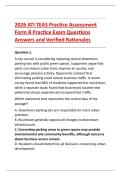
Question 1.
A city council is considering replacing several downtown
parking lots with public green spaces. Supporters argue that
parks can reduce urban heat, improve air quality, and
encourage physical activity. Opponents contend that
eliminating parking could reduce business traffic. A recent
survey found that 68% of residents supported the conversion,
while a separate study found that businesses located near
pedestrian plazas experienced increased foot traffic.
Which statement best represents the central idea of the
passage?
A. Downtown parking lots are responsible for most urban
pollution.
B. Businesses generally oppose all changes to downtown
infrastructure.
C. Converting parking areas to green spaces may provide
environmental and community benefits, although concerns
about business access remain.
D. Residents should determine all decisions concerning urban
development.
,Rationale: The passage presents both benefits of green
spaces and concerns about parking and business access. The
central idea must incorporate both perspectives rather than
focusing exclusively on one detail.
Question 2.
A researcher writes, "Although the initial results appear
promising, the sample size was too small to establish whether
the intervention would be effective in the general
population."
What is the primary purpose of this statement?
A. To reject the intervention completely
B. To prove the intervention is ineffective
C. To acknowledge limitations that prevent broad
conclusions
D. To argue that larger studies are unnecessary
Rationale: The researcher recognizes encouraging preliminary
findings but cautions that the limited sample prevents
generalizing the results. This is an acknowledgment of study
limitations.
Question 3.
Read the passage:
Some educators argue that digital textbooks improve
accessibility because students can enlarge text, search for
terms, and use built-in reading tools. However, critics note
,that prolonged screen exposure may contribute to fatigue
and that digital devices can introduce distractions. The most
effective format may therefore depend on the learner, the
subject, and the learning environment.
Which inference is best supported?
A. Digital textbooks are always superior to printed books.
B. Printed textbooks should replace digital resources.
C. The effectiveness of a textbook format may vary
according to circumstances.
D. Students cannot learn effectively from digital materials.
Rationale: The passage explicitly presents advantages and
disadvantages of digital textbooks and concludes that
effectiveness depends on multiple factors. Therefore, no
single format is universally superior.
Question 4.
A passage describes how a community initially resisted the
construction of a public library because residents feared
higher taxes. After the library opened, however, local literacy
programs expanded, adult education enrollment increased,
and nearby businesses reported greater activity.
Which organizational pattern is primarily used?
A. Compare and contrast
B. Cause and effect only
C. Problem and resolution
D. Chronological biography
, Rationale: The passage introduces a community concern and
then describes how the library project ultimately addressed
broader community needs. This reflects a problem-and-
resolution structure.
Question 5.
A writer states, "The proposal's supporters describe the plan
as an investment in the future, whereas its opponents
characterize it as an unnecessary expense."
What is the author's purpose in presenting these opposing
descriptions?
A. To establish that the proposal is unquestionably beneficial
B. To demonstrate contrasting perspectives on the proposal
C. To prove that the opponents are correct
D. To provide statistical evidence supporting the proposal
Rationale: The wording deliberately presents two contrasting
interpretations. The author is emphasizing differing
perspectives rather than endorsing one side.
Question 6 — Difficulty: Hard
A paragraph begins with a description of declining bee
populations, then discusses pesticide exposure, habitat loss,
and climate change. It concludes by explaining that
protecting pollinators requires coordinated environmental
strategies.
Form B Practice Exam Questions
Answers and Verified Rationales
Question 1.
A city council is considering replacing several downtown
parking lots with public green spaces. Supporters argue that
parks can reduce urban heat, improve air quality, and
encourage physical activity. Opponents contend that
eliminating parking could reduce business traffic. A recent
survey found that 68% of residents supported the conversion,
while a separate study found that businesses located near
pedestrian plazas experienced increased foot traffic.
Which statement best represents the central idea of the
passage?
A. Downtown parking lots are responsible for most urban
pollution.
B. Businesses generally oppose all changes to downtown
infrastructure.
C. Converting parking areas to green spaces may provide
environmental and community benefits, although concerns
about business access remain.
D. Residents should determine all decisions concerning urban
development.
,Rationale: The passage presents both benefits of green
spaces and concerns about parking and business access. The
central idea must incorporate both perspectives rather than
focusing exclusively on one detail.
Question 2.
A researcher writes, "Although the initial results appear
promising, the sample size was too small to establish whether
the intervention would be effective in the general
population."
What is the primary purpose of this statement?
A. To reject the intervention completely
B. To prove the intervention is ineffective
C. To acknowledge limitations that prevent broad
conclusions
D. To argue that larger studies are unnecessary
Rationale: The researcher recognizes encouraging preliminary
findings but cautions that the limited sample prevents
generalizing the results. This is an acknowledgment of study
limitations.
Question 3.
Read the passage:
Some educators argue that digital textbooks improve
accessibility because students can enlarge text, search for
terms, and use built-in reading tools. However, critics note
,that prolonged screen exposure may contribute to fatigue
and that digital devices can introduce distractions. The most
effective format may therefore depend on the learner, the
subject, and the learning environment.
Which inference is best supported?
A. Digital textbooks are always superior to printed books.
B. Printed textbooks should replace digital resources.
C. The effectiveness of a textbook format may vary
according to circumstances.
D. Students cannot learn effectively from digital materials.
Rationale: The passage explicitly presents advantages and
disadvantages of digital textbooks and concludes that
effectiveness depends on multiple factors. Therefore, no
single format is universally superior.
Question 4.
A passage describes how a community initially resisted the
construction of a public library because residents feared
higher taxes. After the library opened, however, local literacy
programs expanded, adult education enrollment increased,
and nearby businesses reported greater activity.
Which organizational pattern is primarily used?
A. Compare and contrast
B. Cause and effect only
C. Problem and resolution
D. Chronological biography
, Rationale: The passage introduces a community concern and
then describes how the library project ultimately addressed
broader community needs. This reflects a problem-and-
resolution structure.
Question 5.
A writer states, "The proposal's supporters describe the plan
as an investment in the future, whereas its opponents
characterize it as an unnecessary expense."
What is the author's purpose in presenting these opposing
descriptions?
A. To establish that the proposal is unquestionably beneficial
B. To demonstrate contrasting perspectives on the proposal
C. To prove that the opponents are correct
D. To provide statistical evidence supporting the proposal
Rationale: The wording deliberately presents two contrasting
interpretations. The author is emphasizing differing
perspectives rather than endorsing one side.
Question 6 — Difficulty: Hard
A paragraph begins with a description of declining bee
populations, then discusses pesticide exposure, habitat loss,
and climate change. It concludes by explaining that
protecting pollinators requires coordinated environmental
strategies.