
NUR2502 / NUR 2502 — Exam 1: Multidimensional Care III (MDC 3) Page 1
Rasmussen University
College of Nursing
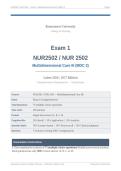
Exam 1
NUR2502 / NUR 2502
Multidimensional Care III (MDC 3)
Latest Edition
Comprehensive Examination — 75 Questions
Course: NUR2502 / NUR 2502 — Multidimensional Care III
Exam: Exam 1 (Comprehensive)
Total Questions: 75 multiple-choice questions
Time Limit: 150 minutes
Format: Single best answer (A, B, C, D)
Cognitive Mix: 25% Recall | 55% Application | 20% Analysis
Question Style: 70% Scenario-based | 20% Direct recall | 10% Clinical judgment
Sections: 7 sections covering MDC 3 competencies
Examination Instructions
1. This examination consists of 75 multiple-choice questions divided across seven sections.
Each question has only ONE correct answer (A, B, C, or D).
Rasmussen University College of Nursing — 2026/2027 Academic Year 75 Questions | 150 Minutes
,NUR2502 / NUR 2502 — Exam 1: Multidimensional Care III (MDC 3) Page 2
2. Sections are designed to assess all MDC 3 nursing competencies: oncology, hematologic,
immunologic, musculoskeletal, integumentary, sensory/neurological, and integrated
prioritization.
3. Read each question stem carefully. Many questions are scenario-based and require you
to integrate knowledge of pathophysiology, pharmacology, nursing interventions, and
prioritization.
4. Use the provided answer key and rationale at the end of the document for self-review.
Each rationale explains the correct answer, why distractors are incorrect, and the
underlying clinical reasoning.
5. Apply clinical judgment frameworks: ABC (Airway, Breathing, Circulation), Maslow's
hierarchy, acute vs. chronic, and unstable vs. stable prioritization.
6. Time management: budget approximately 2 minutes per question. Mark uncertain
questions and return to them later.
Rasmussen University College of Nursing — 2026/2027 Academic Year 75 Questions | 150 Minutes
,NUR2502 / NUR 2502 — Exam 1: Multidimensional Care III (MDC 3) Page 3
Section 1 — Oncology Nursing (Q1 — Q15)
Content Focus: Cancer pathophysiology (carcinogenesis, oncogenes, tumor suppressor genes),
benign vs. malignant, TNM staging, treatment modalities (surgery, radiation, chemotherapy,
targeted, immunotherapy, hormonal), oncologic emergencies (tumor lysis syndrome, superior vena
cava syndrome, spinal cord compression, neutropenic fever, hypercalcemia), and nursing care
across the cancer trajectory.
1. A 68-year-old patient with newly diagnosed lung cancer asks the oncology nurse about
the difference between benign and malignant tumors. Which response by the nurse is most
accurate?
A. Both benign and malignant tumors invade surrounding tissues and metastasize to distant
sites.
B. Benign tumors are poorly differentiated and grow rapidly, while malignant tumors are
well-differentiated and grow slowly.
C. Malignant tumors are encapsulated and remain localized, while benign tumors have
irregular borders.
D. Malignant tumors invade surrounding tissues and can metastasize, while benign tumors
are typically encapsulated and remain localized.
Correct Answer: D — Malignant tumors invade surrounding tissues and can metastasize,
while benign tumors are typically encapsulated and remain localized.
Rationale: Malignant tumors are characterized by uncontrolled growth, invasion of
surrounding tissues, metastasis to distant sites, poor differentiation, and rapid growth. Benign
tumors are encapsulated, remain localized, well-differentiated, and grow slowly. Distinguishing
these characteristics is essential in MDC 3 oncology nursing because they direct diagnostic
workup, staging, treatment planning, and prognosis. The other options reverse or distort these
defining features.
2. A nurse is teaching about carcinogenesis. Which statement correctly describes the
sequence of initiation, promotion, and progression?
A. Initiation involves exposure to carcinogens causing irreversible DNA mutation;
promotion involves clonal expansion of initiated cells; progression involves additional
mutations leading to malignancy.
B. Promotion occurs first with DNA mutations, followed by initiation with clonal
expansion, then progression.
C. Progression occurs first with metastasis, followed by initiation with DNA damage, then
promotion.
D. The order varies by cancer type and is unpredictable.
Correct Answer: A — Initiation involves exposure to carcinogens causing irreversible DNA
mutation; promotion involves clonal expansion of initiated cells; progression involves
additional mutations leading to malignancy.
Rationale: Carcinogenesis follows the sequence of initiation (irreversible DNA mutation from
carcinogen exposure), promotion (reversible clonal expansion of initiated cells), and
progression (additional mutations producing a malignant phenotype). This model helps nurses
Rasmussen University College of Nursing — 2026/2027 Academic Year 75 Questions | 150 Minutes
, NUR2502 / NUR 2502 — Exam 1: Multidimensional Care III (MDC 3) Page 4
counsel patients on cancer prevention — for example, smoking cessation interrupts promotion
even after initiation has occurred. The other options misorder the steps or claim
unpredictability that contradicts established oncologic science.
3. A 52-year-old female being evaluated for breast cancer has genetic testing revealing a
mutation in the BRCA1 gene. The nurse understands this gene is classified as which type?
A. Oncogene
B. DNA repair gene
C. Tumor suppressor gene
D. Apoptosis promoter gene
Correct Answer: C — Tumor suppressor gene
Rationale: BRCA1 and BRCA2 are tumor suppressor genes that normally repair DNA damage
and prevent uncontrolled cell growth. Loss-of-function mutations in these genes lead to
genomic instability and dramatically increased risk of breast and ovarian cancer. This contrasts
with oncogenes such as HER2/neu and RAS, which promote growth when activated, and DNA
repair genes such as those in Lynch syndrome. Understanding genetic classification guides risk
counseling, screening, and prophylactic decision-making in oncology nursing.
4. A patient with breast cancer has a TNM classification of T2 N1 M0. How should the nurse
interpret this staging?
A. Tumor size greater than 5 cm, no lymph node involvement, no distant metastasis.
B. Tumor size 2 to 5 cm, regional lymph node involvement, no distant metastasis.
C. Tumor size less than 2 cm, distant metastasis present, no lymph node involvement.
D. Carcinoma in situ, no lymph node involvement, distant metastasis present.
Correct Answer: B — Tumor size 2 to 5 cm, regional lymph node involvement, no distant
metastasis.
Rationale: In TNM staging, T2 indicates a primary tumor 2 to 5 cm in greatest dimension, N1
indicates involvement of mobile ipsilateral regional lymph nodes, and M0 indicates no distant
metastasis. Higher T, N, and M values correspond with more advanced disease and feed into the
overall stage grouping (Stages 0 through IV). TNM staging directly informs treatment
decisions — surgery vs. neoadjuvant chemotherapy vs. palliative care — and prognosis.
5. A patient is receiving external beam radiation therapy for head and neck cancer. Based
on the radiation field, which side effect should the nurse most anticipate?
A. Cardiotoxicity
B. Mucositis
C. Neurotoxicity
D. Hemorrhagic cystitis
Correct Answer: B — Mucositis
Rationale: External beam radiation to the head and neck commonly produces mucositis
because the rapidly dividing mucosal cells within the radiation field are damaged. Other
localized radiation effects include skin erythema, fatigue, and (with large fields) bone marrow
Rasmussen University College of Nursing — 2026/2027 Academic Year 75 Questions | 150 Minutes
Rasmussen University
College of Nursing
Exam 1
NUR2502 / NUR 2502
Multidimensional Care III (MDC 3)
Latest Edition
Comprehensive Examination — 75 Questions
Course: NUR2502 / NUR 2502 — Multidimensional Care III
Exam: Exam 1 (Comprehensive)
Total Questions: 75 multiple-choice questions
Time Limit: 150 minutes
Format: Single best answer (A, B, C, D)
Cognitive Mix: 25% Recall | 55% Application | 20% Analysis
Question Style: 70% Scenario-based | 20% Direct recall | 10% Clinical judgment
Sections: 7 sections covering MDC 3 competencies
Examination Instructions
1. This examination consists of 75 multiple-choice questions divided across seven sections.
Each question has only ONE correct answer (A, B, C, or D).
Rasmussen University College of Nursing — 2026/2027 Academic Year 75 Questions | 150 Minutes
,NUR2502 / NUR 2502 — Exam 1: Multidimensional Care III (MDC 3) Page 2
2. Sections are designed to assess all MDC 3 nursing competencies: oncology, hematologic,
immunologic, musculoskeletal, integumentary, sensory/neurological, and integrated
prioritization.
3. Read each question stem carefully. Many questions are scenario-based and require you
to integrate knowledge of pathophysiology, pharmacology, nursing interventions, and
prioritization.
4. Use the provided answer key and rationale at the end of the document for self-review.
Each rationale explains the correct answer, why distractors are incorrect, and the
underlying clinical reasoning.
5. Apply clinical judgment frameworks: ABC (Airway, Breathing, Circulation), Maslow's
hierarchy, acute vs. chronic, and unstable vs. stable prioritization.
6. Time management: budget approximately 2 minutes per question. Mark uncertain
questions and return to them later.
Rasmussen University College of Nursing — 2026/2027 Academic Year 75 Questions | 150 Minutes
,NUR2502 / NUR 2502 — Exam 1: Multidimensional Care III (MDC 3) Page 3
Section 1 — Oncology Nursing (Q1 — Q15)
Content Focus: Cancer pathophysiology (carcinogenesis, oncogenes, tumor suppressor genes),
benign vs. malignant, TNM staging, treatment modalities (surgery, radiation, chemotherapy,
targeted, immunotherapy, hormonal), oncologic emergencies (tumor lysis syndrome, superior vena
cava syndrome, spinal cord compression, neutropenic fever, hypercalcemia), and nursing care
across the cancer trajectory.
1. A 68-year-old patient with newly diagnosed lung cancer asks the oncology nurse about
the difference between benign and malignant tumors. Which response by the nurse is most
accurate?
A. Both benign and malignant tumors invade surrounding tissues and metastasize to distant
sites.
B. Benign tumors are poorly differentiated and grow rapidly, while malignant tumors are
well-differentiated and grow slowly.
C. Malignant tumors are encapsulated and remain localized, while benign tumors have
irregular borders.
D. Malignant tumors invade surrounding tissues and can metastasize, while benign tumors
are typically encapsulated and remain localized.
Correct Answer: D — Malignant tumors invade surrounding tissues and can metastasize,
while benign tumors are typically encapsulated and remain localized.
Rationale: Malignant tumors are characterized by uncontrolled growth, invasion of
surrounding tissues, metastasis to distant sites, poor differentiation, and rapid growth. Benign
tumors are encapsulated, remain localized, well-differentiated, and grow slowly. Distinguishing
these characteristics is essential in MDC 3 oncology nursing because they direct diagnostic
workup, staging, treatment planning, and prognosis. The other options reverse or distort these
defining features.
2. A nurse is teaching about carcinogenesis. Which statement correctly describes the
sequence of initiation, promotion, and progression?
A. Initiation involves exposure to carcinogens causing irreversible DNA mutation;
promotion involves clonal expansion of initiated cells; progression involves additional
mutations leading to malignancy.
B. Promotion occurs first with DNA mutations, followed by initiation with clonal
expansion, then progression.
C. Progression occurs first with metastasis, followed by initiation with DNA damage, then
promotion.
D. The order varies by cancer type and is unpredictable.
Correct Answer: A — Initiation involves exposure to carcinogens causing irreversible DNA
mutation; promotion involves clonal expansion of initiated cells; progression involves
additional mutations leading to malignancy.
Rationale: Carcinogenesis follows the sequence of initiation (irreversible DNA mutation from
carcinogen exposure), promotion (reversible clonal expansion of initiated cells), and
progression (additional mutations producing a malignant phenotype). This model helps nurses
Rasmussen University College of Nursing — 2026/2027 Academic Year 75 Questions | 150 Minutes
, NUR2502 / NUR 2502 — Exam 1: Multidimensional Care III (MDC 3) Page 4
counsel patients on cancer prevention — for example, smoking cessation interrupts promotion
even after initiation has occurred. The other options misorder the steps or claim
unpredictability that contradicts established oncologic science.
3. A 52-year-old female being evaluated for breast cancer has genetic testing revealing a
mutation in the BRCA1 gene. The nurse understands this gene is classified as which type?
A. Oncogene
B. DNA repair gene
C. Tumor suppressor gene
D. Apoptosis promoter gene
Correct Answer: C — Tumor suppressor gene
Rationale: BRCA1 and BRCA2 are tumor suppressor genes that normally repair DNA damage
and prevent uncontrolled cell growth. Loss-of-function mutations in these genes lead to
genomic instability and dramatically increased risk of breast and ovarian cancer. This contrasts
with oncogenes such as HER2/neu and RAS, which promote growth when activated, and DNA
repair genes such as those in Lynch syndrome. Understanding genetic classification guides risk
counseling, screening, and prophylactic decision-making in oncology nursing.
4. A patient with breast cancer has a TNM classification of T2 N1 M0. How should the nurse
interpret this staging?
A. Tumor size greater than 5 cm, no lymph node involvement, no distant metastasis.
B. Tumor size 2 to 5 cm, regional lymph node involvement, no distant metastasis.
C. Tumor size less than 2 cm, distant metastasis present, no lymph node involvement.
D. Carcinoma in situ, no lymph node involvement, distant metastasis present.
Correct Answer: B — Tumor size 2 to 5 cm, regional lymph node involvement, no distant
metastasis.
Rationale: In TNM staging, T2 indicates a primary tumor 2 to 5 cm in greatest dimension, N1
indicates involvement of mobile ipsilateral regional lymph nodes, and M0 indicates no distant
metastasis. Higher T, N, and M values correspond with more advanced disease and feed into the
overall stage grouping (Stages 0 through IV). TNM staging directly informs treatment
decisions — surgery vs. neoadjuvant chemotherapy vs. palliative care — and prognosis.
5. A patient is receiving external beam radiation therapy for head and neck cancer. Based
on the radiation field, which side effect should the nurse most anticipate?
A. Cardiotoxicity
B. Mucositis
C. Neurotoxicity
D. Hemorrhagic cystitis
Correct Answer: B — Mucositis
Rationale: External beam radiation to the head and neck commonly produces mucositis
because the rapidly dividing mucosal cells within the radiation field are damaged. Other
localized radiation effects include skin erythema, fatigue, and (with large fields) bone marrow
Rasmussen University College of Nursing — 2026/2027 Academic Year 75 Questions | 150 Minutes

