

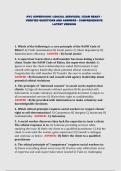
NYC SUPERVISOR I (SOCIAL SERVICES) | EXAM READY -
VERIFIED QUESTIONS AND ANSWERS - COMPREHENSIVE
LATEST VERSION
1. Which of the following is a core principle of the NASW Code of
Ethics? A) Profit maximization B) Social justice C) Client dependency D)
Administrative efficiency ANSWER : B) Social justice
2. A supervisor learns that a staff member has been dating a former
client. Under the NASW Code of Ethics, the supervisor should: A)
Ignore it since the client relationship has ended B) Document it and
consult with agency leadership about potential ethical violations C)
Congratulate the staff member D) Transfer the case to another worker
ANSWER : B) Document it and consult with agency leadership about
potential ethical violations
3. The principle of "informed consent" in social work requires that
clients: A) Sign all documents without question B) Be provided with
information to make voluntary and knowledgeable decisions C) Agree to
all recommended services D) Waive their right to confidentiality
ANSWER : B) Be provided with information to make voluntary and
knowledgeable decisions
4. Which ethical principle requires social workers to respect clients'
right to self-determination? A) Competence B) Integrity C) Autonomy D)
Confidentiality ANSWER : C) Autonomy
5. A social worker discovers they lack the expertise to treat a client.
The ethical response is to: A) Continue providing services while
studying the issue B) Refer the client to a qualified practitioner C) Ask the
client to wait until the worker gains experience D) Consult a colleague
and continue as before ANSWER : B) Refer the client to a qualified
practitioner
6. The ethical principle of "competence" requires social workers to:
A) Know everything about every issue B) Practice only within their areas
of expertise and seek supervision when needed C) Take on challenging
,cases to build skills D) Delegate all complex cases to supervisors
ANSWER : B) Practice only within their areas of expertise and seek
supervision when needed
7. Which of the following best describes the principle of "dignity and
worth of the person"? A) Treating all clients with respect and
recognizing their inherent value B) Ensuring clients follow all agency
rules C) Prioritizing agency goals over client needs D) Maintaining
professional distance at all times ANSWER : A) Treating all clients with
respect and recognizing their inherent value
8. A supervisor overhears a staff member making disparaging
comments about a client's religion. The supervisor should: A) Ignore
it if the client is not present B) Address it immediately as a violation of
ethical standards C) Wait for a formal complaint D) Document it only if
the client complains ANSWER : B) Address it immediately as a
violation of ethical standards
9. Dual relationships in social work are: A) Encouraged to build trust
B) Generally to be avoided as they may impair professional judgment C)
Required for comprehensive service delivery D) Only problematic if they
involve financial transactions ANSWER : B) Generally to be avoided as
they may impair professional judgment
10. The ethical principle of "integrity" requires social workers to: A)
Always agree with clients B) Act honestly and responsibly in professional
practice C) Prioritize agency policies over ethical concerns D) Maintain
emotional detachment from clients ANSWER : B) Act honestly and
responsibly in professional practice
11. When a client's goals conflict with agency policy, a social worker
should: A) Automatically follow agency policy B) Advocate for the client
while working within ethical and legal boundaries C) Terminate services
D) Ignore the conflict ANSWER : B) Advocate for the client while
working within ethical and legal boundaries
12. Cultural competence in social work includes: A) Treating all clients
the same regardless of background B) Understanding and respecting
diverse cultural backgrounds and their impact on service delivery C)
Learning one foreign language D) Following only Western therapeutic
models ANSWER : B) Understanding and respecting diverse cultural
backgrounds and their impact on service delivery
,13. A supervisor learns that a staff member accepted a $100 gift
from a client. The supervisor should: A) Allow it since it was a small
amount B) Review agency policy on gift acceptance and address the
ethical implications C) Accept the gift on behalf of the agency D) Ignore it
to avoid conflict ANSWER : B) Review agency policy on gift acceptance
and address the ethical implications
14. The "strengths perspective" in social work emphasizes: A)
Identifying client deficits and problems B) Building on client assets,
resources, and capabilities C) Focusing primarily on pathology D)
Comparing clients to normative standards ANSWER : B) Building on
client assets, resources, and capabilities
15. A social worker's primary obligation is to: A) The agency
employing them B) The client, within the bounds of professional ethics
and law C) The government funding source D) Their professional
colleagues ANSWER : B) The client, within the bounds of professional
ethics and law
16. Which of the following is NOT a core value of social work
according to the NASW Code of Ethics? A) Service B) Social justice C)
Profit D) Dignity and worth of the person ANSWER : C) Profit
17. Boundary crossings in the supervisory relationship: A) Are always
harmful B) May be benign but should be evaluated for potential harm C)
Are encouraged to build rapport D) Are only problematic if they become
sexual ANSWER : B) May be benign but should be evaluated for
potential harm
18. A supervisor should model ethical behavior by: A) Only following
rules when being observed B) Demonstrating honesty, transparency, and
respect in all interactions C) Prioritizing outcomes over process D)
Delegating all ethical decisions to agency counsel ANSWER : B)
Demonstrating honesty, transparency, and respect in all interactions
19. The principle of "least restrictive alternative" in social services
means: A) Using the most intensive intervention available B) Choosing
interventions that preserve client autonomy while ensuring safety C)
Avoiding all interventions D) Requiring court orders for all services
ANSWER : B) Choosing interventions that preserve client autonomy
while ensuring safety
, 20. A staff member discloses personal information about a client
during a staff meeting without the client's consent. This is a violation
of: A) Only agency policy B) Confidentiality and potentially law C)
Professional courtesy D) Teamwork expectations ANSWER : B)
Confidentiality and potentially law
21. Social workers have a duty to report unethical behavior by
colleagues when: A) It is minor and does not affect clients B) It causes
harm or poses a risk to clients or the profession C) They personally
dislike the colleague D) It is required by the colleague's supervisor
ANSWER : B) It causes harm or poses a risk to clients or the
profession
22. The "precautionary principle" in social work supervision
suggests: A) Taking risks with new interventions B) Erring on the side of
caution when client safety is at stake C) Avoiding documentation D)
Delegating all decisions to higher authority ANSWER : B) Erring on the
side of caution when client safety is at stake
23. A supervisor should address a staff member's burnout because:
A) It is the staff member's personal problem B) Burnout can impair
judgment and harm client care C) Burnout is not a real condition D) It
only affects productivity, not ethics ANSWER : B) Burnout can impair
judgment and harm client care
24. Which approach best aligns with ethical social work supervision?
A) Authoritarian and directive only B) Supportive, educational, and
focused on both client welfare and worker development C) Hands-off with
no oversight D) Focused solely on productivity metrics ANSWER : B)
Supportive, educational, and focused on both client welfare and
worker development
25. When a supervisor has concerns about a staff member's
competence, the first step should be: A) Terminate the staff member
immediately B) Provide additional training, supervision, and support C)
Reassign all their clients without discussion D) Report to the licensing
board immediately ANSWER : B) Provide additional training,
supervision, and support
26. The ethical concept of "fidelity" refers to: A) Being faithful to
agency budgets B) Keeping promises and being loyal to commitments
made to clients C) Following all laws regardless of ethics D) Maintaining
VERIFIED QUESTIONS AND ANSWERS - COMPREHENSIVE
LATEST VERSION
1. Which of the following is a core principle of the NASW Code of
Ethics? A) Profit maximization B) Social justice C) Client dependency D)
Administrative efficiency ANSWER : B) Social justice
2. A supervisor learns that a staff member has been dating a former
client. Under the NASW Code of Ethics, the supervisor should: A)
Ignore it since the client relationship has ended B) Document it and
consult with agency leadership about potential ethical violations C)
Congratulate the staff member D) Transfer the case to another worker
ANSWER : B) Document it and consult with agency leadership about
potential ethical violations
3. The principle of "informed consent" in social work requires that
clients: A) Sign all documents without question B) Be provided with
information to make voluntary and knowledgeable decisions C) Agree to
all recommended services D) Waive their right to confidentiality
ANSWER : B) Be provided with information to make voluntary and
knowledgeable decisions
4. Which ethical principle requires social workers to respect clients'
right to self-determination? A) Competence B) Integrity C) Autonomy D)
Confidentiality ANSWER : C) Autonomy
5. A social worker discovers they lack the expertise to treat a client.
The ethical response is to: A) Continue providing services while
studying the issue B) Refer the client to a qualified practitioner C) Ask the
client to wait until the worker gains experience D) Consult a colleague
and continue as before ANSWER : B) Refer the client to a qualified
practitioner
6. The ethical principle of "competence" requires social workers to:
A) Know everything about every issue B) Practice only within their areas
of expertise and seek supervision when needed C) Take on challenging
,cases to build skills D) Delegate all complex cases to supervisors
ANSWER : B) Practice only within their areas of expertise and seek
supervision when needed
7. Which of the following best describes the principle of "dignity and
worth of the person"? A) Treating all clients with respect and
recognizing their inherent value B) Ensuring clients follow all agency
rules C) Prioritizing agency goals over client needs D) Maintaining
professional distance at all times ANSWER : A) Treating all clients with
respect and recognizing their inherent value
8. A supervisor overhears a staff member making disparaging
comments about a client's religion. The supervisor should: A) Ignore
it if the client is not present B) Address it immediately as a violation of
ethical standards C) Wait for a formal complaint D) Document it only if
the client complains ANSWER : B) Address it immediately as a
violation of ethical standards
9. Dual relationships in social work are: A) Encouraged to build trust
B) Generally to be avoided as they may impair professional judgment C)
Required for comprehensive service delivery D) Only problematic if they
involve financial transactions ANSWER : B) Generally to be avoided as
they may impair professional judgment
10. The ethical principle of "integrity" requires social workers to: A)
Always agree with clients B) Act honestly and responsibly in professional
practice C) Prioritize agency policies over ethical concerns D) Maintain
emotional detachment from clients ANSWER : B) Act honestly and
responsibly in professional practice
11. When a client's goals conflict with agency policy, a social worker
should: A) Automatically follow agency policy B) Advocate for the client
while working within ethical and legal boundaries C) Terminate services
D) Ignore the conflict ANSWER : B) Advocate for the client while
working within ethical and legal boundaries
12. Cultural competence in social work includes: A) Treating all clients
the same regardless of background B) Understanding and respecting
diverse cultural backgrounds and their impact on service delivery C)
Learning one foreign language D) Following only Western therapeutic
models ANSWER : B) Understanding and respecting diverse cultural
backgrounds and their impact on service delivery
,13. A supervisor learns that a staff member accepted a $100 gift
from a client. The supervisor should: A) Allow it since it was a small
amount B) Review agency policy on gift acceptance and address the
ethical implications C) Accept the gift on behalf of the agency D) Ignore it
to avoid conflict ANSWER : B) Review agency policy on gift acceptance
and address the ethical implications
14. The "strengths perspective" in social work emphasizes: A)
Identifying client deficits and problems B) Building on client assets,
resources, and capabilities C) Focusing primarily on pathology D)
Comparing clients to normative standards ANSWER : B) Building on
client assets, resources, and capabilities
15. A social worker's primary obligation is to: A) The agency
employing them B) The client, within the bounds of professional ethics
and law C) The government funding source D) Their professional
colleagues ANSWER : B) The client, within the bounds of professional
ethics and law
16. Which of the following is NOT a core value of social work
according to the NASW Code of Ethics? A) Service B) Social justice C)
Profit D) Dignity and worth of the person ANSWER : C) Profit
17. Boundary crossings in the supervisory relationship: A) Are always
harmful B) May be benign but should be evaluated for potential harm C)
Are encouraged to build rapport D) Are only problematic if they become
sexual ANSWER : B) May be benign but should be evaluated for
potential harm
18. A supervisor should model ethical behavior by: A) Only following
rules when being observed B) Demonstrating honesty, transparency, and
respect in all interactions C) Prioritizing outcomes over process D)
Delegating all ethical decisions to agency counsel ANSWER : B)
Demonstrating honesty, transparency, and respect in all interactions
19. The principle of "least restrictive alternative" in social services
means: A) Using the most intensive intervention available B) Choosing
interventions that preserve client autonomy while ensuring safety C)
Avoiding all interventions D) Requiring court orders for all services
ANSWER : B) Choosing interventions that preserve client autonomy
while ensuring safety
, 20. A staff member discloses personal information about a client
during a staff meeting without the client's consent. This is a violation
of: A) Only agency policy B) Confidentiality and potentially law C)
Professional courtesy D) Teamwork expectations ANSWER : B)
Confidentiality and potentially law
21. Social workers have a duty to report unethical behavior by
colleagues when: A) It is minor and does not affect clients B) It causes
harm or poses a risk to clients or the profession C) They personally
dislike the colleague D) It is required by the colleague's supervisor
ANSWER : B) It causes harm or poses a risk to clients or the
profession
22. The "precautionary principle" in social work supervision
suggests: A) Taking risks with new interventions B) Erring on the side of
caution when client safety is at stake C) Avoiding documentation D)
Delegating all decisions to higher authority ANSWER : B) Erring on the
side of caution when client safety is at stake
23. A supervisor should address a staff member's burnout because:
A) It is the staff member's personal problem B) Burnout can impair
judgment and harm client care C) Burnout is not a real condition D) It
only affects productivity, not ethics ANSWER : B) Burnout can impair
judgment and harm client care
24. Which approach best aligns with ethical social work supervision?
A) Authoritarian and directive only B) Supportive, educational, and
focused on both client welfare and worker development C) Hands-off with
no oversight D) Focused solely on productivity metrics ANSWER : B)
Supportive, educational, and focused on both client welfare and
worker development
25. When a supervisor has concerns about a staff member's
competence, the first step should be: A) Terminate the staff member
immediately B) Provide additional training, supervision, and support C)
Reassign all their clients without discussion D) Report to the licensing
board immediately ANSWER : B) Provide additional training,
supervision, and support
26. The ethical concept of "fidelity" refers to: A) Being faithful to
agency budgets B) Keeping promises and being loyal to commitments
made to clients C) Following all laws regardless of ethics D) Maintaining

