

Escrito por estudiantes que aprobaron Inmediatamente disponible después del pago Leer en línea o como PDF ¿Documento equivocado? Cámbialo gratis 4,6 TrustPilot
logo-home
Document preview thumbnail
Vista previa 2 fuera de 5 páginas
Examen

CS 159 Lab 12 Exam Questions and Answers | 30+ Practice Questions | Pointers, Arrays, Pointer Arithmetic, Dynamic Memory Allocation & malloc

Document preview thumbnail
Vista previa 2 fuera de 5 páginas

Prepare effectively for CS 159 Lab 12 with this comprehensive collection of 30+ exam-style questions and verified answers covering the fundamental concepts of C programming pointers, arrays, pointer arithmetic, memory management, and dynamic memory allocation. This study guide is presented in a structured true/false and concept-review format, providing a focused review of pointer operations, dereferencing, array manipulation, function pointers, memory allocation, and standard library functions commonly assessed in programming labs, quizzes, and final examinations. It is an excellent resource for reinforcing core programming concepts and preparing for practical coding assessments. The material provides in-depth coverage of pointer variables, memory addresses, pointer initialization, dereferencing, indirection operator (*), address operator (&), pointer assignment, pointer arithmetic, arrays as pointer constants, array indexing, array traversal using pointers, function arguments passed by address, functions returning pointers, pointer expressions, array and pointer equivalence, static memory allocation, dynamic memory allocation, heap memory, malloc(), sizeof operator, stdlib.h, memory allocation functions, and memory management fundamentals. It also demonstrates how arrays can be accessed using pointer arithmetic and explains the relationship between pointers, arrays, and function calls in the C programming language. The question-and-answer format promotes active recall while strengthening students' understanding of low-level memory concepts and pointer operations essential for C programming proficiency. The content aligns closely with the concepts presented in Deitel, P., & Deitel, H. (2021). C How to Program (9th ed.). Pearson, which provides comprehensive coverage of pointers, arrays, dynamic memory allocation, and memory management in C. It also reflects the principles described in King, K. N. (2008). C Programming: A Modern Approach (2nd ed.). W. W. Norton & Company, a widely adopted textbook covering pointer manipulation, pointer arithmetic, arrays, functions, and dynamic memory allocation using the C Standard Library. Relevant Students: CS 159 students, Computer Science students, Software Engineering students, Computer Engineering students, Programming Fundamentals students, C Programming students, Systems Programming students, Embedded Systems students, Information Technology students, Coding Bootcamp students, undergraduate computer science majors, and students preparing for C programming labs, quizzes, practical coding assessments, and final examinations. Keywords: CS 159, CS159, Lab 12, C Programming, C Language, Programming Fundamentals, Pointers, Pointer Variables, Pointer Initialization, Memory Address, Memory Management, Dereferencing, Indirection Operator, Address Operator, Pointer Arithmetic, Arrays, Array Indexing, Array Traversal, Pointer Expressions, Pointer Constants, Array Pointers, Function Pointers, Pass by Address, Functions Returning Pointers, Static Memory Allocation, Dynamic Memory Allocation, Heap Memory, malloc, stdlib.h, sizeof Operator, Memory Allocation, Pointer and Array Relationship, C Arrays, C Functions, Low Level Programming, Practice Questions, Exam Questions, Programming Study Guide

Vista previa del contenido

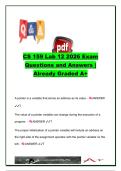
CS 159 Lab 12 2026 Exam
Questions and Answers |
Already Graded A+


A pointer is a variable that stores an address as its value - ANSWER

✔✔T


The value of a pointer variable can change during the execution of a

program. - ANSWER ✔✔T


The proper initialization of a pointer variable will include an address on

the right side of the assignment operator with the pointer variable on the

left - ANSWER ✔✔T

, The indirection operator (*) is a unary operator whose operand must be

a pointer value. - ANSWER ✔✔T


The act of dereferencing a pointer variable permits access to the value

at the memory location to which the pointer variable points (or refers). -

ANSWER ✔✔T


The asterisk character (*) is used in two different contexts for pointer

variables; for declaration and for dereferencing. - ANSWER ✔✔T


The indirection and address operators are the inverse of each other and

when combined in an expression they cancel each other. - ANSWER

✔✔T


Working with an uninitialized pointer variable is a logical error. -

ANSWER ✔✔T


Every time we want a called function to access a variable in the calling

function we pass the address of that variable to the called function -

ANSWER ✔✔T


A user-defined function may be declared to return a pointer value -

ANSWER ✔✔T


The name of an array is a pointer constant to its first element. -

ANSWER ✔✔T

Información del documento

Subido en
28 de julio de 2026
Número de páginas
5
Escrito en
2025/2026
Tipo
Examen
Contiene
Preguntas y respuestas
$18.99

¿Documento equivocado? Cámbialo gratis Dentro de los 14 días posteriores a la compra y antes de descargarlo, puedes elegir otro documento. Puedes gastar el importe de nuevo.
Escrito por estudiantes que aprobaron
Inmediatamente disponible después del pago
Leer en línea o como PDF

Seller avatar
Los indicadores de reputación están sujetos a la cantidad de artículos vendidos por una tarifa y las reseñas que ha recibido por esos documentos. Hay tres niveles: Bronce, Plata y Oro. Cuanto mayor reputación, más podrás confiar en la calidad del trabajo del vendedor.
JOSHCLAY
3.5
(82)
Vendido
368
Seguidores
16
Artículos
20078
Última venta
4 horas hace


Por qué los estudiantes eligen Stuvia

Creado por compañeros estudiantes, verificado por reseñas

Calidad en la que puedes confiar: escrito por estudiantes que aprobaron y evaluado por otros que han usado estos resúmenes.

¿No estás satisfecho? Elige otro documento

¡No te preocupes! Puedes elegir directamente otro documento que se ajuste mejor a lo que buscas.

Paga como quieras, empieza a estudiar al instante

Sin suscripción, sin compromisos. Paga como estés acostumbrado con tarjeta de crédito y descarga tu documento PDF inmediatamente.

Student with book image

“Comprado, descargado y aprobado. Así de fácil puede ser.”

Alisha Student

Preguntas frecuentes
