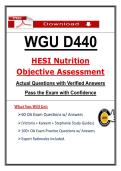
WGU D440
HESI Nutrition
Objective Assessment
Actual Questions with Verified Answers
Pass the Exam with Confidence
What You Will Get:
➢60 OA Exam Questions w/ Answers
➢ (Victoria + Kareem + Stephanie Study Guides)
➢ 100+ OA Exam Practice Questions w/ Answers
➢ Expert Rationales included.
, Preview Pages Below
Get the Complete PDF After Purchase
"If you require further clarification or in need of any study resources, feel
free to Message me."
Digital preview sample
,Table of Contents
D440 HESI Nutrition OA Exam .............................................. 2
D440 HESI OA Exam Practice QS ......................................... 41
D440 HESI OA Exam Study Guide ....................................... 85
D440 HESI Nutrition OA Exam
Case Study: Postoperative Dietary Management
A nurse is providing discharge instructions to a client who underwent a
laparoscopic cholecystectomy earlier in the week. The client asks for specific
guidance on dietary modifications to prevent complications during recovery.
Question 1. Which dietary instruction should the nurse include in the discharge
teaching plan?
A. Maintain a low-fat diet for 6 weeks to reduce bile demand
B. Follow a high-protein, high-calorie diet to promote incision healing
C. Begin a clear liquid diet for the first 2 weeks post-discharge
D. Avoid all dairy products permanently to prevent gallstone recurrence
Correct Answer: A
Rationale:
After laparoscopic cholecystectomy, the liver continues to produce bile but no
longer stores it in a concentrated form. A low-fat diet for approximately 4–6 weeks
reduces the demand for bile and minimizes gastrointestinal distress, bloating, and
diarrhea. Option B is incorrect because while protein is important, high-fat
,content would strain the digestive system. Option C is unnecessary beyond the
immediate postoperative period. Option D is incorrect because dairy avoidance is
not required unless the client has concurrent lactose intolerance.
Question 2. A client hospitalized with partial-thickness and full-thickness burns
to both legs is prescribed a high-calorie, high-protein diet. Which breakfast
selection should the nurse encourage the client to consume?
A. Oatmeal with sliced banana and herbal tea
B. Scrambled eggs, sausage, and orange juice
C. Whole wheat toast with jelly and black coffee
D. Fresh fruit salad with low-fat yogurt
Correct Answer: B
Rationale:
Burn injuries create a hypermetabolic state with significant protein and calorie
losses through wound exudate. Scrambled eggs and sausage provide high
biological value protein and calories necessary for wound healing and tissue
regeneration. Orange juice offers vitamin C for collagen synthesis. Option A lacks
adequate protein. Option C is insufficient in protein and calories. Option D is too
low in protein and energy density for burn recovery needs.
Question 3. A nurse instructs a client with type 2 diabetes mellitus to avoid
refined sugars and simple carbohydrates. Which food selection indicates the
client understands the dietary teaching?
A. White rice with stir-fried vegetables
B. Avocado slices with lemon juice
C. Baked potato with sour cream
D. Pretzels with hummus
,Correct Answer: B
Rationale:
Avocado is rich in monounsaturated fats and fiber with minimal carbohydrate
impact, making it ideal for glycemic control. White rice (A), baked potatoes (C),
and pretzels (D) are high in carbohydrates that rapidly convert to glucose,
potentially causing hyperglycemia. The nurse should reinforce that healthy fats
and fiber slow glucose absorption.
Question 4. A client scheduled for abdominal surgery later today is prescribed a
clear liquid breakfast. The client requests a small cup of chocolate ice cream.
Which action should the nurse take?
A. Provide the ice cream because it melts into a liquid at room temperature
B. Explain that a popsicle or gelatin cup can be offered instead
C. Notify the surgeon that the client is noncompliant with NPO status
D. Allow the ice cream because it provides needed calories before surgery
Correct Answer: B
Rationale:
Clear liquid diets include transparent or translucent foods that leave minimal
residue, such as water, clear broths, gelatin, and popsicles. Chocolate ice cream is
not considered a clear liquid because it contains milk fat, cocoa solids, and residue
that increases aspiration risk and gastric volume. Option B provides an
appropriate therapeutic alternative while maintaining preoperative safety.
Question 5. A client with glomerulonephritis is preparing for discharge and asks
which diet to follow at home. Which dietary teaching should the nurse
prioritize?
,and is rich in fiber and healthy fats, resulting in a very low glycemic impact.
Unlimited fruit (A) is incorrect because fructose still raises blood glucose.
Eliminating all carbohydrates (C) is unsafe and unnecessary. White rice (D) has a
significantly higher glycemic index than brown rice due to fiber and nutrient
removal during processing.
D440 HESI OA Exam Practice QS
A young mother of three children complains of increased anxiety during her
annual physical exam. What information should the nurse obtain first?
A. Sexual activity patterns
B. Nutritional history
C. leisure activities
D. financial stressors
B. Nutritional history.
The nurse is using a genogram while conducting a client's health assessment
and past medical history. What information should the genogram provide?
A. genetic and familial health disorders.
B. chronic health problems
C. reason for seeking health care
D. undetected disorders
A. genetic and familial health disorders
The nurse is teaching a client with numerous allergies how to avoid allergens.
Which instruction should be included in this teaching plan?
A. avoid any types of sprays, powders, and perfumes
B. wearing a mask while cleaning will not help to avoid allergens.
C. purchase any type of clothing, but be sure it is washed before wearing it.
D. pollen count is related to hay fever, not to allergens
A. Avoid any types of sprays, powders, and perfumes.
The nurse is caring for a client who is receiving 24-hour total parenteral nutrition
(TPN) via a central line at 54 ml/hr. When initially assessing the client, the nurse
notes that the TPN solution has run out and the next TPN solution is not
,available. What immediate action should the nurse take?
A. infuse normal saline at a keep vein open rate
B. discontinue the IV and flush the port with heparin
C. infuse 10% dextrose and water at 54 ml/hr
D. obtain a stat blood glucose level and notify the healthcare provider
C. Infuse 10% dextrose and water at 54 ml/hr.
The nurse observes an unlicensed assistive personnel (UAP) taking a client's
blood pressure with a cuff that is too small, but the blood pressure reading
obtained is within the client's usual range. What action is most important for the
nurse to implement?
A. tell the UAP to use a larger cuff at the next scheduled assessment
B. reassess the client's blood pressure using a larger cuff
C. have the unit educator review this procedure with the UAPs
D. Teach the UAP the correct technique for assessing blood pressure.
B. Reassess the client's blood pressure using a larger cuff
A client with acute hemorrhagic anemia is to receive four units of packed RBCs
as rapidly as possible. Which intervention is most important for the nurse to
implement?
A. obtain the pre-transfusion hemoglobin level
B. prime tubing and prepare a blood pump set-up
C. monitor vital signs q15 minutes for the first hour
D. ensure the accuracy of the blood type match
D. ensure the accuracy of the blood type match
An obese male client discusses with the nurse his plans to begin a longterm
weight loss regimen. In addition to dietary changes, he plans to begin an
intensive aerobic exercise program 3 to 4 times a week and to take stress
management classes. After praising the client for his decision, which instruction
is most important for the nurse to provide?
A. "be sure to have a complete physical examination before beginning your
planned exercise program"
B. "be careful that the exercise program doesn't simply add to your stress level,
making you want to eat more."
C. "increased exercise helps to reduce stress, so you may not need to spend
money on a stress management class"
D. "make sure to monitor your weight loss regularly to provide a sense of
accomplishment and motivation"
, D440 HESI OA Exam Study Guide
WGU HESI Nutrition - D440 (Victoria + Kareem + Stephanie Study Guides)
Know blood tests test nutritional status: ...
BMI and albumin
PT who has issues swallowing (dysphagia) will always be the most at risk for ...
nutrition deficiency.
Which patient would need more water?
(A. Breastfeeding)
know what diet for a pt who lost their dentures would be on
mechanical soft
Athletic patient complains with leg cramps due to low calcium, offer...
broccoli, cheese.
Know nutrient dense foods.
???
Folic acid Is found in ....
yogurt.
1 oz = ? mL
30 ml
1 cup = ? oz
,8 oz
BMI Ranges:
18.5-24.9 = normal
25-29.9 = overweight
30 and over = obese
(these values were on test)
Fat = ? per gram
Carbs = ? per gram
Protein = ? per gram
9
4
4
Glomerulonephritis diet: caused by untreated strep (a kidney disease)
Fluid restriction
Sodium restriction (salty meats & processed foods)
Decrease Protein
Increase carbs (Carbs provide energy and stop the breakdown of proteins)
Renal Disease diet
fluid restriction, Low sodium, Low protein, low potassium, high calcium
Urinary Tract infections (UTI) diet:
Cranberries, blueberries, raspberries, and other berries, probiotics (yogurt)
Avoid foods and drinks that cause bladder irritation, such as coffee, tea, soft drinks, and
chocolate, avoid smoking.
Diabetic needs to drink sugar-free cranberry juices
Heart Failure diet
Fluid restriction (spread out fluids during the day & suck on hard candy to decrease
thirst)
Decrease sodium, fat, & cholesterol
Heart Health Diet:
, Decrease in saturated fats
Increase in Fiber
DASH Diet: aims to lower BP and LDL
Low sodium, low fat, high calcium, high potassium, high fiber
4-6 servings of fruits and veggies*
Celiac Disease diet:
Gluten free diet
No "BROW"
Barley Rye Oats Wheats
Ice cream, malted milk, prepared puddings, grains anything including made from wheat,
rye, oats, or barley, such as breads, rolls, cookies, cakes, crackers, cereal, spaghetti,
macaroni noodles, beer, and ale, oatmeal
Stomatitis diet: Inflammation of the oral mucous lining of the mouth
Soft and easy to eat foods, eat food at room temp., high protein & calorie, avoid alcohol
and spicy foods
Peritonitis diet: inflammation of the lining of stomach
Eat foods high in B-vitamins and calcium, such as almonds, beans, whole grains (if no
allergy), dark leafy greens (spinach and kale), and sea vegetables. Avoid refined foods,
such as white breads, pastas, and especially sugar. Use healthy oils in foods, such as
olive oil or vegetable oil
Cholecystitis diet:
low fat, high fiber and protein and carbs
avoid gassy foods like broccoli.
Diverticulitis:
High fiber, no nuts/seeds
Hemorrhoids diet:
Increase fiber and increase fluid intake.
Diabetes diet:
HESI Nutrition
Objective Assessment
Actual Questions with Verified Answers
Pass the Exam with Confidence
What You Will Get:
➢60 OA Exam Questions w/ Answers
➢ (Victoria + Kareem + Stephanie Study Guides)
➢ 100+ OA Exam Practice Questions w/ Answers
➢ Expert Rationales included.
, Preview Pages Below
Get the Complete PDF After Purchase
"If you require further clarification or in need of any study resources, feel
free to Message me."
Digital preview sample
,Table of Contents
D440 HESI Nutrition OA Exam .............................................. 2
D440 HESI OA Exam Practice QS ......................................... 41
D440 HESI OA Exam Study Guide ....................................... 85
D440 HESI Nutrition OA Exam
Case Study: Postoperative Dietary Management
A nurse is providing discharge instructions to a client who underwent a
laparoscopic cholecystectomy earlier in the week. The client asks for specific
guidance on dietary modifications to prevent complications during recovery.
Question 1. Which dietary instruction should the nurse include in the discharge
teaching plan?
A. Maintain a low-fat diet for 6 weeks to reduce bile demand
B. Follow a high-protein, high-calorie diet to promote incision healing
C. Begin a clear liquid diet for the first 2 weeks post-discharge
D. Avoid all dairy products permanently to prevent gallstone recurrence
Correct Answer: A
Rationale:
After laparoscopic cholecystectomy, the liver continues to produce bile but no
longer stores it in a concentrated form. A low-fat diet for approximately 4–6 weeks
reduces the demand for bile and minimizes gastrointestinal distress, bloating, and
diarrhea. Option B is incorrect because while protein is important, high-fat
,content would strain the digestive system. Option C is unnecessary beyond the
immediate postoperative period. Option D is incorrect because dairy avoidance is
not required unless the client has concurrent lactose intolerance.
Question 2. A client hospitalized with partial-thickness and full-thickness burns
to both legs is prescribed a high-calorie, high-protein diet. Which breakfast
selection should the nurse encourage the client to consume?
A. Oatmeal with sliced banana and herbal tea
B. Scrambled eggs, sausage, and orange juice
C. Whole wheat toast with jelly and black coffee
D. Fresh fruit salad with low-fat yogurt
Correct Answer: B
Rationale:
Burn injuries create a hypermetabolic state with significant protein and calorie
losses through wound exudate. Scrambled eggs and sausage provide high
biological value protein and calories necessary for wound healing and tissue
regeneration. Orange juice offers vitamin C for collagen synthesis. Option A lacks
adequate protein. Option C is insufficient in protein and calories. Option D is too
low in protein and energy density for burn recovery needs.
Question 3. A nurse instructs a client with type 2 diabetes mellitus to avoid
refined sugars and simple carbohydrates. Which food selection indicates the
client understands the dietary teaching?
A. White rice with stir-fried vegetables
B. Avocado slices with lemon juice
C. Baked potato with sour cream
D. Pretzels with hummus
,Correct Answer: B
Rationale:
Avocado is rich in monounsaturated fats and fiber with minimal carbohydrate
impact, making it ideal for glycemic control. White rice (A), baked potatoes (C),
and pretzels (D) are high in carbohydrates that rapidly convert to glucose,
potentially causing hyperglycemia. The nurse should reinforce that healthy fats
and fiber slow glucose absorption.
Question 4. A client scheduled for abdominal surgery later today is prescribed a
clear liquid breakfast. The client requests a small cup of chocolate ice cream.
Which action should the nurse take?
A. Provide the ice cream because it melts into a liquid at room temperature
B. Explain that a popsicle or gelatin cup can be offered instead
C. Notify the surgeon that the client is noncompliant with NPO status
D. Allow the ice cream because it provides needed calories before surgery
Correct Answer: B
Rationale:
Clear liquid diets include transparent or translucent foods that leave minimal
residue, such as water, clear broths, gelatin, and popsicles. Chocolate ice cream is
not considered a clear liquid because it contains milk fat, cocoa solids, and residue
that increases aspiration risk and gastric volume. Option B provides an
appropriate therapeutic alternative while maintaining preoperative safety.
Question 5. A client with glomerulonephritis is preparing for discharge and asks
which diet to follow at home. Which dietary teaching should the nurse
prioritize?
,and is rich in fiber and healthy fats, resulting in a very low glycemic impact.
Unlimited fruit (A) is incorrect because fructose still raises blood glucose.
Eliminating all carbohydrates (C) is unsafe and unnecessary. White rice (D) has a
significantly higher glycemic index than brown rice due to fiber and nutrient
removal during processing.
D440 HESI OA Exam Practice QS
A young mother of three children complains of increased anxiety during her
annual physical exam. What information should the nurse obtain first?
A. Sexual activity patterns
B. Nutritional history
C. leisure activities
D. financial stressors
B. Nutritional history.
The nurse is using a genogram while conducting a client's health assessment
and past medical history. What information should the genogram provide?
A. genetic and familial health disorders.
B. chronic health problems
C. reason for seeking health care
D. undetected disorders
A. genetic and familial health disorders
The nurse is teaching a client with numerous allergies how to avoid allergens.
Which instruction should be included in this teaching plan?
A. avoid any types of sprays, powders, and perfumes
B. wearing a mask while cleaning will not help to avoid allergens.
C. purchase any type of clothing, but be sure it is washed before wearing it.
D. pollen count is related to hay fever, not to allergens
A. Avoid any types of sprays, powders, and perfumes.
The nurse is caring for a client who is receiving 24-hour total parenteral nutrition
(TPN) via a central line at 54 ml/hr. When initially assessing the client, the nurse
notes that the TPN solution has run out and the next TPN solution is not
,available. What immediate action should the nurse take?
A. infuse normal saline at a keep vein open rate
B. discontinue the IV and flush the port with heparin
C. infuse 10% dextrose and water at 54 ml/hr
D. obtain a stat blood glucose level and notify the healthcare provider
C. Infuse 10% dextrose and water at 54 ml/hr.
The nurse observes an unlicensed assistive personnel (UAP) taking a client's
blood pressure with a cuff that is too small, but the blood pressure reading
obtained is within the client's usual range. What action is most important for the
nurse to implement?
A. tell the UAP to use a larger cuff at the next scheduled assessment
B. reassess the client's blood pressure using a larger cuff
C. have the unit educator review this procedure with the UAPs
D. Teach the UAP the correct technique for assessing blood pressure.
B. Reassess the client's blood pressure using a larger cuff
A client with acute hemorrhagic anemia is to receive four units of packed RBCs
as rapidly as possible. Which intervention is most important for the nurse to
implement?
A. obtain the pre-transfusion hemoglobin level
B. prime tubing and prepare a blood pump set-up
C. monitor vital signs q15 minutes for the first hour
D. ensure the accuracy of the blood type match
D. ensure the accuracy of the blood type match
An obese male client discusses with the nurse his plans to begin a longterm
weight loss regimen. In addition to dietary changes, he plans to begin an
intensive aerobic exercise program 3 to 4 times a week and to take stress
management classes. After praising the client for his decision, which instruction
is most important for the nurse to provide?
A. "be sure to have a complete physical examination before beginning your
planned exercise program"
B. "be careful that the exercise program doesn't simply add to your stress level,
making you want to eat more."
C. "increased exercise helps to reduce stress, so you may not need to spend
money on a stress management class"
D. "make sure to monitor your weight loss regularly to provide a sense of
accomplishment and motivation"
, D440 HESI OA Exam Study Guide
WGU HESI Nutrition - D440 (Victoria + Kareem + Stephanie Study Guides)
Know blood tests test nutritional status: ...
BMI and albumin
PT who has issues swallowing (dysphagia) will always be the most at risk for ...
nutrition deficiency.
Which patient would need more water?
(A. Breastfeeding)
know what diet for a pt who lost their dentures would be on
mechanical soft
Athletic patient complains with leg cramps due to low calcium, offer...
broccoli, cheese.
Know nutrient dense foods.
???
Folic acid Is found in ....
yogurt.
1 oz = ? mL
30 ml
1 cup = ? oz
,8 oz
BMI Ranges:
18.5-24.9 = normal
25-29.9 = overweight
30 and over = obese
(these values were on test)
Fat = ? per gram
Carbs = ? per gram
Protein = ? per gram
9
4
4
Glomerulonephritis diet: caused by untreated strep (a kidney disease)
Fluid restriction
Sodium restriction (salty meats & processed foods)
Decrease Protein
Increase carbs (Carbs provide energy and stop the breakdown of proteins)
Renal Disease diet
fluid restriction, Low sodium, Low protein, low potassium, high calcium
Urinary Tract infections (UTI) diet:
Cranberries, blueberries, raspberries, and other berries, probiotics (yogurt)
Avoid foods and drinks that cause bladder irritation, such as coffee, tea, soft drinks, and
chocolate, avoid smoking.
Diabetic needs to drink sugar-free cranberry juices
Heart Failure diet
Fluid restriction (spread out fluids during the day & suck on hard candy to decrease
thirst)
Decrease sodium, fat, & cholesterol
Heart Health Diet:
, Decrease in saturated fats
Increase in Fiber
DASH Diet: aims to lower BP and LDL
Low sodium, low fat, high calcium, high potassium, high fiber
4-6 servings of fruits and veggies*
Celiac Disease diet:
Gluten free diet
No "BROW"
Barley Rye Oats Wheats
Ice cream, malted milk, prepared puddings, grains anything including made from wheat,
rye, oats, or barley, such as breads, rolls, cookies, cakes, crackers, cereal, spaghetti,
macaroni noodles, beer, and ale, oatmeal
Stomatitis diet: Inflammation of the oral mucous lining of the mouth
Soft and easy to eat foods, eat food at room temp., high protein & calorie, avoid alcohol
and spicy foods
Peritonitis diet: inflammation of the lining of stomach
Eat foods high in B-vitamins and calcium, such as almonds, beans, whole grains (if no
allergy), dark leafy greens (spinach and kale), and sea vegetables. Avoid refined foods,
such as white breads, pastas, and especially sugar. Use healthy oils in foods, such as
olive oil or vegetable oil
Cholecystitis diet:
low fat, high fiber and protein and carbs
avoid gassy foods like broccoli.
Diverticulitis:
High fiber, no nuts/seeds
Hemorrhoids diet:
Increase fiber and increase fluid intake.
Diabetes diet: