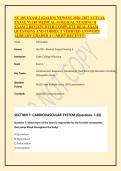
NU 185 EXAM 2 (GALEN) NEWEST 2026/ 2027 ACTUAL
EXAM| NU185 MEDICAL-SURGICAL NURSING II
EXAM 2 REVIEW WITH COMPLETE REAL EXAM
QUESTIONS AND CORRECT VERIFIED ANSWERS/
ALREADY GRADED A+ (MOST RECENT!!)
Detail Information
Course NU 185 – Medical-Surgical Nursing II
Institution Galen College of Nursing
Exam Exam 2
Cardiovascular, Respiratory, Hematologic, Fluid/Electrolyte Disorders, Immobility,
Key Topics
Orthopedics, Burns
Question
NCLEX-style multiple choice, SATA, prioritization
Format
Test Bank 2026/2027 Actual Questions
SECTION 1: CARDIOVASCULAR SYSTEM (Questions 1-20)
Question 1: Which layer of the heart is responsible for the forceful contractions
that pump blood throughout the body?
A) Epicardium
B) Myocardium
C) Endocardium
D) Pericardium
,Answer: B. Myocardium
Rationale: The myocardium is the thick muscular middle layer responsible for the
heart's contractions and pumping action. The epicardium is the outer layer, the
endocardium lines the interior, and the pericardium is the sac enclosing the heart .
Question 2: Which of the following correctly describes the flow of oxygenated
blood?
A) Right atrium → right ventricle → pulmonary artery
B) Pulmonary veins → left atrium → left ventricle
C) Superior vena cava → right atrium → right ventricle
D) Left ventricle → right atrium → lungs
Answer: B. Pulmonary veins → left atrium → left ventricle
Rationale: Oxygenated blood returns from the lungs through the pulmonary veins to
the left atrium, then moves to the left ventricle before being pumped to the rest of the
body. The other options describe deoxygenated blood flow or incorrect pathways .
Question 3: Which vessel type is responsible for gas exchange at the tissue level?
A) Arteries
B) Veins
C) Capillaries
D) Venules
Answer: C. Capillaries
,Rationale: Capillaries are the smallest blood vessels where oxygen and carbon dioxide
exchange occurs between blood and tissues. Arteries carry blood away from the heart,
veins return blood to the heart, and venules are small veins .
Question 4: Which cardiac diagnostic marker is most specific for myocardial
infarction?
A) CK-MB
B) Myoglobin
C) Troponin
D) BNP
Answer: C. Troponin
Rationale: Troponin is the most specific marker for myocardial injury. While CK-MB and
myoglobin are used in cardiac assessment, troponin is preferred due to its high
specificity for cardiac muscle and prolonged elevation (7-10 days) after MI .
Question 5: The nurse is assessing a client for signs of a mild transfusion reaction.
Which finding would the nurse expect?
A) Fever and chills
B) Rash, hives, itching, and facial flushing
C) Hypotension and tachycardia
D) Low back pain and hematuria
Answer: B. Rash, hives, itching, and facial flushing
, Rationale: Mild transfusion reactions typically present with rash, hives, itching, and
facial flushing. The nurse should slow the transfusion and administer Benadryl as
prescribed. Fever, chills, hypotension, tachycardia, low back pain, and hematuria indicate
a more severe reaction .
Question 6: Which action should the nurse take if a client is having a severe
transfusion reaction?
A) Slow the infusion and notify the provider
B) Stop the transfusion, disconnect the tubing, and flush the line with normal saline
C) Administer diphenhydramine and continue monitoring
D) Stop the transfusion, keep the line open with new normal saline tubing, and notify
the provider
Answer: D. Stop the transfusion, keep the line open with new normal saline tubing,
and notify the provider
Rationale: Fever, chills, and back pain indicate an acute hemolytic transfusion reaction.
The transfusion must be stopped immediately. The nurse should use entirely new tubing
to maintain IV access with normal saline so the residual blood in the old tubing is not
infused .
Question 7: Which HDL level would be considered normal for a male client?
A) 40 mg/dL
B) 35 mg/dL
C) 55 mg/dL
D) 25 mg/dL
EXAM| NU185 MEDICAL-SURGICAL NURSING II
EXAM 2 REVIEW WITH COMPLETE REAL EXAM
QUESTIONS AND CORRECT VERIFIED ANSWERS/
ALREADY GRADED A+ (MOST RECENT!!)
Detail Information
Course NU 185 – Medical-Surgical Nursing II
Institution Galen College of Nursing
Exam Exam 2
Cardiovascular, Respiratory, Hematologic, Fluid/Electrolyte Disorders, Immobility,
Key Topics
Orthopedics, Burns
Question
NCLEX-style multiple choice, SATA, prioritization
Format
Test Bank 2026/2027 Actual Questions
SECTION 1: CARDIOVASCULAR SYSTEM (Questions 1-20)
Question 1: Which layer of the heart is responsible for the forceful contractions
that pump blood throughout the body?
A) Epicardium
B) Myocardium
C) Endocardium
D) Pericardium
,Answer: B. Myocardium
Rationale: The myocardium is the thick muscular middle layer responsible for the
heart's contractions and pumping action. The epicardium is the outer layer, the
endocardium lines the interior, and the pericardium is the sac enclosing the heart .
Question 2: Which of the following correctly describes the flow of oxygenated
blood?
A) Right atrium → right ventricle → pulmonary artery
B) Pulmonary veins → left atrium → left ventricle
C) Superior vena cava → right atrium → right ventricle
D) Left ventricle → right atrium → lungs
Answer: B. Pulmonary veins → left atrium → left ventricle
Rationale: Oxygenated blood returns from the lungs through the pulmonary veins to
the left atrium, then moves to the left ventricle before being pumped to the rest of the
body. The other options describe deoxygenated blood flow or incorrect pathways .
Question 3: Which vessel type is responsible for gas exchange at the tissue level?
A) Arteries
B) Veins
C) Capillaries
D) Venules
Answer: C. Capillaries
,Rationale: Capillaries are the smallest blood vessels where oxygen and carbon dioxide
exchange occurs between blood and tissues. Arteries carry blood away from the heart,
veins return blood to the heart, and venules are small veins .
Question 4: Which cardiac diagnostic marker is most specific for myocardial
infarction?
A) CK-MB
B) Myoglobin
C) Troponin
D) BNP
Answer: C. Troponin
Rationale: Troponin is the most specific marker for myocardial injury. While CK-MB and
myoglobin are used in cardiac assessment, troponin is preferred due to its high
specificity for cardiac muscle and prolonged elevation (7-10 days) after MI .
Question 5: The nurse is assessing a client for signs of a mild transfusion reaction.
Which finding would the nurse expect?
A) Fever and chills
B) Rash, hives, itching, and facial flushing
C) Hypotension and tachycardia
D) Low back pain and hematuria
Answer: B. Rash, hives, itching, and facial flushing
, Rationale: Mild transfusion reactions typically present with rash, hives, itching, and
facial flushing. The nurse should slow the transfusion and administer Benadryl as
prescribed. Fever, chills, hypotension, tachycardia, low back pain, and hematuria indicate
a more severe reaction .
Question 6: Which action should the nurse take if a client is having a severe
transfusion reaction?
A) Slow the infusion and notify the provider
B) Stop the transfusion, disconnect the tubing, and flush the line with normal saline
C) Administer diphenhydramine and continue monitoring
D) Stop the transfusion, keep the line open with new normal saline tubing, and notify
the provider
Answer: D. Stop the transfusion, keep the line open with new normal saline tubing,
and notify the provider
Rationale: Fever, chills, and back pain indicate an acute hemolytic transfusion reaction.
The transfusion must be stopped immediately. The nurse should use entirely new tubing
to maintain IV access with normal saline so the residual blood in the old tubing is not
infused .
Question 7: Which HDL level would be considered normal for a male client?
A) 40 mg/dL
B) 35 mg/dL
C) 55 mg/dL
D) 25 mg/dL