
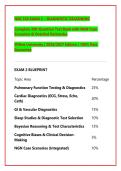
NSG 550 EXAM 2 – DIAGNOSTIC REASONING
Complete 200-Question Test Bank with NGN Case
Scenarios & Detailed Rationales
Wilkes University | 2026/2027 Edition | 100% Pass
Guarantee
EXAM 2 BLUEPRINT
Topic Area Percentage
Pulmonary Function Testing & Diagnostics 25%
Cardiac Diagnostics (ECG, Stress, Echo,
20%
Cath)
GI & Vascular Diagnostics 15%
Sleep Studies & Diagnostic Test Selection 10%
Bayesian Reasoning & Test Characteristics 15%
Cognitive Biases & Clinical Decision-
5%
Making
NGN Case Scenarios (Integrated) 10%
,SECTION 1: PULMONARY FUNCTION TESTING &
DIAGNOSTICS (Questions 1–50)
1. A 45-year-old male presents with a chronic cough and
dyspnea on exertion. He has a 30-pack-year smoking
history. Which initial diagnostic test is most appropriate?
A) Chest X-ray
B) Spirometry
C) CT chest
D) Bronchoscopy
Answer: B) Spirometry
Rationale: Spirometry is the initial test to evaluate for
obstructive or restrictive lung disease in patients with
respiratory symptoms and smoking history. It provides
objective measurement of airflow limitation. Chest X-ray
(A) and CT (C) may follow but are not the initial diagnostic
test. Bronchoscopy (D) is invasive and reserved for specific
indications.
,2. Which of the following is a contraindication to performing
spirometry?
A) Age >65 years
B) Recent myocardial infarction
C) Mild obesity
D) History of smoking
Answer: B) Recent myocardial infarction
Rationale: Contraindications to spirometry include recent
MI (any cardiovascular problem), pneumothorax, active
hemoptysis, pulmonary embolism, recent surgery, cerebral
aneurysm, and respiratory infections. Spirometry requires
forceful exhalation and can increase intrathoracic pressure.
3. A patient's spirometry shows an FEV1/FVC ratio of 65%
with FEV1 55% of predicted. What is the most likely
diagnosis?
A) Restrictive lung disease
B) Obstructive lung disease
C) Normal lung function
D) Mixed obstructive-restrictive
Answer: B) Obstructive lung disease
Rationale: An FEV1/FVC ratio <70% indicates obstruction.
The reduced FEV1 (55% predicted) indicates moderate
obstruction. This pattern is seen in COPD, asthma, and other
, obstructive diseases. Restrictive disease (A) would show a
normal or elevated FEV1/FVC ratio with reduced total lung
capacity.
4. What is the primary purpose of measuring diffusing
capacity of the lungs for carbon monoxide (DLCO)?
A) Assess airway obstruction
B) Assess gas exchange across the alveolar-capillary
membrane
C) Measure lung volumes
D) Evaluate for sleep apnea
Answer: B) Assess gas exchange across the alveolar-capillary
membrane
Rationale: DLCO measures how well gases (specifically
carbon monoxide) diffuse from the alveoli into the
pulmonary capillaries. It assesses the integrity of the
alveolar-capillary membrane and is useful in diagnosing
interstitial lung disease, emphysema, and pulmonary
vascular disease.
5. A 60-year-old with early-onset emphysema and a family
history of "lung problems" denies smoking. Which test is
Complete 200-Question Test Bank with NGN Case
Scenarios & Detailed Rationales
Wilkes University | 2026/2027 Edition | 100% Pass
Guarantee
EXAM 2 BLUEPRINT
Topic Area Percentage
Pulmonary Function Testing & Diagnostics 25%
Cardiac Diagnostics (ECG, Stress, Echo,
20%
Cath)
GI & Vascular Diagnostics 15%
Sleep Studies & Diagnostic Test Selection 10%
Bayesian Reasoning & Test Characteristics 15%
Cognitive Biases & Clinical Decision-
5%
Making
NGN Case Scenarios (Integrated) 10%
,SECTION 1: PULMONARY FUNCTION TESTING &
DIAGNOSTICS (Questions 1–50)
1. A 45-year-old male presents with a chronic cough and
dyspnea on exertion. He has a 30-pack-year smoking
history. Which initial diagnostic test is most appropriate?
A) Chest X-ray
B) Spirometry
C) CT chest
D) Bronchoscopy
Answer: B) Spirometry
Rationale: Spirometry is the initial test to evaluate for
obstructive or restrictive lung disease in patients with
respiratory symptoms and smoking history. It provides
objective measurement of airflow limitation. Chest X-ray
(A) and CT (C) may follow but are not the initial diagnostic
test. Bronchoscopy (D) is invasive and reserved for specific
indications.
,2. Which of the following is a contraindication to performing
spirometry?
A) Age >65 years
B) Recent myocardial infarction
C) Mild obesity
D) History of smoking
Answer: B) Recent myocardial infarction
Rationale: Contraindications to spirometry include recent
MI (any cardiovascular problem), pneumothorax, active
hemoptysis, pulmonary embolism, recent surgery, cerebral
aneurysm, and respiratory infections. Spirometry requires
forceful exhalation and can increase intrathoracic pressure.
3. A patient's spirometry shows an FEV1/FVC ratio of 65%
with FEV1 55% of predicted. What is the most likely
diagnosis?
A) Restrictive lung disease
B) Obstructive lung disease
C) Normal lung function
D) Mixed obstructive-restrictive
Answer: B) Obstructive lung disease
Rationale: An FEV1/FVC ratio <70% indicates obstruction.
The reduced FEV1 (55% predicted) indicates moderate
obstruction. This pattern is seen in COPD, asthma, and other
, obstructive diseases. Restrictive disease (A) would show a
normal or elevated FEV1/FVC ratio with reduced total lung
capacity.
4. What is the primary purpose of measuring diffusing
capacity of the lungs for carbon monoxide (DLCO)?
A) Assess airway obstruction
B) Assess gas exchange across the alveolar-capillary
membrane
C) Measure lung volumes
D) Evaluate for sleep apnea
Answer: B) Assess gas exchange across the alveolar-capillary
membrane
Rationale: DLCO measures how well gases (specifically
carbon monoxide) diffuse from the alveoli into the
pulmonary capillaries. It assesses the integrity of the
alveolar-capillary membrane and is useful in diagnosing
interstitial lung disease, emphysema, and pulmonary
vascular disease.
5. A 60-year-old with early-onset emphysema and a family
history of "lung problems" denies smoking. Which test is

