

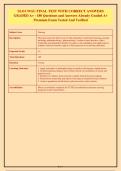
SLO1 WGU FINAL TEST WITH CORRECT ANSWERS
GRADED A+ - 180 Questions and Answers Already Graded A+
Premium Exam Tested And Verified
Subject Area Nursing
Description This final exam for SLO1 assesses the integration of advanced nursing concepts
including pathophysiology, pharmacology, evidence-based practice, ethics,
leadership, and population health. It requires critical thinking and application to
complex clinical scenarios typical of baccalaureate-level nursing education.
Expected Grade A+
Total Questions 180
Duration 3 hours
Learning Outcomes 1. Apply principles of pathophysiology to predict and manage complications.
2. Evaluate pharmacological interventions based on mechanism of action and
patient factors.
3. Synthesize evidence from research to guide clinical decision-making.
4. Demonstrate leadership and ethical reasoning in interprofessional contexts.
5. Analyze population health data to plan preventive interventions.
Accreditation Meets accreditation standards for CCNE-accredited baccalaureate nursing
programs in the United States.
Page 1
,1. A developing country experiences a cholera outbreak with high mortality.
Which combination of interventions best addresses both immediate case
fatality and long-term prevention?
Answer: Rapid diagnostic testing and point-of-use water chlorination plus
hygiene education
Rapid diagnostic testing enables targeted treatment, while point-of-use water
chlorination and hygiene education prevent transmission and address root
causes. ORS is critical for treatment, but mass antibiotics are not recommended
due to resistance. IV fluids are for severe cases only. Vaccination and
infrastructure are longer-term and insufficient for immediate outbreak control.
2. A patient on warfarin for mechanical mitral valve presents with INR 8.2 and
minor epistaxis. Which intervention is most appropriate?
Answer: Hold warfarin, give vitamin K 2.5 mg orally, and resume warfarin
at reduced dose
For supratherapeutic INR without major bleeding, guidelines recommend
withholding warfarin and giving oral vitamin K 2.5 mg to gradually lower INR,
then restarting at a lower dose. IV vitamin K and PCC are for major bleeding.
FFP is for life-threatening bleeding. Oral 1 mg is too low for INR >5. Option A is
insufficient; D is too aggressive.
3. A researcher tests a new drug for hypertension. In the control group, mean
systolic BP drops by 8 mmHg (SD=10); in the experimental group, it drops by
12 mmHg (SD=10). The p-value is 0.08. Which interpretation is most accurate?
Answer: The study fails to reject the null hypothesis; the difference may be
due to chance
A p-value of 0.08 > 0.05 means the result is not statistically significant, so we fail
to reject the null hypothesis. While there is a trend, we cannot conclude the drug
is effective. Accepting the null (B) is incorrect terminology. D incorrectly states
statistical insignificance but implies a causal effect. Clinical significance (A) is not
supported by the p-value.
Page 2
,4. During a hospital disaster drill, the incident commander orders triage using
Simple Triage and Rapid Treatment (START). A victim is apneic; after
opening the airway, breathing resumes at 25 breaths/min. Capillary refill is <2
seconds. What is the correct triage category?
Answer: Red (immediate)
START triage assigns Red (immediate) to any victim with respiratory rate >30 or
<10, or who requires airway intervention. Here, the victim was apneic (requires
airway), and even after breathing resumes, the respiratory rate is 25 (normal),
but the need for airway intervention places them in immediate category. Cap
refill <2 sec is normal, but the respiratory criterion overrides.
5. A nurse delegates vital sign measurement to an unlicensed assistive
personnel (UAP) for stable patients. Which scenario requires the nurse to
immediately reassess the patient?
Answer: UAP reports a temperature of 38.9°C (102°F) in a neutropenic
patient
The nurse must reassess any deviation from baseline that indicates a potential
acute change. In a neutropenic patient, a fever of 38.9°C may signal sepsis and
requires immediate evaluation. The other values are expected: BP stable, HR
slightly low due to beta-blocker but normal for that drug, RR elevated after
activity (expected).
6. A patient with type 1 diabetes and gastroparesis has erratic blood glucose
levels. Which insulin regimen is likely most effective?
Answer: Insulin pump with continuous subcutaneous insulin infusion (CSII)
using rapid-acting analog alone
Gastroparesis causes unpredictable gastric emptying, making mealtime boluses
unreliable. An insulin pump allows for extended boluses or square-wave delivery
to match delayed absorption. Basal-bolus (B) still requires mealtime dosing.
Split-dose (A) and premixed (D) are too inflexible for erratic absorption patterns.
Page 3
, 7. Which finding most clearly supports a diagnosis of metabolic syndrome in
an adult?
Answer: Waist circumference 88 cm, blood pressure 138/88, fasting glucose
110 mg/dL
Metabolic syndrome requires at least 3 of 5 criteria: increased waist
circumference (88 cm in women), elevated BP (130/85), elevated fasting glucose
(100), low HDL (<40 men, <50 women), elevated triglycerides (150). Option B
meets all three. Option A has borderline glucose but HDL is normal for men (45
is >40). Option C misses waist/triglycerides. Option D lacks BP and glucose
criteria.
8. In a patient with severe sepsis and lactate 4.5 mmol/L, which hemodynamic
target should guide initial fluid resuscitation?
Answer: Mean arterial pressure (MAP) of 65 mmHg
Current Surviving Sepsis Campaign guidelines recommend an initial MAP target
of 65 mmHg as the primary hemodynamic goal during resuscitation. CVP and
ScvO2 have been de-emphasized due to lack of evidence; they may be used in
certain contexts but are not the primary target. Urine output is a secondary
indicator.
9. A community health nurse analyzes data showing a higher incidence of
asthma exacerbations in a low-income neighborhood near a major highway.
Which intervention at the population level is most likely to reduce disparities?
Answer: Advocate for zoning regulations to reduce truck traffic near
residential areas
Population-level interventions that address upstream determinants (e.g.,
environmental exposure) have the greatest potential to reduce health disparities.
Truck traffic reduction decreases particulate matter, lowering asthma triggers for
all residents. Distributing inhalers (A) treats symptoms, not cause. Education (C)
places burden on individuals. Mobile clinic (D) improves access but does not
change exposure.
Page 4
GRADED A+ - 180 Questions and Answers Already Graded A+
Premium Exam Tested And Verified
Subject Area Nursing
Description This final exam for SLO1 assesses the integration of advanced nursing concepts
including pathophysiology, pharmacology, evidence-based practice, ethics,
leadership, and population health. It requires critical thinking and application to
complex clinical scenarios typical of baccalaureate-level nursing education.
Expected Grade A+
Total Questions 180
Duration 3 hours
Learning Outcomes 1. Apply principles of pathophysiology to predict and manage complications.
2. Evaluate pharmacological interventions based on mechanism of action and
patient factors.
3. Synthesize evidence from research to guide clinical decision-making.
4. Demonstrate leadership and ethical reasoning in interprofessional contexts.
5. Analyze population health data to plan preventive interventions.
Accreditation Meets accreditation standards for CCNE-accredited baccalaureate nursing
programs in the United States.
Page 1
,1. A developing country experiences a cholera outbreak with high mortality.
Which combination of interventions best addresses both immediate case
fatality and long-term prevention?
Answer: Rapid diagnostic testing and point-of-use water chlorination plus
hygiene education
Rapid diagnostic testing enables targeted treatment, while point-of-use water
chlorination and hygiene education prevent transmission and address root
causes. ORS is critical for treatment, but mass antibiotics are not recommended
due to resistance. IV fluids are for severe cases only. Vaccination and
infrastructure are longer-term and insufficient for immediate outbreak control.
2. A patient on warfarin for mechanical mitral valve presents with INR 8.2 and
minor epistaxis. Which intervention is most appropriate?
Answer: Hold warfarin, give vitamin K 2.5 mg orally, and resume warfarin
at reduced dose
For supratherapeutic INR without major bleeding, guidelines recommend
withholding warfarin and giving oral vitamin K 2.5 mg to gradually lower INR,
then restarting at a lower dose. IV vitamin K and PCC are for major bleeding.
FFP is for life-threatening bleeding. Oral 1 mg is too low for INR >5. Option A is
insufficient; D is too aggressive.
3. A researcher tests a new drug for hypertension. In the control group, mean
systolic BP drops by 8 mmHg (SD=10); in the experimental group, it drops by
12 mmHg (SD=10). The p-value is 0.08. Which interpretation is most accurate?
Answer: The study fails to reject the null hypothesis; the difference may be
due to chance
A p-value of 0.08 > 0.05 means the result is not statistically significant, so we fail
to reject the null hypothesis. While there is a trend, we cannot conclude the drug
is effective. Accepting the null (B) is incorrect terminology. D incorrectly states
statistical insignificance but implies a causal effect. Clinical significance (A) is not
supported by the p-value.
Page 2
,4. During a hospital disaster drill, the incident commander orders triage using
Simple Triage and Rapid Treatment (START). A victim is apneic; after
opening the airway, breathing resumes at 25 breaths/min. Capillary refill is <2
seconds. What is the correct triage category?
Answer: Red (immediate)
START triage assigns Red (immediate) to any victim with respiratory rate >30 or
<10, or who requires airway intervention. Here, the victim was apneic (requires
airway), and even after breathing resumes, the respiratory rate is 25 (normal),
but the need for airway intervention places them in immediate category. Cap
refill <2 sec is normal, but the respiratory criterion overrides.
5. A nurse delegates vital sign measurement to an unlicensed assistive
personnel (UAP) for stable patients. Which scenario requires the nurse to
immediately reassess the patient?
Answer: UAP reports a temperature of 38.9°C (102°F) in a neutropenic
patient
The nurse must reassess any deviation from baseline that indicates a potential
acute change. In a neutropenic patient, a fever of 38.9°C may signal sepsis and
requires immediate evaluation. The other values are expected: BP stable, HR
slightly low due to beta-blocker but normal for that drug, RR elevated after
activity (expected).
6. A patient with type 1 diabetes and gastroparesis has erratic blood glucose
levels. Which insulin regimen is likely most effective?
Answer: Insulin pump with continuous subcutaneous insulin infusion (CSII)
using rapid-acting analog alone
Gastroparesis causes unpredictable gastric emptying, making mealtime boluses
unreliable. An insulin pump allows for extended boluses or square-wave delivery
to match delayed absorption. Basal-bolus (B) still requires mealtime dosing.
Split-dose (A) and premixed (D) are too inflexible for erratic absorption patterns.
Page 3
, 7. Which finding most clearly supports a diagnosis of metabolic syndrome in
an adult?
Answer: Waist circumference 88 cm, blood pressure 138/88, fasting glucose
110 mg/dL
Metabolic syndrome requires at least 3 of 5 criteria: increased waist
circumference (88 cm in women), elevated BP (130/85), elevated fasting glucose
(100), low HDL (<40 men, <50 women), elevated triglycerides (150). Option B
meets all three. Option A has borderline glucose but HDL is normal for men (45
is >40). Option C misses waist/triglycerides. Option D lacks BP and glucose
criteria.
8. In a patient with severe sepsis and lactate 4.5 mmol/L, which hemodynamic
target should guide initial fluid resuscitation?
Answer: Mean arterial pressure (MAP) of 65 mmHg
Current Surviving Sepsis Campaign guidelines recommend an initial MAP target
of 65 mmHg as the primary hemodynamic goal during resuscitation. CVP and
ScvO2 have been de-emphasized due to lack of evidence; they may be used in
certain contexts but are not the primary target. Urine output is a secondary
indicator.
9. A community health nurse analyzes data showing a higher incidence of
asthma exacerbations in a low-income neighborhood near a major highway.
Which intervention at the population level is most likely to reduce disparities?
Answer: Advocate for zoning regulations to reduce truck traffic near
residential areas
Population-level interventions that address upstream determinants (e.g.,
environmental exposure) have the greatest potential to reduce health disparities.
Truck traffic reduction decreases particulate matter, lowering asthma triggers for
all residents. Distributing inhalers (A) treats symptoms, not cause. Education (C)
places burden on individuals. Mobile clinic (D) improves access but does not
change exposure.
Page 4

