

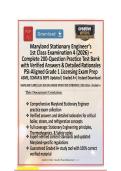
,Maryland Stationary Engineer's 1st Class Examination 4 (2026) –
Complete 200-Question Practice Test Bank with Verified Answers &
Detailed Rationales | PSI-Aligned Grade 1 Licensing Exam Prep |
ASME, COMAR & BEPS Updated | Graded A+ | Instant Download
1. According to the Maryland Stationary Engineers Act, what is the
minimum equipment capacity threshold that mandates the
supervision of a licensed stationary engineer?
A. Any boiler operating at atmospheric pressure
B. Equipment generating pressure of more than 15 PSI and operating at
30 or more horsepower, or hot water boilers exceeding 160 psig or
250°F
C. Any commercial HVAC system over 10 tons capacity
D. Steam boilers operating below 10 PSI with less than 15 horsepower
Answer: B
Rationale: The Maryland Stationary Engineers Act applies to power
plants, machinery, or boilers generating pressure greater than 15 PSI
and 30 or more horsepower (HP), or hot water boilers exceeding 160
psig or 250°F.
2. Which Maryland Stationary Engineer license grade is required to
operate a high-pressure plant with a total capacity of 500 or more
horsepower?
A. Grade 5
B. Grade 3
C. Grade 2
,D. Grade 1
Answer: D
Rationale: A Grade 1 stationary engineer license in Maryland authorizes
the holder to oversee and operate power plants and equipment totaling
500 or more horsepower.
3. Under the Code of Maryland Regulations (COMAR) and ASME
Section VII, what is the recommended frequency for testing low-water
fuel cutoffs on high-pressure steam boilers during regular operation?
A. Annually during the insurance inspection
B. Monthly by a certified third party
C. Daily or at least once per shift through a slow drain test or
evaporative test
D. Weekly using electrical multimeter checks only
Answer: C
Rationale: ASME Section VII and standard operating guidelines mandate
that low-water fuel cutoffs (LWFC) be tested daily (or once per
operating shift) to ensure proper burner trip functionality in case of a
low water condition.
4. What is the primary regulatory objective of Maryland's Building
Energy Performance Standards (BEPS) as applied to large commercial
and institutional facilities?
A. Mandating the immediate replacement of all steam boilers with
electric heat pumps
, B. Establishing energy performance metrics and greenhouse gas
emissions reduction targets for large existing buildings over specified
square footages
C. Regulating the hourly wage of licensed stationary engineers
D. Enforcing municipal water usage fees for cooling towers
Answer: B
Rationale: Maryland's BEPS framework targets large buildings to
improve energy efficiency, reduce carbon emissions, and meet state
greenhouse gas reduction mandates through building performance
tracking and retrofits.
5. According to ASME Section I, what is the minimum number of
safety valves required on a steam boiler with more than 500 square
feet of bare heating surface?
A. One safety valve
B. Two or more safety valves
C. Four safety valves
D. One safety valve and one relief valve
Answer: B
Rationale: ASME Section I requires any boiler with more than 500
square feet of heating surface (or an electric boiler over 1,100 kW) to
have two or more safety valves to ensure sufficient relieving capacity if
one fails.
Complete 200-Question Practice Test Bank with Verified Answers &
Detailed Rationales | PSI-Aligned Grade 1 Licensing Exam Prep |
ASME, COMAR & BEPS Updated | Graded A+ | Instant Download
1. According to the Maryland Stationary Engineers Act, what is the
minimum equipment capacity threshold that mandates the
supervision of a licensed stationary engineer?
A. Any boiler operating at atmospheric pressure
B. Equipment generating pressure of more than 15 PSI and operating at
30 or more horsepower, or hot water boilers exceeding 160 psig or
250°F
C. Any commercial HVAC system over 10 tons capacity
D. Steam boilers operating below 10 PSI with less than 15 horsepower
Answer: B
Rationale: The Maryland Stationary Engineers Act applies to power
plants, machinery, or boilers generating pressure greater than 15 PSI
and 30 or more horsepower (HP), or hot water boilers exceeding 160
psig or 250°F.
2. Which Maryland Stationary Engineer license grade is required to
operate a high-pressure plant with a total capacity of 500 or more
horsepower?
A. Grade 5
B. Grade 3
C. Grade 2
,D. Grade 1
Answer: D
Rationale: A Grade 1 stationary engineer license in Maryland authorizes
the holder to oversee and operate power plants and equipment totaling
500 or more horsepower.
3. Under the Code of Maryland Regulations (COMAR) and ASME
Section VII, what is the recommended frequency for testing low-water
fuel cutoffs on high-pressure steam boilers during regular operation?
A. Annually during the insurance inspection
B. Monthly by a certified third party
C. Daily or at least once per shift through a slow drain test or
evaporative test
D. Weekly using electrical multimeter checks only
Answer: C
Rationale: ASME Section VII and standard operating guidelines mandate
that low-water fuel cutoffs (LWFC) be tested daily (or once per
operating shift) to ensure proper burner trip functionality in case of a
low water condition.
4. What is the primary regulatory objective of Maryland's Building
Energy Performance Standards (BEPS) as applied to large commercial
and institutional facilities?
A. Mandating the immediate replacement of all steam boilers with
electric heat pumps
, B. Establishing energy performance metrics and greenhouse gas
emissions reduction targets for large existing buildings over specified
square footages
C. Regulating the hourly wage of licensed stationary engineers
D. Enforcing municipal water usage fees for cooling towers
Answer: B
Rationale: Maryland's BEPS framework targets large buildings to
improve energy efficiency, reduce carbon emissions, and meet state
greenhouse gas reduction mandates through building performance
tracking and retrofits.
5. According to ASME Section I, what is the minimum number of
safety valves required on a steam boiler with more than 500 square
feet of bare heating surface?
A. One safety valve
B. Two or more safety valves
C. Four safety valves
D. One safety valve and one relief valve
Answer: B
Rationale: ASME Section I requires any boiler with more than 500
square feet of heating surface (or an electric boiler over 1,100 kW) to
have two or more safety valves to ensure sufficient relieving capacity if
one fails.

