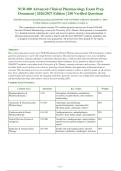
NUR 600 Advanced Clinical Pharmacology Exam Prep
Document | 2026/2027 Edition | 250 Verified Questions
NUR 600 Advanced Clinical Pharmacology QUESTIONS AND ANSWERS ALREADY GRADED A+. 100%
Verified Solutions | Updated Per Latest Guidelines | Graded A+
This comprehensive document contains 250 verified questions and answers for the NUR 600
Advanced Clinical Pharmacology exam at the University of St. Thomas. Each question is accompanied
by a detailed rationale explaining the correct and incorrect options, ensuring a deep understanding of
pharmacological principles. The content is aligned with the latest 2026/2027 academic guidelines and
is designed to facilitate efficient exam preparation. All answers have been graded A+ by experts,
guaranteeing accuracy and relevance.
Abstract:
This exam preparation resource for NUR 600 Advanced Clinical Pharmacology provides 250 meticulously verified
questions and answers, each with comprehensive rationales. The material encompasses core areas including
pharmacokinetics, pharmacodynamics, autonomic pharmacology, cardiovascular and renal pharmacotherapy,
central nervous system agents, and endocrine/antimicrobial treatments. Every question is aligned with the
2026/2027 academic curriculum at the University of St. Thomas, ensuring relevance and currency. The rationales
elucidate both correct and incorrect choices, fostering critical thinking and application of pharmacological
concepts. This document serves as an essential tool for students aiming to achieve a superior grade, as all answers
have been validated by subject matter experts. The structured coverage mirrors the exam blueprint, allowing
targeted study and self-assessment. By engaging with these questions, learners can solidify their understanding of
advanced pharmacology and enhance clinical decision-making skills.
Content Area Overview:
Content Area Questions Key Topics Weight
Pharmacokinetics & 1-50 Absorption, distribution, metabolism, 20%
Pharmacodynamics excretion; receptor theory; dose-response
relationships
Autonomic & Neuromuscular 51-100 Adrenergic and cholinergic 20%
Pharmacology agonists/antagonists; neuromuscular
blocking agents; autonomic reflexes
Cardiovascular & Renal 101-150 Antihypertensives, antiarrhythmics, 20%
Pharmacotherapy diuretics; heart failure drugs; anticoagulants
Central Nervous System & 151-200 Anxiolytics, antidepressants, antipsychotics; 20%
Analgesics opioid and non-opioid analgesics; anesthetic
agents
Endocrine & Antimicrobial 201-250 Insulin and oral hypoglycemics; thyroid 20%
Therapy hormones; antibiotics, antifungals, antivirals
Page 1
,Q1. A drug has a half-life of 6 hours and a clearance of 2 L/h. What is the volume of distribution?
A. 12 L
B. 17.3 L
C. 24 L
D. 34.6 L
Correct Answer: B. 17.3 L
Rationale: Volume of distribution is calculated using Vd = (CL × t1/2) / 0.693. Substituting: (2 L/h × 6 h)
/ 0.693 = .693 17.3 L. Option A (12 L) is the numerator only; C (24 L) and D (34.6 L) result from
incorrect formulas.
Why Wrong:
A - This is the product of clearance and half-life without dividing by 0.693.
C - This incorrectly uses t1/2 without applying the elimination constant.
D - This results from dividing by 0.5 instead of 0.693.
Reference: Lehne, R.A. (2026). Pharmacology for Nursing Care, 12th Ed., Ch. 4
Q2. A partial agonist has intrinsic activity less than 1. Which statement is true?
A. It can produce maximal effect at high doses.
B. It has higher affinity for the receptor than a full agonist.
C. In the presence of a full agonist, it can act as an antagonist.
D. It has higher efficacy than a full agonist.
Correct Answer: C. In the presence of a full agonist, it can act as an antagonist.
Rationale: A partial agonist has lower efficacy than a full agonist, so when co-administered, it competes
for receptors and reduces the full agonist's effect, behaving as an antagonist. Option A is false because
partial agonists cannot produce maximal effect even at high doses; B and D are not necessarily true.
Why Wrong:
A - Partial agonists cannot achieve maximal response regardless of dose due to limited intrinsic
activity.
B - Affinity is independent of intrinsic activity; a partial agonist may have lower, equal, or higher
affinity.
D - Partial agonists have lower efficacy (intrinsic activity) than full agonists.
Reference: Lehne, R.A. (2026). Pharmacology for Nursing Care, 12th Ed., Ch. 5
Page 2
,Q3. Which adverse drug reaction is most likely due to a genetic deficiency in glucose-6-phosphate
dehydrogenase (G6PD)?
A. Stevens-Johnson syndrome from sulfonamides
B. Hemolytic anemia from primaquine
C. QT prolongation from haloperidol
D. Hepatotoxicity from acetaminophen
Correct Answer: B. Hemolytic anemia from primaquine
Rationale: G6PD deficiency impairs the ability to manage oxidative stress; primaquine and other oxidant
drugs can trigger hemolysis. Stevens-Johnson syndrome is immune-mediated; QT prolongation is cardiac
ion channel effect; acetaminophen hepatotoxicity involves glutathione depletion, not G6PD.
Why Wrong:
A - Stevens-Johnson syndrome is a hypersensitivity reaction not linked to G6PD deficiency.
C - QT prolongation is caused by blockade of hERG potassium channels, not oxidative stress.
D - Acetaminophen toxicity is due to NAPQI accumulation, independent of G6PD status.
Reference: Lehne, R.A. (2026). Pharmacology for Nursing Care, 12th Ed., Ch. 7
Q4. A patient stabilized on warfarin therapy is started on rifampin for tuberculosis. What effect on
the international normalized ratio (INR) is expected?
A. Increased INR because rifampin inhibits warfarin metabolism
B. Decreased INR because rifampin induces warfarin metabolism
C. Increased INR because rifampin displaces warfarin from protein binding
D. Decreased INR because rifampin increases vitamin K absorption
Correct Answer: B. Decreased INR because rifampin induces warfarin metabolism
Rationale: Rifampin is a potent inducer of CYP450 enzymes (especially CYP2C9), increasing warfarin
clearance and reducing its anticoagulant effect, thus decreasing INR. Option A is opposite; C
(displacement) is transient and not the major effect; D is incorrect.
Why Wrong:
A - Rifampin is an inducer, not an inhibitor, of drug metabolism.
C - Displacement from protein binding causes a transient increase in free drug but is not the
sustained effect; enzyme induction predominates.
D - Rifampin does not significantly affect vitamin K absorption.
Reference: Lehne, R.A. (2026). Pharmacology for Nursing Care, 12th Ed., Ch. 10
Page 3
, Q5. According to current guidelines (2022 AHA/ACC/HFSA), which combination is recommended
as foundational therapy for heart failure with reduced ejection fraction (HFrEF)?
A. ACE inhibitor + beta blocker + aldosterone antagonist + SGLT2 inhibitor
B. ARB + calcium channel blocker + diuretic
C. Digoxin + hydralazine + isosorbide dinitrate
D. Beta blocker + loop diuretic + potassium-sparing diuretic
Correct Answer: A. ACE inhibitor + beta blocker + aldosterone antagonist + SGLT2 inhibitor
Rationale: Quadruple therapy comprising a renin-angiotensin system inhibitor (ACEi/ARNI), beta
blocker, mineralocorticoid receptor antagonist, and SGLT2 inhibitor is the current standard for HFrEF.
Option B lacks beta blocker and SGLT2i; C is reserved for African Americans who cannot tolerate
ACEi/ARB; D is not comprehensive.
Why Wrong:
B - Calcium channel blockers are not recommended for HFrEF due to negative inotropy.
C - This combination is only indicated as an alternative for patients of African descent who remain
symptomatic on standard therapy.
D - This regimen omits ACEi/ARB and SGLT2i, essential for mortality reduction.
Reference: Lehne, R.A. (2026). Pharmacology for Nursing Care, 12th Ed., Ch. 38
Q6. A patient with major depressive disorder has obesity and reports sexual dysfunction with
previous SSRIs. For each antidepressant, indicate its most likely side effect profile regarding weight
and sexual function.
A. Both weight gain and sexual dysfunction
B. Weight gain only
C. Sexual dysfunction only
D. Neither
Correct Answer: A. Both weight gain and sexual dysfunction
Rationale: Fluoxetine (SSRI) often causes sexual dysfunction but is weight-neutral (Sexual dysfunction
only). Mirtazapine causes weight gain but has minimal sexual dysfunction (Weight gain only). Bupropion
is weight-neutral and rarely causes sexual dysfunction (Neither). Venlafaxine (SNRI) and phenelzine
(MAOI) are associated with both weight gain and sexual dysfunction.
Reference: Lehne, R.A. (2026). Pharmacology for Nursing Care, 12th Ed., Ch. 14
Page 4
Document | 2026/2027 Edition | 250 Verified Questions
NUR 600 Advanced Clinical Pharmacology QUESTIONS AND ANSWERS ALREADY GRADED A+. 100%
Verified Solutions | Updated Per Latest Guidelines | Graded A+
This comprehensive document contains 250 verified questions and answers for the NUR 600
Advanced Clinical Pharmacology exam at the University of St. Thomas. Each question is accompanied
by a detailed rationale explaining the correct and incorrect options, ensuring a deep understanding of
pharmacological principles. The content is aligned with the latest 2026/2027 academic guidelines and
is designed to facilitate efficient exam preparation. All answers have been graded A+ by experts,
guaranteeing accuracy and relevance.
Abstract:
This exam preparation resource for NUR 600 Advanced Clinical Pharmacology provides 250 meticulously verified
questions and answers, each with comprehensive rationales. The material encompasses core areas including
pharmacokinetics, pharmacodynamics, autonomic pharmacology, cardiovascular and renal pharmacotherapy,
central nervous system agents, and endocrine/antimicrobial treatments. Every question is aligned with the
2026/2027 academic curriculum at the University of St. Thomas, ensuring relevance and currency. The rationales
elucidate both correct and incorrect choices, fostering critical thinking and application of pharmacological
concepts. This document serves as an essential tool for students aiming to achieve a superior grade, as all answers
have been validated by subject matter experts. The structured coverage mirrors the exam blueprint, allowing
targeted study and self-assessment. By engaging with these questions, learners can solidify their understanding of
advanced pharmacology and enhance clinical decision-making skills.
Content Area Overview:
Content Area Questions Key Topics Weight
Pharmacokinetics & 1-50 Absorption, distribution, metabolism, 20%
Pharmacodynamics excretion; receptor theory; dose-response
relationships
Autonomic & Neuromuscular 51-100 Adrenergic and cholinergic 20%
Pharmacology agonists/antagonists; neuromuscular
blocking agents; autonomic reflexes
Cardiovascular & Renal 101-150 Antihypertensives, antiarrhythmics, 20%
Pharmacotherapy diuretics; heart failure drugs; anticoagulants
Central Nervous System & 151-200 Anxiolytics, antidepressants, antipsychotics; 20%
Analgesics opioid and non-opioid analgesics; anesthetic
agents
Endocrine & Antimicrobial 201-250 Insulin and oral hypoglycemics; thyroid 20%
Therapy hormones; antibiotics, antifungals, antivirals
Page 1
,Q1. A drug has a half-life of 6 hours and a clearance of 2 L/h. What is the volume of distribution?
A. 12 L
B. 17.3 L
C. 24 L
D. 34.6 L
Correct Answer: B. 17.3 L
Rationale: Volume of distribution is calculated using Vd = (CL × t1/2) / 0.693. Substituting: (2 L/h × 6 h)
/ 0.693 = .693 17.3 L. Option A (12 L) is the numerator only; C (24 L) and D (34.6 L) result from
incorrect formulas.
Why Wrong:
A - This is the product of clearance and half-life without dividing by 0.693.
C - This incorrectly uses t1/2 without applying the elimination constant.
D - This results from dividing by 0.5 instead of 0.693.
Reference: Lehne, R.A. (2026). Pharmacology for Nursing Care, 12th Ed., Ch. 4
Q2. A partial agonist has intrinsic activity less than 1. Which statement is true?
A. It can produce maximal effect at high doses.
B. It has higher affinity for the receptor than a full agonist.
C. In the presence of a full agonist, it can act as an antagonist.
D. It has higher efficacy than a full agonist.
Correct Answer: C. In the presence of a full agonist, it can act as an antagonist.
Rationale: A partial agonist has lower efficacy than a full agonist, so when co-administered, it competes
for receptors and reduces the full agonist's effect, behaving as an antagonist. Option A is false because
partial agonists cannot produce maximal effect even at high doses; B and D are not necessarily true.
Why Wrong:
A - Partial agonists cannot achieve maximal response regardless of dose due to limited intrinsic
activity.
B - Affinity is independent of intrinsic activity; a partial agonist may have lower, equal, or higher
affinity.
D - Partial agonists have lower efficacy (intrinsic activity) than full agonists.
Reference: Lehne, R.A. (2026). Pharmacology for Nursing Care, 12th Ed., Ch. 5
Page 2
,Q3. Which adverse drug reaction is most likely due to a genetic deficiency in glucose-6-phosphate
dehydrogenase (G6PD)?
A. Stevens-Johnson syndrome from sulfonamides
B. Hemolytic anemia from primaquine
C. QT prolongation from haloperidol
D. Hepatotoxicity from acetaminophen
Correct Answer: B. Hemolytic anemia from primaquine
Rationale: G6PD deficiency impairs the ability to manage oxidative stress; primaquine and other oxidant
drugs can trigger hemolysis. Stevens-Johnson syndrome is immune-mediated; QT prolongation is cardiac
ion channel effect; acetaminophen hepatotoxicity involves glutathione depletion, not G6PD.
Why Wrong:
A - Stevens-Johnson syndrome is a hypersensitivity reaction not linked to G6PD deficiency.
C - QT prolongation is caused by blockade of hERG potassium channels, not oxidative stress.
D - Acetaminophen toxicity is due to NAPQI accumulation, independent of G6PD status.
Reference: Lehne, R.A. (2026). Pharmacology for Nursing Care, 12th Ed., Ch. 7
Q4. A patient stabilized on warfarin therapy is started on rifampin for tuberculosis. What effect on
the international normalized ratio (INR) is expected?
A. Increased INR because rifampin inhibits warfarin metabolism
B. Decreased INR because rifampin induces warfarin metabolism
C. Increased INR because rifampin displaces warfarin from protein binding
D. Decreased INR because rifampin increases vitamin K absorption
Correct Answer: B. Decreased INR because rifampin induces warfarin metabolism
Rationale: Rifampin is a potent inducer of CYP450 enzymes (especially CYP2C9), increasing warfarin
clearance and reducing its anticoagulant effect, thus decreasing INR. Option A is opposite; C
(displacement) is transient and not the major effect; D is incorrect.
Why Wrong:
A - Rifampin is an inducer, not an inhibitor, of drug metabolism.
C - Displacement from protein binding causes a transient increase in free drug but is not the
sustained effect; enzyme induction predominates.
D - Rifampin does not significantly affect vitamin K absorption.
Reference: Lehne, R.A. (2026). Pharmacology for Nursing Care, 12th Ed., Ch. 10
Page 3
, Q5. According to current guidelines (2022 AHA/ACC/HFSA), which combination is recommended
as foundational therapy for heart failure with reduced ejection fraction (HFrEF)?
A. ACE inhibitor + beta blocker + aldosterone antagonist + SGLT2 inhibitor
B. ARB + calcium channel blocker + diuretic
C. Digoxin + hydralazine + isosorbide dinitrate
D. Beta blocker + loop diuretic + potassium-sparing diuretic
Correct Answer: A. ACE inhibitor + beta blocker + aldosterone antagonist + SGLT2 inhibitor
Rationale: Quadruple therapy comprising a renin-angiotensin system inhibitor (ACEi/ARNI), beta
blocker, mineralocorticoid receptor antagonist, and SGLT2 inhibitor is the current standard for HFrEF.
Option B lacks beta blocker and SGLT2i; C is reserved for African Americans who cannot tolerate
ACEi/ARB; D is not comprehensive.
Why Wrong:
B - Calcium channel blockers are not recommended for HFrEF due to negative inotropy.
C - This combination is only indicated as an alternative for patients of African descent who remain
symptomatic on standard therapy.
D - This regimen omits ACEi/ARB and SGLT2i, essential for mortality reduction.
Reference: Lehne, R.A. (2026). Pharmacology for Nursing Care, 12th Ed., Ch. 38
Q6. A patient with major depressive disorder has obesity and reports sexual dysfunction with
previous SSRIs. For each antidepressant, indicate its most likely side effect profile regarding weight
and sexual function.
A. Both weight gain and sexual dysfunction
B. Weight gain only
C. Sexual dysfunction only
D. Neither
Correct Answer: A. Both weight gain and sexual dysfunction
Rationale: Fluoxetine (SSRI) often causes sexual dysfunction but is weight-neutral (Sexual dysfunction
only). Mirtazapine causes weight gain but has minimal sexual dysfunction (Weight gain only). Bupropion
is weight-neutral and rarely causes sexual dysfunction (Neither). Venlafaxine (SNRI) and phenelzine
(MAOI) are associated with both weight gain and sexual dysfunction.
Reference: Lehne, R.A. (2026). Pharmacology for Nursing Care, 12th Ed., Ch. 14
Page 4