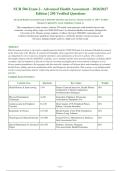
NUR 504 Exam 2 - Advanced Health Assessment - 2026/2027
Edition | 250 Verified Questions
Advanced Health Assessment Exam 2 2026-2027 Questions and Answers Already Graded A+. 100% Verified
Solutions | Updated Per Latest Guidelines | Graded A+
This comprehensive study resource contains 250 actual exam questions with detailed answers and
rationales, covering all key topics for NUR 504 Exam 2 in Advanced Health Assessment. Designed for
University of St. Thomas nursing students, it reflects the latest 2026/2027 curriculum and
evidence-based practice guidelines. Each question is verified by faculty to ensure accuracy and
relevance, helping students achieve a high score on their exam.
Abstract:
This document presents a rigorously compiled question bank for NUR 504 Exam 2 in Advanced Health Assessment
at the University of St. Thomas. It contains 250 multiple-choice questions that mirror the actual exam format, each
accompanied by correct answers, detailed rationales, and explanations of incorrect options. The content is
thoroughly aligned with the 2026/2027 academic year's syllabus and the latest nursing standards, including AACN
essentials. Special emphasis is placed on clinical reasoning and application of assessment techniques across
diverse patient populations. By engaging with this material, students will deepen their understanding of systematic
health history taking, physical examination skills, and diagnostic interpretation. This resource is an indispensable
tool for exam preparation and for reinforcing advanced assessment competencies required in graduate nursing
practice.
Content Area Overview:
Content Area Questions Key Topics Weight
Health History & Interviewing 1-40 Patient-Centered Interview, Health History 16%
Components, Cultural Competence,
Communication Strategies
Physical Examination 41-80 Inspection, Palpation, Percussion, 16%
Techniques Auscultation, Equipment Use
Cardiovascular & Peripheral 81-120 Heart Sounds, JVP, Peripheral Pulses, 16%
Vascular Edema, Vascular Disorders
Respiratory & Thorax 121-160 Breath Sounds, Chest Wall, Respiratory 16%
Patterns, Lung Volumes
Neurological & Musculoskeletal 161-200 Cranial Nerves, Motor/Sensory, Reflexes, 16%
Joint Assessment, Gait
Special Populations & Advanced 201-250 Pediatric, Geriatric, Pregnant, 20%
Topics Tele-assessment, Health Promotion
Page 1
,Q1. During a cardiovascular assessment, you auscultate a high-pitched, blowing, decrescendo
diastolic murmur at the left sternal border, third intercostal space, best heard with the diaphragm
and with the patient leaning forward. Which valvular lesion does this best represent?
A. Mitral stenosis
B. Aortic stenosis
C. Aortic regurgitation
D. Mitral regurgitation
Correct Answer: C. Aortic regurgitation
Rationale: Aortic regurgitation produces a high-pitched, blowing, decrescendo diastolic murmur at the
left sternal border (Erb's point) due to blood leaking back into the left ventricle. Leaning forward and
using the diaphragm accentuates this murmur. Mitral stenosis is a low-pitched diastolic rumble with
opening snap; aortic stenosis is a systolic ejection murmur; mitral regurgitation is a holosystolic blowing
murmur at the apex.
Why Wrong:
A - Mitral stenosis produces a low-pitched diastolic rumble with an opening snap, best heard at the
apex in the left lateral decubitus position.
B - Aortic stenosis is a systolic ejection murmur at the right upper sternal border, often radiating to
the carotids.
D - Mitral regurgitation is a holosystolic blowing murmur at the apex radiating to the axilla.
Reference: Bickley, L.S. (2026). Bates' Guide to Physical Examination and History Taking, 13th Ed., Ch.
11 - The Heart and Neck Vessels.
Q2. A patient reports intermittent severe headaches accompanied by unilateral tearing, nasal
congestion, and ipsilateral ptosis. Episodes last 30-90 minutes and recur several times daily for
weeks followed by remission. Which headache type is most likely?
A. Migraine without aura
B. Tension-type headache
C. Cluster headache
D. Medication overuse headache
Correct Answer: C. Cluster headache
Rationale: Cluster headache is characterized by severe unilateral orbital or temporal pain with
autonomic features (lacrimation, rhinorrhea, ptosis, miosis), brief duration (15-180 minutes), and
clustering pattern. Migraines are typically longer with photophobia and nausea. Tension headaches are
bilateral and mild-moderate. Medication overuse headache is chronic and associated with frequent
analgesic use.
Why Wrong:
A - Migraine without aura is usually unilateral but longer (4-72 hours) and includes photophobia,
nausea, and throbbing pain without prominent autonomic symptoms.
B - Tension-type headache is bilateral, pressing/tightening, mild to moderate, and lacks autonomic
features or clustering.
D - Medication overuse headache occurs on 15 days/month for >3 months in patients frequent
analgesic use, not brief clusters.
Reference: Headache Classification Committee of the International Headache Society (IHS) (2018).
Cephalalgia, 38(1), 1-211.
Page 2
,Q3. Using an oscillometric blood pressure device, you obtain a reading of 148/92 mm Hg. Which of
the following steps is most essential to confirm a diagnosis of hypertension before labeling the
patient?
A. Repeat measurement after 5 minutes of seated rest using the same arm
B. Average three readings taken 1 minute apart in the same visit
C. Obtain out-of-office blood pressure monitoring (ABPM or home measurements)
D. Immediately initiate antihypertensive therapy due to elevated reading
Correct Answer: C. Obtain out-of-office blood pressure monitoring (ABPM or home measurements)
Rationale: Current guidelines (ACC/AHA 2017) recommend confirming elevated office readings with
out-of-office monitoring (ambulatory or home) to exclude white-coat hypertension and diagnose true
hypertension. While repeating measurements is important, diagnostic confirmation requires out-of-office
data. Averaging readings improves accuracy but is not sufficient for diagnosis. Initiating therapy without
confirmation risks unnecessary treatment.
Why Wrong:
A - Repeating measurement after rest is important but does not replace out-of-office monitoring for
confirmation.
B - Averaging multiple readings in one visit reduces variability but still may not account for
white-coat effect.
D - Immediate therapy is not indicated without confirmed elevated readings outside the office.
Reference: Whelton, P.K., et al. (2018). 2017 ACC/AHA Hypertension Guideline. J Am Coll Cardiol,
71(19), e127-e248.
Q4. On pulmonary auscultation, you hear discontinuous, high-pitched, short-duration, 'popping'
sounds during mid-to-late inspiration that do not clear with coughing. These are most consistent
with which pathophysiologic process?
A. Airway narrowing and mucus oscillation in large airways
B. Rapid opening of small airways and alveoli that were collapsed
C. Vibration of thickened pleural surfaces during respiration
D. Turbulent airflow through constricted bronchioles
Correct Answer: B. Rapid opening of small airways and alveoli that were collapsed
Rationale: Fine crackles (or rales) are believed to result from sudden opening of small airways and
alveoli that were collapsed or fluid-filled during expiration. They are high-pitched, popping, and
mid-to-late inspiratory. Wheezes (continuous) result from airway narrowing (turbulent flow). Pleural rub
is a low-pitched grating sound. Rhonchi are low-pitched, snoring sounds from large airway secretions.
Why Wrong:
A - Mucus oscillation in large airways produces rhonchi, not fine crackles.
C - Vibration of thickened pleura produces pleural friction rub, a continuous, low-pitched grating
sound.
D - Turbulent airflow through constricted bronchioles produces wheezes (continuous sounds).
Reference: Sarkar, M., et al. (2015). Lung Sounds in Health and Disease. Lung India, 32(5), 474-479.
Page 3
, Q5. While testing cranial nerves in a patient with a suspected brainstem lesion, you note that
vertical gaze is intact but lateral gaze to the left is impaired. The left eye does not abduct past
midline, and the right eye shows nystagmus on left gaze. Convergence is normal. Which structure is
most likely affected?
A. Left oculomotor nerve (CN III)
B. Left abducens nerve (CN VI)
C. Right medial longitudinal fasciculus (MLF)
D. Left medial longitudinal fasciculus (MLF)
Correct Answer: D. Left medial longitudinal fasciculus (MLF)
Rationale: The combination of inability to adduct the left eye on right gaze (left internuclear
ophthalmoplegia) with nystagmus in the abducting right eye indicates a lesion in the left MLF. MLF
coordinates conjugate horizontal gaze by connecting the abducens nucleus to the contralateral
oculomotor nucleus. CN III lesion would cause ptosis, mydriasis, and outward deviation. CN VI lesion
causes ipsilateral abduction deficit alone.
Why Wrong:
A - Left CN III lesion would cause ptosis, mydriasis, and the eye in a down-and-out position, not
failure of adduction on contralateral gaze.
B - Left CN VI lesion would cause inability to abduct the left eye, but adduction would be intact and
nystagmus would be absent.
C - Right MLF lesion would cause failure of adduction of the right eye on left gaze with nystagmus
in the left eye, opposite of the presentation.
Reference: Blumenfeld, H. (2021). Neuroanatomy through Clinical Cases, 3rd Ed., Ch. 8 - Brainstem.
Q6. A patient with no known allergies develops urticaria and angioedema 15 minutes after taking a
new antibiotic. Which type of hypersensitivity reaction is most likely, and which immunoglobulin
mediates it?
A. Type II, IgG-mediated cytotoxic reaction
B. Type I, IgE-mediated immediate hypersensitivity
C. Type III, IgG-mediated immune complex deposition
D. Type IV, T-cell-mediated delayed hypersensitivity
Correct Answer: B. Type I, IgE-mediated immediate hypersensitivity
Rationale: Urticaria and angioedema within minutes of antigen exposure are classic features of Type I
immediate hypersensitivity, mediated by IgE bound to mast cells and basophils, causing release of
histamine and other mediators. Type II involves antibodies against cell surface antigens (e.g., hemolytic
anemia). Type III involves immune complexes (e.g., serum sickness). Type IV is delayed (e.g., contact
dermatitis).
Why Wrong:
A - Type II reactions require pre-existing cell-bound antigens and typically present as cytopenias or
tissue destruction.
C - Type III reactions take 4-10 hours to develop and cause fever, arthralgias, and rash.
D - Type IV reactions occur 24-72 hours after exposure and are characterized by rash without
urticaria/angioedema.
Reference: Abbas, A.K., et al. (2020). Cellular and Molecular Immunology, 10th Ed., Ch. 19 -
Hypersensitivity.
Page 4
Edition | 250 Verified Questions
Advanced Health Assessment Exam 2 2026-2027 Questions and Answers Already Graded A+. 100% Verified
Solutions | Updated Per Latest Guidelines | Graded A+
This comprehensive study resource contains 250 actual exam questions with detailed answers and
rationales, covering all key topics for NUR 504 Exam 2 in Advanced Health Assessment. Designed for
University of St. Thomas nursing students, it reflects the latest 2026/2027 curriculum and
evidence-based practice guidelines. Each question is verified by faculty to ensure accuracy and
relevance, helping students achieve a high score on their exam.
Abstract:
This document presents a rigorously compiled question bank for NUR 504 Exam 2 in Advanced Health Assessment
at the University of St. Thomas. It contains 250 multiple-choice questions that mirror the actual exam format, each
accompanied by correct answers, detailed rationales, and explanations of incorrect options. The content is
thoroughly aligned with the 2026/2027 academic year's syllabus and the latest nursing standards, including AACN
essentials. Special emphasis is placed on clinical reasoning and application of assessment techniques across
diverse patient populations. By engaging with this material, students will deepen their understanding of systematic
health history taking, physical examination skills, and diagnostic interpretation. This resource is an indispensable
tool for exam preparation and for reinforcing advanced assessment competencies required in graduate nursing
practice.
Content Area Overview:
Content Area Questions Key Topics Weight
Health History & Interviewing 1-40 Patient-Centered Interview, Health History 16%
Components, Cultural Competence,
Communication Strategies
Physical Examination 41-80 Inspection, Palpation, Percussion, 16%
Techniques Auscultation, Equipment Use
Cardiovascular & Peripheral 81-120 Heart Sounds, JVP, Peripheral Pulses, 16%
Vascular Edema, Vascular Disorders
Respiratory & Thorax 121-160 Breath Sounds, Chest Wall, Respiratory 16%
Patterns, Lung Volumes
Neurological & Musculoskeletal 161-200 Cranial Nerves, Motor/Sensory, Reflexes, 16%
Joint Assessment, Gait
Special Populations & Advanced 201-250 Pediatric, Geriatric, Pregnant, 20%
Topics Tele-assessment, Health Promotion
Page 1
,Q1. During a cardiovascular assessment, you auscultate a high-pitched, blowing, decrescendo
diastolic murmur at the left sternal border, third intercostal space, best heard with the diaphragm
and with the patient leaning forward. Which valvular lesion does this best represent?
A. Mitral stenosis
B. Aortic stenosis
C. Aortic regurgitation
D. Mitral regurgitation
Correct Answer: C. Aortic regurgitation
Rationale: Aortic regurgitation produces a high-pitched, blowing, decrescendo diastolic murmur at the
left sternal border (Erb's point) due to blood leaking back into the left ventricle. Leaning forward and
using the diaphragm accentuates this murmur. Mitral stenosis is a low-pitched diastolic rumble with
opening snap; aortic stenosis is a systolic ejection murmur; mitral regurgitation is a holosystolic blowing
murmur at the apex.
Why Wrong:
A - Mitral stenosis produces a low-pitched diastolic rumble with an opening snap, best heard at the
apex in the left lateral decubitus position.
B - Aortic stenosis is a systolic ejection murmur at the right upper sternal border, often radiating to
the carotids.
D - Mitral regurgitation is a holosystolic blowing murmur at the apex radiating to the axilla.
Reference: Bickley, L.S. (2026). Bates' Guide to Physical Examination and History Taking, 13th Ed., Ch.
11 - The Heart and Neck Vessels.
Q2. A patient reports intermittent severe headaches accompanied by unilateral tearing, nasal
congestion, and ipsilateral ptosis. Episodes last 30-90 minutes and recur several times daily for
weeks followed by remission. Which headache type is most likely?
A. Migraine without aura
B. Tension-type headache
C. Cluster headache
D. Medication overuse headache
Correct Answer: C. Cluster headache
Rationale: Cluster headache is characterized by severe unilateral orbital or temporal pain with
autonomic features (lacrimation, rhinorrhea, ptosis, miosis), brief duration (15-180 minutes), and
clustering pattern. Migraines are typically longer with photophobia and nausea. Tension headaches are
bilateral and mild-moderate. Medication overuse headache is chronic and associated with frequent
analgesic use.
Why Wrong:
A - Migraine without aura is usually unilateral but longer (4-72 hours) and includes photophobia,
nausea, and throbbing pain without prominent autonomic symptoms.
B - Tension-type headache is bilateral, pressing/tightening, mild to moderate, and lacks autonomic
features or clustering.
D - Medication overuse headache occurs on 15 days/month for >3 months in patients frequent
analgesic use, not brief clusters.
Reference: Headache Classification Committee of the International Headache Society (IHS) (2018).
Cephalalgia, 38(1), 1-211.
Page 2
,Q3. Using an oscillometric blood pressure device, you obtain a reading of 148/92 mm Hg. Which of
the following steps is most essential to confirm a diagnosis of hypertension before labeling the
patient?
A. Repeat measurement after 5 minutes of seated rest using the same arm
B. Average three readings taken 1 minute apart in the same visit
C. Obtain out-of-office blood pressure monitoring (ABPM or home measurements)
D. Immediately initiate antihypertensive therapy due to elevated reading
Correct Answer: C. Obtain out-of-office blood pressure monitoring (ABPM or home measurements)
Rationale: Current guidelines (ACC/AHA 2017) recommend confirming elevated office readings with
out-of-office monitoring (ambulatory or home) to exclude white-coat hypertension and diagnose true
hypertension. While repeating measurements is important, diagnostic confirmation requires out-of-office
data. Averaging readings improves accuracy but is not sufficient for diagnosis. Initiating therapy without
confirmation risks unnecessary treatment.
Why Wrong:
A - Repeating measurement after rest is important but does not replace out-of-office monitoring for
confirmation.
B - Averaging multiple readings in one visit reduces variability but still may not account for
white-coat effect.
D - Immediate therapy is not indicated without confirmed elevated readings outside the office.
Reference: Whelton, P.K., et al. (2018). 2017 ACC/AHA Hypertension Guideline. J Am Coll Cardiol,
71(19), e127-e248.
Q4. On pulmonary auscultation, you hear discontinuous, high-pitched, short-duration, 'popping'
sounds during mid-to-late inspiration that do not clear with coughing. These are most consistent
with which pathophysiologic process?
A. Airway narrowing and mucus oscillation in large airways
B. Rapid opening of small airways and alveoli that were collapsed
C. Vibration of thickened pleural surfaces during respiration
D. Turbulent airflow through constricted bronchioles
Correct Answer: B. Rapid opening of small airways and alveoli that were collapsed
Rationale: Fine crackles (or rales) are believed to result from sudden opening of small airways and
alveoli that were collapsed or fluid-filled during expiration. They are high-pitched, popping, and
mid-to-late inspiratory. Wheezes (continuous) result from airway narrowing (turbulent flow). Pleural rub
is a low-pitched grating sound. Rhonchi are low-pitched, snoring sounds from large airway secretions.
Why Wrong:
A - Mucus oscillation in large airways produces rhonchi, not fine crackles.
C - Vibration of thickened pleura produces pleural friction rub, a continuous, low-pitched grating
sound.
D - Turbulent airflow through constricted bronchioles produces wheezes (continuous sounds).
Reference: Sarkar, M., et al. (2015). Lung Sounds in Health and Disease. Lung India, 32(5), 474-479.
Page 3
, Q5. While testing cranial nerves in a patient with a suspected brainstem lesion, you note that
vertical gaze is intact but lateral gaze to the left is impaired. The left eye does not abduct past
midline, and the right eye shows nystagmus on left gaze. Convergence is normal. Which structure is
most likely affected?
A. Left oculomotor nerve (CN III)
B. Left abducens nerve (CN VI)
C. Right medial longitudinal fasciculus (MLF)
D. Left medial longitudinal fasciculus (MLF)
Correct Answer: D. Left medial longitudinal fasciculus (MLF)
Rationale: The combination of inability to adduct the left eye on right gaze (left internuclear
ophthalmoplegia) with nystagmus in the abducting right eye indicates a lesion in the left MLF. MLF
coordinates conjugate horizontal gaze by connecting the abducens nucleus to the contralateral
oculomotor nucleus. CN III lesion would cause ptosis, mydriasis, and outward deviation. CN VI lesion
causes ipsilateral abduction deficit alone.
Why Wrong:
A - Left CN III lesion would cause ptosis, mydriasis, and the eye in a down-and-out position, not
failure of adduction on contralateral gaze.
B - Left CN VI lesion would cause inability to abduct the left eye, but adduction would be intact and
nystagmus would be absent.
C - Right MLF lesion would cause failure of adduction of the right eye on left gaze with nystagmus
in the left eye, opposite of the presentation.
Reference: Blumenfeld, H. (2021). Neuroanatomy through Clinical Cases, 3rd Ed., Ch. 8 - Brainstem.
Q6. A patient with no known allergies develops urticaria and angioedema 15 minutes after taking a
new antibiotic. Which type of hypersensitivity reaction is most likely, and which immunoglobulin
mediates it?
A. Type II, IgG-mediated cytotoxic reaction
B. Type I, IgE-mediated immediate hypersensitivity
C. Type III, IgG-mediated immune complex deposition
D. Type IV, T-cell-mediated delayed hypersensitivity
Correct Answer: B. Type I, IgE-mediated immediate hypersensitivity
Rationale: Urticaria and angioedema within minutes of antigen exposure are classic features of Type I
immediate hypersensitivity, mediated by IgE bound to mast cells and basophils, causing release of
histamine and other mediators. Type II involves antibodies against cell surface antigens (e.g., hemolytic
anemia). Type III involves immune complexes (e.g., serum sickness). Type IV is delayed (e.g., contact
dermatitis).
Why Wrong:
A - Type II reactions require pre-existing cell-bound antigens and typically present as cytopenias or
tissue destruction.
C - Type III reactions take 4-10 hours to develop and cause fever, arthralgias, and rash.
D - Type IV reactions occur 24-72 hours after exposure and are characterized by rash without
urticaria/angioedema.
Reference: Abbas, A.K., et al. (2020). Cellular and Molecular Immunology, 10th Ed., Ch. 19 -
Hypersensitivity.
Page 4