

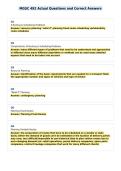
MGSC 492 Actual Questions and Correct Answers
Q1
4 Routing & Scheduling Problems
Answer: resource planning "what if" planning fixed-route scheduling variable/daily
route schedules
Q2
Complications of Routing & Scheduling Problems
Answer: many different types of problems that need to be understood and approached
in different ways many different algorithms or methods can be used many detailed
aspects that need to be taken into account
Q3
Resource Planning
Answer: identification of the basic requirements that are needed for a transport fleet:
the appropriate number and types of vehicles and type of drivers
Q4
"What If" Planning
Answer: contingency planning
Q5
Planning Fixed Routes
Answer: Planning Fixed Routes
Q6
Planning Variable Routes
Answer: the preparation of routes that have to be scheduled on a weekly or daily
basis; either the demand of goods can't be estimated or the location of delivery points
may vary; very difficult/impossible to use historical data to plan vehicle routes due to
ever-changing demand (ex: retail operations, parcel delivery companies, spare parts
companies, contract haulage companies that work for many different clients)
, Q7
Major Benefit of a Scheduler
Answer: the scheduler is in a position to make changes to routes as they are required
Q8
Savings Method
Answer: Memorize formula: A+B-C if number is positive, you go all the way around if
number is negative, you go out to A, back to origin, then out to B and back to origin
Q9
Advantages of Scheduling & Planning Software
Answer: decreased standing costs as the number of vehicles required by a fleet can be
minimized decreased running costs as efficient routing reduces distance travelled by
the vehicle less need to hire in vehicles increased customer service through consistent
and reliable schedules less chance of breaking transport regulations through the
ability to program in legislative constraints savings in management time as schedules
can be calculated quickly increased level of control because more accurate
management reporting is possible
Q10
Role of a Freight Forwarder
Answer: oversee and manage the movement of freight from the point of origin to the
point of destination
Q11
Uncertanties of Global Logistics Activities
Answer: Distance: longer transport distance Demand: increased uncertainty of
demand Diversity: diversity of culture and administration Documentation: wide
differences in documentation required to facilitate international freight Desires (5th
D): increasing desires of customers who expect lower prices
Q12
Non-Vessel Operating Common Carrier (NVOCC) Services
Answer: maritime support purchase space on vessels at a discounted rate that they
then sell on to clients at a higher rate many are freight forwarders that issue bills of
ladings on ships they don't own, called house bills of lading
Q1
4 Routing & Scheduling Problems
Answer: resource planning "what if" planning fixed-route scheduling variable/daily
route schedules
Q2
Complications of Routing & Scheduling Problems
Answer: many different types of problems that need to be understood and approached
in different ways many different algorithms or methods can be used many detailed
aspects that need to be taken into account
Q3
Resource Planning
Answer: identification of the basic requirements that are needed for a transport fleet:
the appropriate number and types of vehicles and type of drivers
Q4
"What If" Planning
Answer: contingency planning
Q5
Planning Fixed Routes
Answer: Planning Fixed Routes
Q6
Planning Variable Routes
Answer: the preparation of routes that have to be scheduled on a weekly or daily
basis; either the demand of goods can't be estimated or the location of delivery points
may vary; very difficult/impossible to use historical data to plan vehicle routes due to
ever-changing demand (ex: retail operations, parcel delivery companies, spare parts
companies, contract haulage companies that work for many different clients)
, Q7
Major Benefit of a Scheduler
Answer: the scheduler is in a position to make changes to routes as they are required
Q8
Savings Method
Answer: Memorize formula: A+B-C if number is positive, you go all the way around if
number is negative, you go out to A, back to origin, then out to B and back to origin
Q9
Advantages of Scheduling & Planning Software
Answer: decreased standing costs as the number of vehicles required by a fleet can be
minimized decreased running costs as efficient routing reduces distance travelled by
the vehicle less need to hire in vehicles increased customer service through consistent
and reliable schedules less chance of breaking transport regulations through the
ability to program in legislative constraints savings in management time as schedules
can be calculated quickly increased level of control because more accurate
management reporting is possible
Q10
Role of a Freight Forwarder
Answer: oversee and manage the movement of freight from the point of origin to the
point of destination
Q11
Uncertanties of Global Logistics Activities
Answer: Distance: longer transport distance Demand: increased uncertainty of
demand Diversity: diversity of culture and administration Documentation: wide
differences in documentation required to facilitate international freight Desires (5th
D): increasing desires of customers who expect lower prices
Q12
Non-Vessel Operating Common Carrier (NVOCC) Services
Answer: maritime support purchase space on vessels at a discounted rate that they
then sell on to clients at a higher rate many are freight forwarders that issue bills of
ladings on ships they don't own, called house bills of lading

