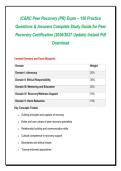
IC&RC Peer Recovery (PR) Exam – 150 Practice
Questions & Answers Complete Study Guide for Peer
Recovery Certification (2026/2027 Update) Instant Pdf
Download
Content Domains and Exam Blueprint:
Domain Weight
Domain I: Advocacy 20%
Domain II: Ethical Responsibility 30%
Domain III: Mentoring and Education 20%
Domain IV: Recovery/Wellness Support 15%
Domain V: Harm Reduction 15%
Key Concepts Tested:
Guiding principles and aspects of recovery
Roles and core values of peer recovery specialists
Relationship building and communication skills
Cultural competence in recovery support
Boundaries and ethical issues
Trauma-informed approaches
, Recovery and wellness planning
Section 1: Advocacy (Domain I – 20%) (Questions 1-30)
1. A peer recovery specialist is helping a person access housing assistance. The
peer knows the individual qualifies for a program, but the application is complex.
Which action best demonstrates individual advocacy?
A) Complete the application for the individual without their input
B) Support the individual in completing the application themselves while offering guidance
C) Refer the individual to a social worker and step away from the case
D) Tell the individual that housing is not a priority right now
Answer: B
Rationale: Individual advocacy means supporting the person to speak and act on their own
behalf. The peer should empower the individual to navigate systems while providing
appropriate guidance. Completing the application for them (A) creates dependency, not
empowerment.
2. Advocacy is intended to:
A) Provide education to peers/consumers
B) Support and find appropriate employment for peers/consumers
C) Provide housing and shelter for peers/consumers
D) Promote the dignity of and reduction of stigma against peers/consumers
Answer: D
Rationale: Advocacy is intended to promote the dignity of and reduce stigma against
peers/consumers.
,3. Which of the following best describes the role of a peer recovery specialist as an
advocate?
A) Making decisions on behalf of the peer
B) Speaking for the peer in all situations
C) Supporting the peer to speak for themselves and access their rights
D) Avoiding involvement in systems that affect the peer
Answer: C
Rationale: A peer recovery specialist advocates by supporting peers to speak for
themselves and access their rights.
4. When advocating within systems to promote person-centered recovery, the peer
specialist should:
A) Prioritize what the system requires over the peer's preferences
B) Follow agency policy regardless of the peer's wishes
C) Promote the peer's individual choice and self-determination
D) Refer all advocacy to a professional case manager
Answer: C
Rationale: Advocacy involves promoting individual choice and self-determination, not
prioritizing system needs over the peer's preferences.
5. Self-advocacy is important in recovery because it:
A) Reduces the need for peer support
B) Empowers individuals to take control of their own recovery
C) Eliminates the need for professional services
D) Is only relevant in clinical settings
, Answer: B
Rationale: Self-advocacy is a critical component of recovery because it empowers
individuals to take control of their own recovery journey.
6. A peer specialist notices that a peer is being treated unfairly by a service provider.
The peer specialist should:
A) Confront the provider directly and demand change
B) Ignore the situation to avoid conflict
C) Support the peer in addressing the issue and self-advocating
D) Report the provider to their supervisor immediately
Answer: C
Rationale: The peer specialist supports the peer in self-advocacy, helping them address the
issue themselves while offering guidance and support.
7. Which of the following is an example of systemic advocacy?
A) Helping a peer complete a housing application
B) Accompanying a peer to a doctor's appointment
C) Working to change policies that create barriers to recovery
D) Providing emotional support during a difficult time
Answer: C
Rationale: Systemic advocacy involves working to change policies, systems, or practices
that create barriers to recovery. Individual advocacy focuses on supporting one person.
8. Person-centered language in advocacy means:
A) Using clinical terminology to describe the peer
B) Referring to the peer by their diagnosis first
Questions & Answers Complete Study Guide for Peer
Recovery Certification (2026/2027 Update) Instant Pdf
Download
Content Domains and Exam Blueprint:
Domain Weight
Domain I: Advocacy 20%
Domain II: Ethical Responsibility 30%
Domain III: Mentoring and Education 20%
Domain IV: Recovery/Wellness Support 15%
Domain V: Harm Reduction 15%
Key Concepts Tested:
Guiding principles and aspects of recovery
Roles and core values of peer recovery specialists
Relationship building and communication skills
Cultural competence in recovery support
Boundaries and ethical issues
Trauma-informed approaches
, Recovery and wellness planning
Section 1: Advocacy (Domain I – 20%) (Questions 1-30)
1. A peer recovery specialist is helping a person access housing assistance. The
peer knows the individual qualifies for a program, but the application is complex.
Which action best demonstrates individual advocacy?
A) Complete the application for the individual without their input
B) Support the individual in completing the application themselves while offering guidance
C) Refer the individual to a social worker and step away from the case
D) Tell the individual that housing is not a priority right now
Answer: B
Rationale: Individual advocacy means supporting the person to speak and act on their own
behalf. The peer should empower the individual to navigate systems while providing
appropriate guidance. Completing the application for them (A) creates dependency, not
empowerment.
2. Advocacy is intended to:
A) Provide education to peers/consumers
B) Support and find appropriate employment for peers/consumers
C) Provide housing and shelter for peers/consumers
D) Promote the dignity of and reduction of stigma against peers/consumers
Answer: D
Rationale: Advocacy is intended to promote the dignity of and reduce stigma against
peers/consumers.
,3. Which of the following best describes the role of a peer recovery specialist as an
advocate?
A) Making decisions on behalf of the peer
B) Speaking for the peer in all situations
C) Supporting the peer to speak for themselves and access their rights
D) Avoiding involvement in systems that affect the peer
Answer: C
Rationale: A peer recovery specialist advocates by supporting peers to speak for
themselves and access their rights.
4. When advocating within systems to promote person-centered recovery, the peer
specialist should:
A) Prioritize what the system requires over the peer's preferences
B) Follow agency policy regardless of the peer's wishes
C) Promote the peer's individual choice and self-determination
D) Refer all advocacy to a professional case manager
Answer: C
Rationale: Advocacy involves promoting individual choice and self-determination, not
prioritizing system needs over the peer's preferences.
5. Self-advocacy is important in recovery because it:
A) Reduces the need for peer support
B) Empowers individuals to take control of their own recovery
C) Eliminates the need for professional services
D) Is only relevant in clinical settings
, Answer: B
Rationale: Self-advocacy is a critical component of recovery because it empowers
individuals to take control of their own recovery journey.
6. A peer specialist notices that a peer is being treated unfairly by a service provider.
The peer specialist should:
A) Confront the provider directly and demand change
B) Ignore the situation to avoid conflict
C) Support the peer in addressing the issue and self-advocating
D) Report the provider to their supervisor immediately
Answer: C
Rationale: The peer specialist supports the peer in self-advocacy, helping them address the
issue themselves while offering guidance and support.
7. Which of the following is an example of systemic advocacy?
A) Helping a peer complete a housing application
B) Accompanying a peer to a doctor's appointment
C) Working to change policies that create barriers to recovery
D) Providing emotional support during a difficult time
Answer: C
Rationale: Systemic advocacy involves working to change policies, systems, or practices
that create barriers to recovery. Individual advocacy focuses on supporting one person.
8. Person-centered language in advocacy means:
A) Using clinical terminology to describe the peer
B) Referring to the peer by their diagnosis first