

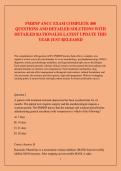
PMHNP ANCC EXAM COMPLETE 400
QUESTIONS AND DETAILED SOLUTIONS WITH
DETAILED RATIONALES LATEST UPDATE THIS
YEAR JUST RELEASED
This comprehensive 400-question ANCC PMHNP practice bank offers a complete, non-
repetitive review across all exam domains. It covers neurobiology, psychopharmacology, DSM-5
diagnostic criteria, psychotherapy modalities, and legal-ethical principles across the lifespan.
Each unique question presents a distinct clinical scenario, testing nuanced decision-making with
detailed rationales to reinforce core competencies. From medication mechanisms, drug
interactions, and side-effect management to therapeutic interventions, cultural formulation, and
risk assessment, this resource provides rigorous, high-yield preparation. With no overlapping
teaching points, it ensures broad, thorough content mastery for board certification success.
Question 1
A patient with treatment-resistant depression has been on phenelzine for six
months. The patient now requires surgery and the anesthesiologist requests a
washout period. The PMHNP knows that the minimal safe washout period before
administering general anesthesia with vasopressors is which of the following?
A) 7 days
B) 14 days
C) 21 days
D) 28 days
Correct Answer: B
Rationale: Phenelzine is a monoamine oxidase inhibitor (MAOI) that irreversibly
inhibits MAO enzymes. After stopping an irreversible MAOI, it takes
1
,approximately 14 days for sufficient new MAO enzyme synthesis to occur,
reducing the risk of hypertensive crisis when interacting with sympathomimetic
agents used in anesthesia. A 7-day period is insufficient, while 21 or 28 days
exceed the clinically recommended minimum.
---
Question 2
A 72-year-old patient with Alzheimer's disease is started on donepezil. The
PMHNP counsels the family about the most common gastrointestinal side effect,
which is primarily mediated by which receptor?
A) Nicotinic acetylcholine receptor
B) Muscarinic M1 receptor
C) Muscarinic M3 receptor
D) Dopamine D2 receptor
Correct Answer: C
Rationale: Donepezil is a cholinesterase inhibitor that increases acetylcholine
levels. The most common side effects, including nausea, vomiting, and diarrhea,
are mediated by peripheral muscarinic M3 receptors, which are abundant in the
gastrointestinal tract and smooth muscle. M1 receptors are more central and
involved in cognition. Nicotinic receptors are not primarily responsible for GI
effects.
---
Question 3
2
,A 16-year-old patient with bipolar I disorder is being treated with lithium. The
PMHNP orders baseline laboratory studies. Which finding would be a relative
contraindication to starting lithium therapy?
A) Serum creatinine of 0.8 mg/dL
B) eGFR of 55 mL/min/1.73m²
C) TSH of 2.5 mIU/L
D) Serum sodium of 138 mEq/L
Correct Answer: B
Rationale: Lithium is excreted renally, and significant renal impairment (eGFR
below 60 mL/min/1.73m²) is a relative contraindication due to the high risk of
lithium accumulation and toxicity. A creatinine of 0.8 is normal, a TSH of 2.5 is
normal, and a sodium of 138 is within normal limits.
---
Question 4
A patient presents with acute dystonia after receiving haloperidol. The PMHNP
administers diphenhydramine. The therapeutic action of diphenhydramine in this
context is mediated by which neurotransmitter system?
A) Dopamine antagonism
B) Acetylcholine antagonism
C) Histamine antagonism
D) Serotonin agonism
Correct Answer: B
Rationale: Acute dystonia from antipsychotics is caused by dopamine D2 receptor
blockade in the nigrostriatal pathway, leading to a relative excess of acetylcholine.
3
, Diphenhydramine is an anticholinergic agent that restores the balance between
dopamine and acetylcholine in the basal ganglia, thereby relieving dystonic
symptoms.
---
Question 5
A patient on long-term clozapine therapy develops significant weight gain and
new-onset hyperglycemia. The PMHNP recognizes that this metabolic syndrome is
most strongly associated with antagonism at which receptor?
A) Alpha-1 adrenergic receptor
B) Histamine H1 receptor
C) Muscarinic M1 receptor
D) Serotonin 5-HT2A receptor
Correct Answer: B
Rationale: Clozapine's high affinity for histamine H1 receptors is strongly
correlated with weight gain, sedation, and metabolic disturbances including
hyperglycemia and dyslipidemia. While 5-HT2A and alpha-1 antagonism also
contribute to side effects, H1 antagonism is the primary driver of metabolic
syndrome with clozapine and olanzapine.
---
Question 6
A 45-year-old patient with generalized anxiety disorder is prescribed buspirone.
The PMHNP explains that buspirone has a delayed onset of therapeutic effect,
typically requiring how many weeks to achieve full efficacy?
A) 1 to 2 weeks
4
QUESTIONS AND DETAILED SOLUTIONS WITH
DETAILED RATIONALES LATEST UPDATE THIS
YEAR JUST RELEASED
This comprehensive 400-question ANCC PMHNP practice bank offers a complete, non-
repetitive review across all exam domains. It covers neurobiology, psychopharmacology, DSM-5
diagnostic criteria, psychotherapy modalities, and legal-ethical principles across the lifespan.
Each unique question presents a distinct clinical scenario, testing nuanced decision-making with
detailed rationales to reinforce core competencies. From medication mechanisms, drug
interactions, and side-effect management to therapeutic interventions, cultural formulation, and
risk assessment, this resource provides rigorous, high-yield preparation. With no overlapping
teaching points, it ensures broad, thorough content mastery for board certification success.
Question 1
A patient with treatment-resistant depression has been on phenelzine for six
months. The patient now requires surgery and the anesthesiologist requests a
washout period. The PMHNP knows that the minimal safe washout period before
administering general anesthesia with vasopressors is which of the following?
A) 7 days
B) 14 days
C) 21 days
D) 28 days
Correct Answer: B
Rationale: Phenelzine is a monoamine oxidase inhibitor (MAOI) that irreversibly
inhibits MAO enzymes. After stopping an irreversible MAOI, it takes
1
,approximately 14 days for sufficient new MAO enzyme synthesis to occur,
reducing the risk of hypertensive crisis when interacting with sympathomimetic
agents used in anesthesia. A 7-day period is insufficient, while 21 or 28 days
exceed the clinically recommended minimum.
---
Question 2
A 72-year-old patient with Alzheimer's disease is started on donepezil. The
PMHNP counsels the family about the most common gastrointestinal side effect,
which is primarily mediated by which receptor?
A) Nicotinic acetylcholine receptor
B) Muscarinic M1 receptor
C) Muscarinic M3 receptor
D) Dopamine D2 receptor
Correct Answer: C
Rationale: Donepezil is a cholinesterase inhibitor that increases acetylcholine
levels. The most common side effects, including nausea, vomiting, and diarrhea,
are mediated by peripheral muscarinic M3 receptors, which are abundant in the
gastrointestinal tract and smooth muscle. M1 receptors are more central and
involved in cognition. Nicotinic receptors are not primarily responsible for GI
effects.
---
Question 3
2
,A 16-year-old patient with bipolar I disorder is being treated with lithium. The
PMHNP orders baseline laboratory studies. Which finding would be a relative
contraindication to starting lithium therapy?
A) Serum creatinine of 0.8 mg/dL
B) eGFR of 55 mL/min/1.73m²
C) TSH of 2.5 mIU/L
D) Serum sodium of 138 mEq/L
Correct Answer: B
Rationale: Lithium is excreted renally, and significant renal impairment (eGFR
below 60 mL/min/1.73m²) is a relative contraindication due to the high risk of
lithium accumulation and toxicity. A creatinine of 0.8 is normal, a TSH of 2.5 is
normal, and a sodium of 138 is within normal limits.
---
Question 4
A patient presents with acute dystonia after receiving haloperidol. The PMHNP
administers diphenhydramine. The therapeutic action of diphenhydramine in this
context is mediated by which neurotransmitter system?
A) Dopamine antagonism
B) Acetylcholine antagonism
C) Histamine antagonism
D) Serotonin agonism
Correct Answer: B
Rationale: Acute dystonia from antipsychotics is caused by dopamine D2 receptor
blockade in the nigrostriatal pathway, leading to a relative excess of acetylcholine.
3
, Diphenhydramine is an anticholinergic agent that restores the balance between
dopamine and acetylcholine in the basal ganglia, thereby relieving dystonic
symptoms.
---
Question 5
A patient on long-term clozapine therapy develops significant weight gain and
new-onset hyperglycemia. The PMHNP recognizes that this metabolic syndrome is
most strongly associated with antagonism at which receptor?
A) Alpha-1 adrenergic receptor
B) Histamine H1 receptor
C) Muscarinic M1 receptor
D) Serotonin 5-HT2A receptor
Correct Answer: B
Rationale: Clozapine's high affinity for histamine H1 receptors is strongly
correlated with weight gain, sedation, and metabolic disturbances including
hyperglycemia and dyslipidemia. While 5-HT2A and alpha-1 antagonism also
contribute to side effects, H1 antagonism is the primary driver of metabolic
syndrome with clozapine and olanzapine.
---
Question 6
A 45-year-old patient with generalized anxiety disorder is prescribed buspirone.
The PMHNP explains that buspirone has a delayed onset of therapeutic effect,
typically requiring how many weeks to achieve full efficacy?
A) 1 to 2 weeks
4

