

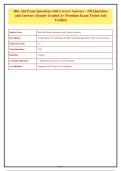
Rite Aid Exam Questions with Correct Answers - 238 Questions
and Answers Already Graded A+ Premium Exam Tested And
Verified
Subject Area Rite Aid Exam Questions with Correct Answers
Description Comprehensive examination on Rite Aid Exam Questions with Correct Answers.
Expected Grade A+
Total Questions 238
Duration 3 hours
Learning Outcomes 1. Demonstrate mastery of core concepts
Accreditation Aligned with US university standards.
Page 1
,1. In a state that mandates pharmacist counseling for all new prescriptions, a patient
presents a prescription for a controlled substance. The patient refuses counseling.
Which action is legally permissible?
A. Document refusal and dispense without counseling
B. Refuse to dispense the prescription
C. Provide written information only
D. Dispense after verbal summary
Answer: A. Document refusal and dispense without counseling
Mandatory counseling laws require an offer; if patient refuses, documentation of
refusal satisfies legal requirements. Refusing to dispense is not required unless the
pharmacist deems it necessary for safety. Written information alone does not meet the
counseling requirement.
2. A patient on warfarin is prescribed a course of fluconazole. What is the primary
mechanism of the resulting drug interaction?
A. Displacement of warfarin from albumin binding sites
B. Inhibition of CYP2C9 metabolism of warfarin
C. Induction of CYP3A4 metabolism of warfarin
D. Competition for renal tubular secretion
Answer: B. Inhibition of CYP2C9 metabolism of warfarin
Fluconazole is a strong inhibitor of CYP2C9, the primary enzyme metabolizing
S-warfarin. This increases warfarin's anticoagulant effect. Displacement from albumin
is minor; fluconazole does not induce CYP3A4 or affect renal secretion of warfarin.
3. A pharmacist receives a prescription for a 30-day supply of a Schedule II
medication with no refills. The patient requests a refill after 28 days. What is the best
course of action?
A. Refill the prescription as a new prescription from the prescriber
B. Provide a 2-day emergency supply under federal law
C. Refuse the refill and refer the patient back to the prescriber
D. Dispense a partial fill of the remaining days
Answer: A. Refill the prescription as a new prescription from the prescriber
Schedule II prescriptions cannot be refilled; a new prescription is required. Federal law
does not allow emergency supplies for C-II. Partial fills are only permitted in specific
circumstances, not routine refills. Therefore, the patient must obtain a new
prescription.
Page 2
,4. A patient with type 2 diabetes on metformin and glipizide develops acute kidney
injury (eGFR 25 mL/min). Which medication adjustment is most critical?
A. Discontinue metformin immediately
B. Reduce glipizide dose by 50%
C. Switch metformin to insulin
D. Continue both with monitoring
Answer: A. Discontinue metformin immediately
Metformin is contraindicated when eGFR <30 mL/min due to risk of lactic acidosis.
Glipizide is hepatically eliminated and does not require dose adjustment in renal
impairment. Switching to insulin may be necessary but is not the most critical
immediate action.
5. Which of the following best describes the mechanism of action of semaglutide in
weight management?
A. Inhibition of pancreatic lipase, reducing fat absorption
B. Agonism at GLP-1 receptors, delaying gastric emptying and increasing satiety
C. Blockade of cannabinoid CB1 receptors, suppressing appetite
D. Activation of melanocortin-4 receptors, increasing energy expenditure
Answer: B. Agonism at GLP-1 receptors, delaying gastric emptying and increasing
satiety
Semaglutide is a GLP-1 receptor agonist that slows gastric emptying and promotes
satiety via central and peripheral actions. It does not inhibit lipase (orlistat), block CB1
(rimonabant, withdrawn), or activate MC4R (setmelanotide, for rare obesity).
6. A patient on lithium presents with nausea, tremor, and confusion. Labs show
lithium level 1.8 mEq/L. Which intervention is most appropriate?
A. Administer sodium polystyrene sulfonate
B. Start hemodialysis immediately
C. Hold lithium and administer IV normal saline
D. Increase lithium dose to overcome tolerance
Answer: C. Hold lithium and administer IV normal saline
Lithium toxicity (level >1.5) requires discontinuation and volume expansion with
normal saline to enhance renal excretion. Sodium polystyrene sulfonate is not effective
for lithium. Hemodialysis is reserved for severe toxicity (level >2.5 or symptoms).
Increasing dose worsens toxicity.
Page 3
, 7. A pharmacy technician accidentally dispenses the wrong medication to a patient.
The patient takes one dose and experiences no adverse effects. The pharmacist
discovers the error the next day. What is the pharmacist's primary legal and ethical
obligation?
A. Document the error in the patient's record and notify the prescriber
B. Report the error to the state board of pharmacy immediately
C. Contact the patient, explain the error, and advise on monitoring
D. Do nothing since no harm occurred
Answer: C. Contact the patient, explain the error, and advise on monitoring
The pharmacist must disclose the error to the patient to maintain trust and allow for
appropriate monitoring. Documentation and prescriber notification are important but
secondary. Reporting to the board is not immediate unless required by law. Doing
nothing violates ethical duties.
8. A patient with a peanut allergy is prescribed a medication that contains peanut oil
as an excipient. The pharmacist should:
A. Dispense as prescribed, as peanut oil is highly refined and safe
B. Contact the prescriber to recommend an alternative formulation
C. Counsel the patient to take with food to reduce reaction risk
D. Advise the patient to carry epinephrine auto-injector
Answer: B. Contact the prescriber to recommend an alternative formulation
Even highly refined peanut oil may pose a risk in sensitive individuals; the safest action
is to recommend an alternative. Dispensing without change could cause anaphylaxis.
Counseling or advising epinephrine does not address the root problem.
9. A patient is prescribed a transdermal fentanyl patch. Which instruction is most
important for the pharmacist to provide?
A. Apply the patch to the same site each time to ensure consistent absorption
B. Cut the patch if a lower dose is needed
C. Avoid exposure to direct heat sources while wearing the patch
D. Apply the patch to hairy skin for better adhesion
Answer: C. Avoid exposure to direct heat sources while wearing the patch
Heat increases fentanyl absorption, risking overdose. Patches should be applied to
non-hairy, clean skin and rotated sites. Cutting patches destroys the rate-controlling
membrane and can cause fatal release. Heat sources must be avoided.
Page 4
and Answers Already Graded A+ Premium Exam Tested And
Verified
Subject Area Rite Aid Exam Questions with Correct Answers
Description Comprehensive examination on Rite Aid Exam Questions with Correct Answers.
Expected Grade A+
Total Questions 238
Duration 3 hours
Learning Outcomes 1. Demonstrate mastery of core concepts
Accreditation Aligned with US university standards.
Page 1
,1. In a state that mandates pharmacist counseling for all new prescriptions, a patient
presents a prescription for a controlled substance. The patient refuses counseling.
Which action is legally permissible?
A. Document refusal and dispense without counseling
B. Refuse to dispense the prescription
C. Provide written information only
D. Dispense after verbal summary
Answer: A. Document refusal and dispense without counseling
Mandatory counseling laws require an offer; if patient refuses, documentation of
refusal satisfies legal requirements. Refusing to dispense is not required unless the
pharmacist deems it necessary for safety. Written information alone does not meet the
counseling requirement.
2. A patient on warfarin is prescribed a course of fluconazole. What is the primary
mechanism of the resulting drug interaction?
A. Displacement of warfarin from albumin binding sites
B. Inhibition of CYP2C9 metabolism of warfarin
C. Induction of CYP3A4 metabolism of warfarin
D. Competition for renal tubular secretion
Answer: B. Inhibition of CYP2C9 metabolism of warfarin
Fluconazole is a strong inhibitor of CYP2C9, the primary enzyme metabolizing
S-warfarin. This increases warfarin's anticoagulant effect. Displacement from albumin
is minor; fluconazole does not induce CYP3A4 or affect renal secretion of warfarin.
3. A pharmacist receives a prescription for a 30-day supply of a Schedule II
medication with no refills. The patient requests a refill after 28 days. What is the best
course of action?
A. Refill the prescription as a new prescription from the prescriber
B. Provide a 2-day emergency supply under federal law
C. Refuse the refill and refer the patient back to the prescriber
D. Dispense a partial fill of the remaining days
Answer: A. Refill the prescription as a new prescription from the prescriber
Schedule II prescriptions cannot be refilled; a new prescription is required. Federal law
does not allow emergency supplies for C-II. Partial fills are only permitted in specific
circumstances, not routine refills. Therefore, the patient must obtain a new
prescription.
Page 2
,4. A patient with type 2 diabetes on metformin and glipizide develops acute kidney
injury (eGFR 25 mL/min). Which medication adjustment is most critical?
A. Discontinue metformin immediately
B. Reduce glipizide dose by 50%
C. Switch metformin to insulin
D. Continue both with monitoring
Answer: A. Discontinue metformin immediately
Metformin is contraindicated when eGFR <30 mL/min due to risk of lactic acidosis.
Glipizide is hepatically eliminated and does not require dose adjustment in renal
impairment. Switching to insulin may be necessary but is not the most critical
immediate action.
5. Which of the following best describes the mechanism of action of semaglutide in
weight management?
A. Inhibition of pancreatic lipase, reducing fat absorption
B. Agonism at GLP-1 receptors, delaying gastric emptying and increasing satiety
C. Blockade of cannabinoid CB1 receptors, suppressing appetite
D. Activation of melanocortin-4 receptors, increasing energy expenditure
Answer: B. Agonism at GLP-1 receptors, delaying gastric emptying and increasing
satiety
Semaglutide is a GLP-1 receptor agonist that slows gastric emptying and promotes
satiety via central and peripheral actions. It does not inhibit lipase (orlistat), block CB1
(rimonabant, withdrawn), or activate MC4R (setmelanotide, for rare obesity).
6. A patient on lithium presents with nausea, tremor, and confusion. Labs show
lithium level 1.8 mEq/L. Which intervention is most appropriate?
A. Administer sodium polystyrene sulfonate
B. Start hemodialysis immediately
C. Hold lithium and administer IV normal saline
D. Increase lithium dose to overcome tolerance
Answer: C. Hold lithium and administer IV normal saline
Lithium toxicity (level >1.5) requires discontinuation and volume expansion with
normal saline to enhance renal excretion. Sodium polystyrene sulfonate is not effective
for lithium. Hemodialysis is reserved for severe toxicity (level >2.5 or symptoms).
Increasing dose worsens toxicity.
Page 3
, 7. A pharmacy technician accidentally dispenses the wrong medication to a patient.
The patient takes one dose and experiences no adverse effects. The pharmacist
discovers the error the next day. What is the pharmacist's primary legal and ethical
obligation?
A. Document the error in the patient's record and notify the prescriber
B. Report the error to the state board of pharmacy immediately
C. Contact the patient, explain the error, and advise on monitoring
D. Do nothing since no harm occurred
Answer: C. Contact the patient, explain the error, and advise on monitoring
The pharmacist must disclose the error to the patient to maintain trust and allow for
appropriate monitoring. Documentation and prescriber notification are important but
secondary. Reporting to the board is not immediate unless required by law. Doing
nothing violates ethical duties.
8. A patient with a peanut allergy is prescribed a medication that contains peanut oil
as an excipient. The pharmacist should:
A. Dispense as prescribed, as peanut oil is highly refined and safe
B. Contact the prescriber to recommend an alternative formulation
C. Counsel the patient to take with food to reduce reaction risk
D. Advise the patient to carry epinephrine auto-injector
Answer: B. Contact the prescriber to recommend an alternative formulation
Even highly refined peanut oil may pose a risk in sensitive individuals; the safest action
is to recommend an alternative. Dispensing without change could cause anaphylaxis.
Counseling or advising epinephrine does not address the root problem.
9. A patient is prescribed a transdermal fentanyl patch. Which instruction is most
important for the pharmacist to provide?
A. Apply the patch to the same site each time to ensure consistent absorption
B. Cut the patch if a lower dose is needed
C. Avoid exposure to direct heat sources while wearing the patch
D. Apply the patch to hairy skin for better adhesion
Answer: C. Avoid exposure to direct heat sources while wearing the patch
Heat increases fentanyl absorption, risking overdose. Patches should be applied to
non-hairy, clean skin and rotated sites. Cutting patches destroys the rate-controlling
membrane and can cause fatal release. Heat sources must be avoided.
Page 4

