

C ERT I F I ED
PCA.
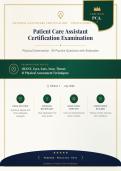
N A T I O N A L H E A LT H C A R E C E R T I F I C A T I O N · P R O F E S S I O N A L S TA N D A R D S
Patient Care Assistant
Certification Examination
Physical Examination · 96 Practice Questions with Rationales
E X A M I N AT I O N F O C U S :
HEENT, Eyes, Ears, Nose, Throat
& Physical Assessment Techniques
Edition 1 · July 2026
EXAM FOCUSED DETAILED HIGH-YIELD CONFIDENCE
RATIONALES CONTENT BUILDER
Questions aligned with
PCA certification Clear explanations for Focus on tested physical Practice smarter and pass
standards every answer exam concepts with confidence
P r e pa r e · P r a c t i c e · Pa s s
Excellence in Patient Care Certification
,PCA CERTIFICATION · PHYSICAL EXAMINATION TABLE OF CONTENTS
Table of Contents
1. Instructions for Use 3
2. Questions 1–96 — Eyes, Ears, Nose, Throat & Physical Assessment 3
3. Seller Appreciation 16
PCA · Patient Care Assistant Certification Page 2
,PCA CERTIFICATION GUIDE INSTRUCTIONS & PRACTICE QUESTIONS 1–96
How to Use This Guide
Read each stem, select your answer, then review the rationale. Correct answers are distributed
across all four letter positions. Covers eyes, ears, nose, throat, and physical examination
techniques for PCA certification.
Questions 1–30: Eyes, Ears & Hearing Assessment
1 The #1 cause of vision loss in the elderly is:
A Macular degeneration
B Cataracts
C Glaucoma
D Diabetic retinopathy
Correct Answer: A. Age-related macular degeneration (AMD) is the leading cause
of severe vision loss in older adults.
Rationale: AMD affects the macula — central vision required for reading and
facial recognition. B causes clouding but is treatable. C damages peripheral vision
first. D is a complication of diabetes.
2 When a patient looks directly at your pen light during an eye exam, you are
viewing the:
A Optic disc and retinal vessels
B Fovea and macula (area of central vision)
C Peripheral retina
D Lens and cornea
Correct Answer: B. Direct fixation aligns the fovea centralis with the examiner's
light — this is the area of sharpest vision.
Rationale: A is viewed when the patient looks slightly away. C requires dilated
exam. D are anterior structures visible without ophthalmoscope.
, 3 Fluorescein stains in an eye exam are used for:
A Measuring intraocular pressure
B Detecting corneal abrasions
C Assessing lens opacity
D Evaluating retinal detachment
Correct Answer: B. Fluorescein dye highlights epithelial defects — corneal
abrasions appear green under cobalt blue light.
Rationale: A uses tonometry. C uses slit lamp. D uses ophthalmoscopy.
Fluorescein is essential for evaluating eye trauma and foreign body sensation.
4 The swinging flashlight test is used to:
A Measure visual acuity
B Test for functional impairment of the optic nerve and detect RAPD/Marcus
Gunn pupil
C Assess extraocular muscle function
D Evaluate corneal reflex
Correct Answer: B. The swinging flashlight test detects relative afferent pupillary
defect — indicating optic nerve or retinal damage.
Rationale: A uses Snellen chart. C uses H-test. D tests CN V/VII. A positive RAPD is
a critical neurological finding requiring further evaluation.
PCA.
N A T I O N A L H E A LT H C A R E C E R T I F I C A T I O N · P R O F E S S I O N A L S TA N D A R D S
Patient Care Assistant
Certification Examination
Physical Examination · 96 Practice Questions with Rationales
E X A M I N AT I O N F O C U S :
HEENT, Eyes, Ears, Nose, Throat
& Physical Assessment Techniques
Edition 1 · July 2026
EXAM FOCUSED DETAILED HIGH-YIELD CONFIDENCE
RATIONALES CONTENT BUILDER
Questions aligned with
PCA certification Clear explanations for Focus on tested physical Practice smarter and pass
standards every answer exam concepts with confidence
P r e pa r e · P r a c t i c e · Pa s s
Excellence in Patient Care Certification
,PCA CERTIFICATION · PHYSICAL EXAMINATION TABLE OF CONTENTS
Table of Contents
1. Instructions for Use 3
2. Questions 1–96 — Eyes, Ears, Nose, Throat & Physical Assessment 3
3. Seller Appreciation 16
PCA · Patient Care Assistant Certification Page 2
,PCA CERTIFICATION GUIDE INSTRUCTIONS & PRACTICE QUESTIONS 1–96
How to Use This Guide
Read each stem, select your answer, then review the rationale. Correct answers are distributed
across all four letter positions. Covers eyes, ears, nose, throat, and physical examination
techniques for PCA certification.
Questions 1–30: Eyes, Ears & Hearing Assessment
1 The #1 cause of vision loss in the elderly is:
A Macular degeneration
B Cataracts
C Glaucoma
D Diabetic retinopathy
Correct Answer: A. Age-related macular degeneration (AMD) is the leading cause
of severe vision loss in older adults.
Rationale: AMD affects the macula — central vision required for reading and
facial recognition. B causes clouding but is treatable. C damages peripheral vision
first. D is a complication of diabetes.
2 When a patient looks directly at your pen light during an eye exam, you are
viewing the:
A Optic disc and retinal vessels
B Fovea and macula (area of central vision)
C Peripheral retina
D Lens and cornea
Correct Answer: B. Direct fixation aligns the fovea centralis with the examiner's
light — this is the area of sharpest vision.
Rationale: A is viewed when the patient looks slightly away. C requires dilated
exam. D are anterior structures visible without ophthalmoscope.
, 3 Fluorescein stains in an eye exam are used for:
A Measuring intraocular pressure
B Detecting corneal abrasions
C Assessing lens opacity
D Evaluating retinal detachment
Correct Answer: B. Fluorescein dye highlights epithelial defects — corneal
abrasions appear green under cobalt blue light.
Rationale: A uses tonometry. C uses slit lamp. D uses ophthalmoscopy.
Fluorescein is essential for evaluating eye trauma and foreign body sensation.
4 The swinging flashlight test is used to:
A Measure visual acuity
B Test for functional impairment of the optic nerve and detect RAPD/Marcus
Gunn pupil
C Assess extraocular muscle function
D Evaluate corneal reflex
Correct Answer: B. The swinging flashlight test detects relative afferent pupillary
defect — indicating optic nerve or retinal damage.
Rationale: A uses Snellen chart. C uses H-test. D tests CN V/VII. A positive RAPD is
a critical neurological finding requiring further evaluation.

