

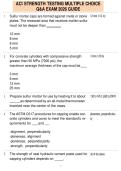
ACI STRENGTH TESTING MULTIPLE CHOICE
Q&A EXAM 2026 GUIDE
1. Sulfur mortar caps are formed against metal or stone 12 mm (1/2 in)
plates. The recessed area that receives molten sulfur
must not be deeper than
12 mm
8 mm
6 mm
5 mm
2. For concrete cylinders with compressive strength 3 mm (1/8 in)
greater than 50 MPa (7000 psi), the
maximum average thickness of the cap must be
3 mm
6 mm
12 mm
25 mm
3. Prepare sulfur mortar for use by heating it to about 130 to 145 C (265 to 290 F)
as determined by an all-metal thermometer
inserted near the center of the mass.
4. The ASTM C617 procedures for capping enable con- planeness, perpendicular-
crete cylinders and cores to meet the standard's re- ly
quirements for and .
-alignment, perpendicularity
-planeness, alignment
-planeness, perpendicularity
-strength, perpendicularity
5. The strength of neat hydraulic cement paste used for all of the above
capping cylinders depends on .
, ACI STRENGTH TESTING MULTIPLE CHOICE
Q&A EXAM 2026 GUIDE
-the water/cement ratio
-time
-its consistency
-the type of cement
-all of the above
6. Hydrogen sulfide gas, which may be produced during True
capping, may be lethal in high concentrations. In lower
concentrations, the gas may result in nausea, stom-
ach distress, dizziness, headache, and irritation of the
eyes.
True or False
7. Plates for neat cement and high-strength gypsum glass
plaster caps should be made of
, metal, granite, or diabase.
-glass
-neoprene
-polychloroprene
-Sulfur
8. The ends of a freshly molded cylinder can be capped -neat cement paste only
with .
-neat cement paste, high strength gypsum paste, or
sulfur mortar
-neat cement paste or high strength gypsum paste
-neat cement paste only
-high strength gypsum paste only
, 9. Empty the pot and recharge with fresh material at Five
intervals to ensure that the oldest material in the pot
has not been used more than times.
-two
-three
-four
-five
10. The end surface of a capped cylinder must be plane 0.05 mm (0.002 in.)
within .
0.5 degrees
1 mm (0.05 in.)
0.2 mm (0.01 in.)
0.05 mm (0.002 in.)
11. ASTM C617 describes procedures for creating plane True
surfaces on the ends of freshly
molded cylinders, hardened cylinders, and drilled
cores.
True or False
12. Prepare sulfur mortar for use by heating to a temper- between 130 to 145 °C
ature . (265 to 290 °F)
-of approximately 130 °C (265 °F)
-no less than 130 °C (265 °F)
-between 130 to 145 °C (265 to 290 °F)
-of approximately 145 °C (290 °F)
13. Sulfur mortars and high-strength gypsum cement -35 MPa [5000 psi]
cubes must demonstrate a minimum
Q&A EXAM 2026 GUIDE
1. Sulfur mortar caps are formed against metal or stone 12 mm (1/2 in)
plates. The recessed area that receives molten sulfur
must not be deeper than
12 mm
8 mm
6 mm
5 mm
2. For concrete cylinders with compressive strength 3 mm (1/8 in)
greater than 50 MPa (7000 psi), the
maximum average thickness of the cap must be
3 mm
6 mm
12 mm
25 mm
3. Prepare sulfur mortar for use by heating it to about 130 to 145 C (265 to 290 F)
as determined by an all-metal thermometer
inserted near the center of the mass.
4. The ASTM C617 procedures for capping enable con- planeness, perpendicular-
crete cylinders and cores to meet the standard's re- ly
quirements for and .
-alignment, perpendicularity
-planeness, alignment
-planeness, perpendicularity
-strength, perpendicularity
5. The strength of neat hydraulic cement paste used for all of the above
capping cylinders depends on .
, ACI STRENGTH TESTING MULTIPLE CHOICE
Q&A EXAM 2026 GUIDE
-the water/cement ratio
-time
-its consistency
-the type of cement
-all of the above
6. Hydrogen sulfide gas, which may be produced during True
capping, may be lethal in high concentrations. In lower
concentrations, the gas may result in nausea, stom-
ach distress, dizziness, headache, and irritation of the
eyes.
True or False
7. Plates for neat cement and high-strength gypsum glass
plaster caps should be made of
, metal, granite, or diabase.
-glass
-neoprene
-polychloroprene
-Sulfur
8. The ends of a freshly molded cylinder can be capped -neat cement paste only
with .
-neat cement paste, high strength gypsum paste, or
sulfur mortar
-neat cement paste or high strength gypsum paste
-neat cement paste only
-high strength gypsum paste only
, 9. Empty the pot and recharge with fresh material at Five
intervals to ensure that the oldest material in the pot
has not been used more than times.
-two
-three
-four
-five
10. The end surface of a capped cylinder must be plane 0.05 mm (0.002 in.)
within .
0.5 degrees
1 mm (0.05 in.)
0.2 mm (0.01 in.)
0.05 mm (0.002 in.)
11. ASTM C617 describes procedures for creating plane True
surfaces on the ends of freshly
molded cylinders, hardened cylinders, and drilled
cores.
True or False
12. Prepare sulfur mortar for use by heating to a temper- between 130 to 145 °C
ature . (265 to 290 °F)
-of approximately 130 °C (265 °F)
-no less than 130 °C (265 °F)
-between 130 to 145 °C (265 to 290 °F)
-of approximately 145 °C (290 °F)
13. Sulfur mortars and high-strength gypsum cement -35 MPa [5000 psi]
cubes must demonstrate a minimum

