Florida PT Jurisprudence Exam
2026/2027 Questions and Answers (Verified Answers)
Aligned with Florida Board of Physical Therapy Jurisprudence Examination Standards
Chapter 486, Chapter 456, Florida Statutes, and Rule 64B17, Florida Administrative Code
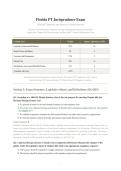
Content Area Weight Approx. Questions (of 40)
Legislative Intent and Definitions 25% 10
Board Powers and Duties 5% 2
Licensure and Examination 7.5% 3
Patient Care 35% 14
Disciplinary Action and Unlawful Practice 15% 6
Consumer Advocacy 12.5% 5
Examination: 40 scored questions | Cognitive Levels: 30% Recall, 50% Application, 20% Analysis
Question Design: 70% Scenario-Based, 25% Direct Recall, 5% Regulatory Analysis
Section 1: Exam Structure, Legislative Intent, and Definitions (Q1-Q25)
Q1: According to s. 486.015, Florida Statutes, what is the sole purpose for enacting Chapter 486, the
Physical Therapy Practice Act?
A. To generate revenue for the state through licensure fees and regulatory fines
B. To ensure every physical therapy practitioner in Florida meets minimum requirements for safe practice
**[CORRECT]**
C. To establish competitive standards that differentiate Florida from other states in practice requirements
D. To limit the number of physical therapy practitioners entering the Florida workforce
Correct Answer: B
Rationale: Rationale: Section 486.015, Florida Statutes, explicitly states that the sole purpose in enacting Chapter 486 is to
ensure every physical therapy practitioner in Florida meets minimum requirements for safe practice. Practitioners who fall
below minimum competency or present a danger to the public shall be prohibited from practicing in this state. The statute is
grounded in the police powers of the state for the preservation of health, safety, and welfare of the public, not revenue
generation, competitive differentiation, or workforce limitation (s. 486.015, F.S.).
Q2: A physical therapy licensee is found to have competency deficiencies that present a danger to the
public. Under the legislative intent of Chapter 486, what is the appropriate regulatory response?
A. The licensee should be required to complete additional continuing education hours and reexamination
B. The licensee should be placed on probation with mandatory supervision requirements
1
, C. The licensee shall be prohibited from practicing in this state until competency is restored to minimum
standards **[CORRECT]**
D. The licensee should receive a written warning and be allowed to continue practicing with monitoring
Correct Answer: C
Rationale: Rationale: Section 486.015 states that practitioners who fall below minimum competency or present a danger to the
public shall be prohibited from practicing in this state. The legislative intent is unambiguous: public safety is paramount, and
practitioners who fail to meet minimum requirements must not be permitted to practice. While probation (B) or additional
education (A) may be disciplinary tools under other provisions, the foundational legislative intent mandates prohibition from
practice for those presenting a danger to the public (s. 486.015, F.S.).
Q3: Under s. 486.021, Florida Statutes, how are the terms 'physical therapy' and 'physiotherapy' defined
in relation to each other?
A. The terms refer to distinct practices with different scopes and regulatory requirements
B. Physiotherapy is a subset of physical therapy limited to therapeutic exercise only
C. The terms are deemed identical and interchangeable with each other **[CORRECT]**
D. Physical therapy is the modern term that replaced the older term physiotherapy
Correct Answer: C
Rationale: Rationale: Section 486.021, Florida Statutes, explicitly provides that the terms 'physical therapy' and 'physiotherapy'
are deemed identical and interchangeable with each other. This statutory definition means there is no legal distinction between
the two terms in Florida law, and they carry the same regulatory weight, scope implications, and licensure requirements.
Option A incorrectly creates a distinction the statute specifically eliminates, while options B and D incorrectly imply a
hierarchical or evolutionary relationship (s. 486.021, F.S.).
Q4: A person graduates from an approved physical therapy program, passes the national examination, and
receives authorization from the Board to practice. Under s. 486.021, what document has been granted?
A. A certification of competency issued by the national examination body
B. A license, which is a document of authorization granted by the board and issued by the Department of
Health **[CORRECT]**
C. An endorsement granted by the Board pursuant to s. 486.081 or s. 486.107
D. A registration that permits practice under limited conditions
Correct Answer: B
Rationale: Rationale: Under s. 486.021, a 'license' is defined as a document of authorization granted by the board and issued by
the Department of Health. While the national examination is a requirement for licensure, the authorization to practice comes
specifically from the Board of Physical Therapy through the licensing process administered by the Department of Health. An
'endorsement' (C) refers specifically to licensure granted pursuant to s. 486.081 or s. 486.107, which involves a different
pathway. Registration (D) is not the statutory term used in Chapter 486 (s. 486.021, F.S.).
Q5: A physical therapist assistant (PTA) wishes to understand the scope of their licensure. According to s.
486.021, which of the following best defines a PTA?
A. A person who is licensed to practice physical therapy independently under the remote oversight of a physical
therapist
B. A person licensed to perform patient-related activities under the direction of a physical therapist, whose
license is in good standing **[CORRECT]**
C. A person who has completed a PTA education program and is awaiting national examination results
2
, D. A person certified by the Board to assist with clerical and administrative tasks in a physical therapy clinic
Correct Answer: B
Rationale: Rationale: Section 486.021 defines a physical therapist assistant as a person licensed to perform patient-related
activities under the direction of a physical therapist, whose license is in good standing. The key elements are: licensure (not
certification or completion of education alone), performance of patient-related activities (not clerical tasks), direction by a
physical therapist (not independent practice or remote oversight), and good standing of the license. Option A incorrectly
suggests independent practice, option C describes a graduate without licensure, and option D incorrectly reduces the PTA role
to clerical duties (s. 486.021, F.S.).
Q6: According to the examination content weights, what percentage of the Florida PT Jurisprudence
Examination is allocated to Legislative Intent and Definitions?
A. 5%
B. 7.5%
C. 12.5%
D. 25% **[CORRECT]**
Correct Answer: D
Rationale: Rationale: The Florida PT Jurisprudence Examination consists of 40 scored questions with the following
approximate content weights: Legislative Intent and Definitions accounts for 25% of the examination content. The remaining
weights are: Board Powers and Duties at 5%, Licensure and Examination at 7.5%, Patient Care at 35%, Disciplinary Action
and Unlawful Practice at 15%, and Consumer Advocacy at 12.5%. Understanding these weight distributions is essential for
effective exam preparation and study prioritization (Florida Board of Physical Therapy Jurisprudence Examination content
outline).
Q7: What is 'direct supervision' as defined under s. 486.021, Florida Statutes?
A. A physical therapist must be available by telephone at all times while the supervisee is treating patients
B. A physical therapist must provide written instructions that are available for review during treatment
C. A physical therapist must be physically present for consultation and direction, with an exception for
emergencies **[CORRECT]**
D. A physical therapist must review patient records within 24 hours of each treatment session
Correct Answer: C
Rationale: Rationale: Section 486.021 defines direct supervision as requiring the physical presence of a licensed physical
therapist for consultation and direction, with an exception for emergencies. This means the supervising PT must be physically
present in the facility or treatment area, not merely available by phone (A) or providing written instructions (B). The
emergency exception acknowledges that in genuine emergency situations, the physical presence requirement may be
temporarily relaxed. Post-treatment record review (D) describes a different level of supervision, not direct supervision (s.
486.021, F.S.).
Q8: A physical therapist performs dry needling as part of a treatment plan. Under s. 486.021, how is dry
needling defined?
A. A complementary therapy based on Eastern medicine that uses filiform needles along meridian lines to restore
energy balance
B. A skilled intervention based on Western medicine that uses filiform needles to stimulate a myofascial
trigger point for evaluation and management of neuromusculoskeletal conditions **[CORRECT]**
C. An invasive procedure requiring additional specialized certification beyond standard PT licensure
D. A technique exclusively performed by acupuncturists that is explicitly excluded from PT scope of practice
3
, Correct Answer: B
Rationale: Rationale: Section 486.021 defines dry needling as a skilled intervention based on Western medicine that uses
filiform needles to stimulate a myofascial trigger point for evaluation and management of neuromusculoskeletal conditions.
This definition deliberately distinguishes dry needling from acupuncture (A) by grounding it in Western medicine and
targeting myofascial trigger points rather than meridian lines. While dry needling requires specific competency, it is within PT
scope of practice in Florida and does not require additional specialized certification (C) beyond what the Board may establish.
It is not exclusive to acupuncturists (D), though acupuncture as defined in Chapter 457 is excluded from PT practice (s.
486.021, F.S.).
Q9: What is 'physical therapy assessment' as defined in s. 486.021, Florida Statutes?
A. The use of diagnostic imaging and laboratory tests to identify pathology
B. Observational, verbal, or manual determinations of movement system function **[CORRECT]**
C. A comprehensive medical diagnosis performed by a physical therapist
D. The administration and interpretation of standardized psychological testing instruments
Correct Answer: B
Rationale: Rationale: Section 486.021 defines physical therapy assessment as observational, verbal, or manual determinations
of movement system function. This definition is deliberately broad to encompass the various methods PTs use to evaluate
patients but is limited to the movement system. It does not include diagnostic imaging or laboratory tests (A), which are outside
PT scope; comprehensive medical diagnosis (C), which is the purview of physicians and other practitioners of record; or
psychological testing (D), which is outside PT practice. The three modalities listed (observational, verbal, manual) represent
the core assessment methods available to PTs under Florida law (s. 486.021, F.S.).
Q10: Under the content weights for the Florida PT Jurisprudence Examination, which topic area carries
the highest percentage allocation?
A. Legislative Intent and Definitions at 25%
B. Disciplinary Action and Unlawful Practice at 15%
C. Patient Care at 35% **[CORRECT]**
D. Consumer Advocacy at 12.5%
Correct Answer: C
Rationale: Rationale: Patient Care carries the highest percentage allocation at 35% of the Florida PT Jurisprudence
Examination. This is followed by Legislative Intent and Definitions at 25%, Disciplinary Action and Unlawful Practice at 15%,
Consumer Advocacy at 12.5%, Licensure and Examination at 7.5%, and Board Powers and Duties at 5%. This distribution
reflects the practical reality that patient care scenarios, including scope of practice, supervision, and treatment implementation,
constitute the largest body of knowledge tested on the jurisprudence examination (Florida Board of Physical Therapy
Jurisprudence Examination content outline).
Q11: A physical therapist is explaining their scope to a new patient. Under the legislative intent of Chapter
486, professions should be regulated for which of the following purposes?
A. To ensure practitioners meet minimum competency standards and for the preservation of health, safety,
and welfare of the public **[CORRECT]**
B. To protect licensed practitioners from unregulated competition in the healthcare marketplace
C. To standardize treatment protocols and ensure uniform outcomes across all practice settings
D. To provide a framework for professional advancement and specialty certification
Correct Answer: A
4