

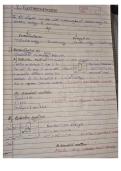
Class notes Neet for physical chemistry Electrochemistry
*Electrochemistry - NEET Complete Notes | NCERT Class 12 Chapter 3 Physical Chemistry* Electrochemistry is one of the most scoring chapters in NEET Physical Chemistry. ∼3-5 questions come every year from this + numericals. *1. What is Electrochemistry - NCERT Definition* "Electrochemistry is the study of production of electricity from energy released during spontaneous chemical reactions and the use of electrical energy to bring about non-spontaneous chemical reactions." *2 Types of Electrochemical Cells* 1. *Galvanic/Voltaic Cell*: Converts chemical energy into electrical energy. Spontaneous reaction. 2. *Electrolytic Cell*: Converts electrical energy into chemical energy. Non-spontaneous reaction. *2. Electrolytic Conductance - Key NCERT Concepts* *Important Terms* - *Electrolyte*: Substance that conducts electricity in solution. Ex: NaCl, HCl, CH3COOH - *Strong Electrolyte*: Completely dissociates. Ex: HCl, NaCl, KCl - *Weak Electrolyte*: Partially dissociates. Ex: CH3COOH, NH4OH - *Conductor*: Allows flow of electrons. Metals - *Electrolytic Conductor*: Allows flow of ions. Solutions *Types of Conductivity* 1. *Specific Conductivity / Conductivity (κ)* Conducting power of 1 cm³ of electrolyte solution. Unit: $S , cm^{-1}$ or $ohm^{-1} , cm^{-1}$ $kappa = frac{1}{rho}$ where $rho$ = resistivity 2. *Molar Conductivity (Λm)* Conducting power of all ions produced by dissolving 1 mole of electrolyte. $Lambda_m = frac{kappa times 1000}{M}$ Unit: $S , cm^2 , mol^{-1}$ M = molarity 3. *Equivalent Conductivity (Λeq)* $Lambda_{eq} = frac{kappa times 1000}{N}$ Unit: $S , cm^2 , eq^{-1}$ *NCERT Important Line* "The conductivity of a solution depends upon the nature and concentration of the electrolyte, temperature, and the nature of solvent." *Kohlrausch Law* "At infinite dilution, each ion makes a definite contribution to molar conductivity irrespective of other ions." $Lambda_m^circ = nu_+ lambda_+^circ + nu_- lambda_-^circ$ Use: To find $Lambda_m^circ$ of weak electrolytes like CH3COOH *Variation with Concentration* - For strong electrolytes: $Lambda_m$ increases slightly with dilution - For weak electrolytes: $Lambda_m$ increases steeply with dilution due to increased dissociation *3. Electrochemical Cells - Galvanic Cell* *Daniel Cell Example* Anode: $Zn(s) rightarrow Zn^{2+}(aq) + 2e^-$ Oxidation Cathode: $Cu^{2+}(aq) + 2e^- rightarrow Cu(s)$ Reduction Overall: $Zn(s) + Cu^{2+}(aq) rightarrow Zn^{2+}(aq) + Cu(s)$ *Cell Notation*: $Zn(s) | Zn^{2+}(aq) || Cu^{2+}(aq) | Cu(s)$ Single vertical line = phase boundary. Double line = salt bridge *Electrode Potential* Tendency of an electrode to lose or gain electrons. Cannot measure absolute E, so we measure relative to SHE. *Standard Hydrogen Electrode SHE* $E^circ = 0.00 , V$. $H^+(aq) + e^- rightarrow frac{1}{2}H_2(g)$ *Standard Electrode Potential $E^circ$* Measured at 298K, 1M, 1 atm *Electrochemical Series* Elements arranged in decreasing $E^circ$ reduction potential. More positive $E^circ$ = better oxidizing agent = gets reduced easily *NCERT Important Line* "The more positive the value of reduction potential, the greater is the tendency of the species to get reduced." *Cell EMF Calculation* $E_{cell}^circ = E_{cathode}^circ - E_{anode}^circ$ $E_{cell}^circ = E_{right}^circ - E_{left}^circ$ If $E_{cell}^circ$ is +ve, reaction is spontaneous *Nernst Equation* - Most important for NEET numericals For reaction: $aA + bB rightarrow cC + dD$ $E_{cell} = E_{cell}^circ - frac{0.0591}{n} log frac{[C]^c [D]^d}{[A]^a [B]^b}$ at 298K For Daniel cell: $E_{cell} = E_{cell}^circ - frac{0.0591}{2} log frac{[Zn^{2+}]}{[Cu^{2+}]}$ *Relation with Gibbs Energy* $Delta G^circ = -nFE_{cell}^circ$ If $E_{cell}^circ$ is +ve, $Delta G^circ$ is -ve = spontaneous Also: $E_{cell}^circ = frac{0.0591}{n} log K_c$ at equilibrium *4. Electrolytic Cells and Faraday’s Laws* *Electrolysis*: Decomposition of electrolyte by passing electricity *Faraday’s First Law* "The amount of substance deposited or liberated at an electrode is directly proportional to the quantity of electricity passed." $w = ZIt = E frac{It}{96500}$ Z = electrochemical equivalent, E = equivalent weight *Faraday’s Second Law* "When same quantity of electricity is passed through different electrolytes, the masses of substances liberated are proportional to their chemical equivalents." $96500 , C = 1 , Faraday = 1 , mole , of , electrons$ *Products of Electrolysis* Depends on: Nature of electrolyte, Electrode material, Concentration Ex: NaCl aq → $H_2$ at cathode, $Cl_2$ at anode NaCl molten → $Na$ at cathode, $Cl_2$ at anode *5. Batteries and Fuel Cells - NCERT Important* **Battery Type** **Anode** **Cathode** **Electrolyte** **Use** Dry Cell / Leclanche Zn Graphite in $MnO_2$ + $NH_4Cl$ Paste Torches Mercury Cell Zn-Hg amalgam HgO + C KOH paste Hearing aids Lead Storage Battery Pb $PbO_2$ 38% $H_2SO_4$ Cars Fuel Cell $H_2$ $O_2$ KOH Space vehicles *NCERT Important Line* "Fuel cells are galvanic cells that are designed to convert the energy from the combustion of fuels like $H_2$, $CH_4$, $CH_3OH$ directly into electrical energy." *Lead Storage Battery Reaction* Discharging: Anode: $Pb + SO_4^{2-} rightarrow PbSO_4 + 2e^-$ Cathode: $PbO_2 + 4H^+ + SO_4^{2-} + 2e^- rightarrow PbSO_4 + 2H_2O$ *6. Corrosion* "Corrosion is an electrochemical phenomenon. In corrosion, a metal is oxidised by loss of electrons to oxygen and formation of oxides." *Rusting of Iron* Anode: $Fe rightarrow Fe^{2+} + 2e^-$ Cathode: $O_2 + 2H_2O + 4e^- rightarrow 4OH^-$ Prevention: Galvanization, Alloying, Paint *7. Key Formulas and Units for NEET* **Term** **Formula** **Unit** Conductivity κ $frac{1}{rho}$ $S , cm^{-1}$ Molar Conductivity $frac{kappa times 1000}{M}$ $S , cm^2 , mol^{-1}$ Nernst Equation $E = E^circ - frac{0.0591}{n} log Q$ V Gibbs Energy $Delta G = -nFE$ J Faraday Law $w = frac{EIt}{96500}$ g *8. NCERT Keywords You MUST Remember* Galvanic cell, Electrolytic cell, Specific conductivity, Molar conductivity, Kohlrausch law, Limiting molar conductivity, Electrochemical series, Nernst equation, Standard electrode potential, Salt bridge, Faraday constants, Electrochemical equivalence, Primary battery, Secondary battery, Fuel cell, Corrosion *9. High Weight NEET Topics* 1. Nernst equation numericals 2. Relation between $E_{cell}^circ$, $Delta G^circ$, and K 3. Kohlrausch law and $Lambda_m^circ$ calculation for weak electrolytes 4. Faraday law numericals 5. Differences between Galvanic and Electrolytic cell 6. Batteries - Lead storage, Fuel cell reactions 7. Electrochemical series and spontaneity *10. SEO / Search Friendly Structure for Notes* Use these headings so your notes show up on top in apps like Telegram, Notion, Google Drive: *Title*: Electrochemistry Class 12 NCERT Notes for NEET 2026 *H2*: Electrochemical Cells Galvanic and Electrolytic *H2*: Conductivity Specific Molar Equivalent Kohlrausch Law *H2*: Nernst Equation and Electrochemical Series *H2*: Faraday Laws of Electrolysis Numericals *H2*: Batteries Lead Storage Dry Cell Fuel Cell *H2*: Corrosion Prevention *H2*: Important Formulas and NCERT Lines Electrochemistry * Electrochemistry NEET notes, Class 12 Physical Chemistry, Nernst equation, Faraday law, Conductivity, Galvanic cell, NCERT electrochemistry
Información del documento
- Año escolar
- 1
- Subido en
- 20 de julio de 2026
- Número de páginas
- 20
- Escrito en
- 2025/2026
- Tipo
- Notas de lectura
- Profesor(es)
- Anand ashok dubey
- Contiene
- 11/12

