

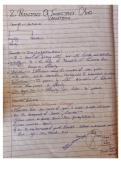
Class notes Neet botany (Principles of inheritance and variations)
*Principles of Inheritance and Variation - NEET Complete Notes (NCERT Based)* This chapter is Chapter 5 of NCERT Class 12 Biology. It’s one of the highest weight chapters for NEET. ∼4-6 questions come every year. *1. Core Concepts and Mendel’s Work* *Why Mendel succeeded* 1. He chose garden pea _Pisum sativum_ - easy to grow, clear contrasting traits, self pollinating 2. He studied one character at a time 3. He used statistical methods and maintained records 4. His laws of probability *NCERT Important Lines* "Mendel conducted hybridisation experiments on garden peas for seven years and proposed the laws of inheritance in living organisms." *7 Contrasting traits Mendel studied in pea*: Stem height, Flower color, Flower position, Pod shape, Pod color, Seed shape, Seed color *2. Key Terms You Must Know* - *Gene*: Unit of inheritance - *Allele*: Alternative forms of a gene. Ex: T and t for tall - *Dominant*: Expresses itself in heterozygous condition - *Recessive*: Expressed only in homozygous condition - *Genotype*: Genetic constitution. Ex: TT, Tt, tt - *Phenotype*: Morphological appearance - *Homozygous*: Same alleles. TT or tt - *Heterozygous*: Different alleles. Tt - *F1, F2 Generation*: First and second filial generation *3. Mendel’s Laws* *Law of Dominance* Out of a pair of contrasting alleles, only one is able to express itself in F1. _Monohybrid cross 3:1 phenotypic ratio in F2_ *Law of Segregation* Alleles do not show any blending and segregate during gamete formation. This is the basis of 3:1 ratio. Also called "Law of purity of gametes" *Law of Independent Assortment* When two pairs of traits are combined in a hybrid, segregation of one pair is independent of the other pair. _Dihybrid cross 9:3:3:1 phenotypic ratio in F2_ *NCERT Important Lines* "The law of segregation is based on the fact that the alleles do not show any blending and that both the characters are recovered as such in the F2 generation." *4. Important Crosses and Ratios for NEET* **Cross Type** **Parents** **F1 Phenotype** **F2 Phenotypic Ratio** **F2 Genotypic Ratio** Monohybrid TT x tt All Tt Tall 3 Tall : 1 Dwarf 1 : 2 : 1 Dihybrid YYRR x yyrr All YyRr Yellow Round 9 : 3 : 3 : 1 1:2:1:2:4:2:1:2:1 Test Cross F1 x Recessive parent Used to check genotype 1:1 for monohybrid - Back Cross F1 x Either parent - - - *Test Cross*: Tt x tt. If 1:1 ratio comes, F1 was heterozygous. *5. Deviations from Mendelism - Variations* *1. Incomplete Dominance* F1 shows intermediate phenotype. Neither allele is dominant. _Example: Snapdragon flower color. Red RR x White rr = Pink Rr in F1_ F2 ratio: 1 : 2 : 1 for both genotype and phenotype *NCERT Important Lines* "In incomplete dominance, a monohybrid cross produces F2 phenotypic ratio that is different from genotypic ratio." *2. Co-dominance* Both alleles express equally in heterozygote. _Example: ABO blood grouping. IAIB = AB blood group_ *3. Multiple Allelism* More than 2 alleles govern a character. _Example: ABO blood groups - IA, IB, i. 6 genotypes, 4 phenotypes_ *4. Pleiotropy* Single gene affects multiple traits. _Example: Phenylketonuria in humans_ *5. Polygenic Inheritance* Many genes control one trait. Also called quantitative inheritance. _Example: Human height, skin color, kernel color in wheat_ F2 ratio: 1:4:6:4:1 for 2 genes *6. Chromosomal Theory of Inheritance* Proposed by Sutton and Boveri. "Chromosomes are the carriers of genes and behave in parallel with the behavior of genes during meiosis" *Linkage*: Tendency of genes to stay together during inheritance. _Discovered by Morgan in Drosophila_ Linked genes violate independent assortment. *Recombination*: New combinations produced due to crossing over. Crossing over frequency is used to make genetic maps. *7. Sex Determination* **Organism** **Mechanism** Humans XX female, XY male. Male heterogametic Birds ZZ male, ZW female. Female heterogametic Honeybee Haplo-diploid. Male from unfertilized egg Grasshopper XO type. Male has one less chromosome *NCERT Important Lines* "The sex of the individual is determined by the pair of sex chromosomes." *8. Mutation and Genetic Disorders* *Mutation*: Sudden heritable change in DNA sequence. Types: Point mutation, Frame shift. _Example: Sickle cell anemia - GAG to GUG_ *Pedigree Analysis*: To trace inheritance of a trait in family. *Major Disorders for NEET* **Disorder** **Type** **Chromosome/ Gene** **Symptoms** Down Syndrome Autosomal Trisomy 21 Round head, broad palm, mental retardation Klinefelter Sex chromosome 47, XXY Male Sterile male, feminine traits Turner Syndrome Sex chromosome 45, XO Female Sterile female, short stature Sickle Cell Anemia Autosomal recessive Hb gene on chr 11 Sickle shaped RBC, anemia Phenylketonuria Autosomal recessive Enzyme deficiency Mental retardation Thalassemia Autosomal recessive Alpha/Beta globin gene Anemia *NCERT Important Lines* "Sickle cell anemia is caused by substitution of Glutamic acid by Valine at 6th position of beta globin chain." *9. Quick Revision Points for NEET* 1. 9:3:3:1 is dihybrid phenotypic ratio 2. 1:2:1 is incomplete dominance F2 ratio 3. Test cross ratio 1:1 proves heterozygosity 4. Human sex determination is XY type 5. ABO blood group is example of multiple allelism + co-dominance 6. Linkage was discovered by Morgan 7. Polygenic traits show continuous variation *10. Important Search Formats / Heading Structure* If you save these notes, use these headings so they rank and are easy to revise: *H1*: Principles of Inheritance and Variation NEET Notes NCERT *H2*: Mendel's Laws, Monohybrid Cross, Dihybrid Cross *H2*: Incomplete Dominance, Co-dominance, Multiple Alleles with Examples *H2*: Linkage and Recombination, Chromosomal Theory *H2*: Sex Determination in Humans, Birds, Honeybee *H2*: Genetic Disorders Chart - Down, Turner, Klinefelter, Sickle Cell, Thalassemia *H2*: NCERT Important Lines for Principles of Inheritance and Variation *H2*: NEET PYQ Pattern and Important Ratios 3:1, 9:3:3:1, 1:2:1 NEET biology notes, NCERT class 12 chapter 5, principles of inheritance, variations, mendelian disorders, sex linked inheritance
Información del documento
- Año escolar
- 1
- Subido en
- 20 de julio de 2026
- Número de páginas
- 29
- Escrito en
- 2025/2026
- Tipo
- Notas de lectura
- Profesor(es)
- Ravish nandkishor dixit
- Contiene
- Todas las clases

