

COMSAE PHASE 1 FORM 113 PRACTICE EXAM QUESTIONS AND
CORRECT ANSWERS (VERIFIED ANSWERS) PLUS RATIONALES 2025|
2026 Q&A | INSTANT DOWNLOAD PDF
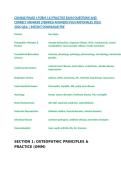
Domain Key Topics
Osteopathic Principles & Somatic dysfunction, Chapman reflexes, HVLA, counterstrain, cranial
Practice manipulation, viscerosomatic reflexes, Fryette mechanics
Foundational Biomedical Anatomy, physiology, pathology, pharmacology, microbiology, biochemistr
Sciences genetics
Ischemic heart disease, heart failure, arrhythmias, valvular disease,
Cardiovascular System
hypertension
Respiratory System Asthma, COPD, pneumonia, PE, restrictive lung disease, lung cancer
Gastrointestinal System Pancreatitis, hepatitis, IBD, peptic ulcer disease
Neurology Stroke, seizure disorders, Parkinson disease, MS, meningitis
Renal/Genitourinary AKI, CKD, nephrotic syndrome, nephrolithiasis
Endocrine/Reproductive Diabetes mellitus, thyroid disorders, adrenal disorders
Infectious Disease Common pathogens, antibiotic therapy, prevention strategies
Musculoskeletal Gout, septic arthritis, RA, OA, fractures
SECTION 1: OSTEOPATHIC PRINCIPLES &
PRACTICE (OMM)
,1. According to Fryette's principles, Type I mechanics occur when
the spine is in which position?
A. Flexion
B. Extension
C. Neutral position
D. Rotation
Answer: C
Rationale: Fryette's Type I mechanics occur when the spine is in a neutral
position (neither flexed nor extended). In Type I, multiple vertebral segments
are involved, and sidebending and rotation occur in opposite directions. Type
II mechanics occur in non-neutral positions .
2. In Fryette's Type II mechanics, how many vertebral segments are
typically involved?
A. Multiple segments
B. A single segment
C. All segments
D. Alternating segments
Answer: B
Rationale: Fryette's Type II mechanics involve a single vertebral segment.
Type II occurs in non-neutral positions (flexion or extension), and
sidebending and rotation occur in the same direction. Type I involves
multiple segments in neutral position .
3. In a Type I somatic dysfunction, sidebending and rotation occur in
which directions?
A. Opposite directions
B. Same direction
C. Only rotation
D. Only sidebending
Answer: A
, Rationale: In Fryette's Type I mechanics, sidebending and rotation occur in
opposite directions. For example, if the spine is sidebent to the right, the
vertebrae rotate to the left .
4. A patient is diagnosed with a somatic dysfunction of the 5th
thoracic vertebra. Palpation reveals that the T5 spinous process is
rotated right. The rotation abnormality worsens during lumbar and
thoracic extension but symmetry improves during flexion. How
should this dysfunction be named?
A. T5 F R(R) S(R)
B. T5 E R(L) S(L)
C. T5 F R(L) S(L)
D. T5 E R(R) S(R)
Answer: A
Rationale: Somatic dysfunctions are named for their position of comfort.
Because symmetry improves in flexion, the vertebra is flexed (F). The
spinous process rotates to the right and sidebends to the right, so the
naming is T5 F R(R) S(R) .
5. A patient with chronic low back pain has a right standing flexion
test positive on the right. In the prone position, the right ASIS is
superior, and the right PSIS is inferior. What is the most likely
diagnosis?
A. Right anterior innominate rotation
B. Right posterior innominate rotation
C. Left superior innominate shear
D. Right superior innominate shear
Answer: B
Rationale: A positive standing flexion test localizes the side of somatic
dysfunction to the right. A posterior innominate rotation is characterized by
an ASIS that is superior and a PSIS that is inferior on the affected side .
CORRECT ANSWERS (VERIFIED ANSWERS) PLUS RATIONALES 2025|
2026 Q&A | INSTANT DOWNLOAD PDF
Domain Key Topics
Osteopathic Principles & Somatic dysfunction, Chapman reflexes, HVLA, counterstrain, cranial
Practice manipulation, viscerosomatic reflexes, Fryette mechanics
Foundational Biomedical Anatomy, physiology, pathology, pharmacology, microbiology, biochemistr
Sciences genetics
Ischemic heart disease, heart failure, arrhythmias, valvular disease,
Cardiovascular System
hypertension
Respiratory System Asthma, COPD, pneumonia, PE, restrictive lung disease, lung cancer
Gastrointestinal System Pancreatitis, hepatitis, IBD, peptic ulcer disease
Neurology Stroke, seizure disorders, Parkinson disease, MS, meningitis
Renal/Genitourinary AKI, CKD, nephrotic syndrome, nephrolithiasis
Endocrine/Reproductive Diabetes mellitus, thyroid disorders, adrenal disorders
Infectious Disease Common pathogens, antibiotic therapy, prevention strategies
Musculoskeletal Gout, septic arthritis, RA, OA, fractures
SECTION 1: OSTEOPATHIC PRINCIPLES &
PRACTICE (OMM)
,1. According to Fryette's principles, Type I mechanics occur when
the spine is in which position?
A. Flexion
B. Extension
C. Neutral position
D. Rotation
Answer: C
Rationale: Fryette's Type I mechanics occur when the spine is in a neutral
position (neither flexed nor extended). In Type I, multiple vertebral segments
are involved, and sidebending and rotation occur in opposite directions. Type
II mechanics occur in non-neutral positions .
2. In Fryette's Type II mechanics, how many vertebral segments are
typically involved?
A. Multiple segments
B. A single segment
C. All segments
D. Alternating segments
Answer: B
Rationale: Fryette's Type II mechanics involve a single vertebral segment.
Type II occurs in non-neutral positions (flexion or extension), and
sidebending and rotation occur in the same direction. Type I involves
multiple segments in neutral position .
3. In a Type I somatic dysfunction, sidebending and rotation occur in
which directions?
A. Opposite directions
B. Same direction
C. Only rotation
D. Only sidebending
Answer: A
, Rationale: In Fryette's Type I mechanics, sidebending and rotation occur in
opposite directions. For example, if the spine is sidebent to the right, the
vertebrae rotate to the left .
4. A patient is diagnosed with a somatic dysfunction of the 5th
thoracic vertebra. Palpation reveals that the T5 spinous process is
rotated right. The rotation abnormality worsens during lumbar and
thoracic extension but symmetry improves during flexion. How
should this dysfunction be named?
A. T5 F R(R) S(R)
B. T5 E R(L) S(L)
C. T5 F R(L) S(L)
D. T5 E R(R) S(R)
Answer: A
Rationale: Somatic dysfunctions are named for their position of comfort.
Because symmetry improves in flexion, the vertebra is flexed (F). The
spinous process rotates to the right and sidebends to the right, so the
naming is T5 F R(R) S(R) .
5. A patient with chronic low back pain has a right standing flexion
test positive on the right. In the prone position, the right ASIS is
superior, and the right PSIS is inferior. What is the most likely
diagnosis?
A. Right anterior innominate rotation
B. Right posterior innominate rotation
C. Left superior innominate shear
D. Right superior innominate shear
Answer: B
Rationale: A positive standing flexion test localizes the side of somatic
dysfunction to the right. A posterior innominate rotation is characterized by
an ASIS that is superior and a PSIS that is inferior on the affected side .

