

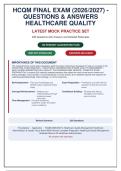
HCQM FINAL EXAM (2026/2027) -
QUESTIONS & ANSWERS
HEALTHCARE QUALITY
LATEST MOCK PRACTICE SET
230 Questions with Answers and Detailed Rationales
100 PERCENT GUARANTEED PASS
INSTANT DOWNLOAD ANSWERS INCLUDED
IMPORTANCE OF THIS DOCUMENT
This comprehensive examination preparation guide has been meticulously developed to help you succeed in the
HCQM FINAL EXAM (2026/2027) - QUESTIONS & ANSWERS HEALTHCARE QUALITY MANAGEMENT |
HEALTHCARE ADMINISTRATION & QUALITY FOCUS BRAND NEW VERSION | COMPLETE EXAM
PREPARATION. It contains 230 carefully selected questions that reflect the most current exam content and
testing strategies. Each question is accompanied by a correct answer and a detailed rationale that explains the
underlying pathophysiology, pharmacology, or clinical reasoning.
Self-Assessment – Test your knowledge and Exam Preparation – Familiarize yourself with the
identify areas requiring further question format and content
study areas
Concept Reinforcement – Deepen your Confidence Building – Develop test-taking
understanding through strategies and reduce
evidence-based exam anxiety
rationales
Time Management – Practice answering
questions under simulated
exam conditions
Review Summary 230 Questions
Foundations - Application - HCQM 2026/2027 & Healthcare Quality Management Healthcare
Administration & Quality Focus Brand NEW Version Complete Preparation Healthcare Quality Management
Graduate Mha/ms IN Healthcare Administration
All answers with rationales
,Table of Contents
Section A - Foundations OF Section B - Quality Improvement
Healthcare Quality Management Models AND Methodologies
Questions 1 to 58 Questions 59 to 116
Section C - Regulatory AND Section D - Patient Safety AND RISK
Accreditation Standards Management
Questions 117 to 174 Questions 175 to 230
,Section A - Foundations OF Healthcare Quality
Management
Q1.
A hospital's readmission rate for heart failure patients is 24%, well above the national
benchmark of 20%. A QI team implements a 90-day intervention including transitional care
coordination and patient education. Which statistical test is most appropriate to compare
pre- and post-intervention readmission rates?
A. Two-sample t-test B. Chi-square test of independence
C. Paired t-test D. One-way ANOVA
Correct: C - Paired t-test
Rationale:The paired t-test is used to compare means from the same group before and after
an intervention. Here, the same hospital's readmission rates before and after the intervention
are paired (same population, different time points). A two-sample t-test compares
independent groups, chi-square tests associations between categorical variables, and
ANOVA compares more than two groups.
Q2.
During a root cause analysis of a wrong-site surgery, the team identifies that the surgical
team skipped the pre-incision timeout because of perceived time pressure from the OR
schedule. Which human factor is the root cause?
A. Inadequate training on the timeout B. Production pressure
protocol
C. Communication breakdown D. Lack of a standardized checklist
Correct: B - Production pressure
Rationale:Production pressure refers to the organizational culture that prioritizes speed and
efficiency over safety, leading staff to bypass safety steps. The scenario explicitly states the
timeout was skipped due to time pressure, which is a classic example of production pressure.
The other options are contributing factors but not the root cause identified in the description.
Q3.
A primary care practice aims to improve colorectal cancer screening rates from 50% to
80% within one year. The team uses the Model for Improvement. After implementing a
patient reminder system, the run chart shows 8 consecutive data points above the
median. What does this indicate?
A. Common cause variation B. A shift indicating special cause variation
Page 3
, Section A - Foundations OF Healthcare Quality Management
C. A trend indicating improvement D. The process is out of control and needs
to be stopped
Correct: B - A shift indicating special cause variation
Rationale:In run chart rules, a 'shift' is defined as 6 or more consecutive points above the
median, indicating non-random (special cause) variation. This suggests the intervention had a
statistically significant effect. A trend would be a steady increase over time, but the rule here
is about consecutive points above median, not direction. Out of control is a control chart
concept, not run chart.
Q4.
A hospital is penalized by CMS under the Hospital-Acquired Condition (HAC) Reduction
Program for high rates of central line-associated bloodstream infections (CLABSI). To
reduce CLABSI, which bundle element is most critical to ensure consistent compliance?
A. Daily review of line necessity B. Use of chlorhexidine for skin antisepsis
C. Hand hygiene before line insertion D. Full barrier precautions during insertion
Correct: A - Daily review of line necessity
Rationale:While all are important, daily review of line necessity is the most critical for
sustained reduction because it directly reduces the number of catheter days, which is the
denominator for CLABSI rate. Removing unnecessary lines eliminates the risk entirely. The
other elements are insertion practices that reduce initial infection risk but do not address
ongoing exposure.
Q5.
A healthcare system implements a bundled payment model for hip replacements. Which
quality metric is most important to monitor to ensure the bundle does not lead to
unintended denial of necessary care?
A. 30-day readmission rate B. Patient satisfaction scores
C. Rate of post-acute care referrals D. Surgical site infection rate
Correct: A - 30-day readmission rate
Rationale:Bundled payments create financial risk for providers, potentially incentivizing them
to avoid high-cost patients or skimp on care to keep costs below the bundle price. The 30-day
readmission rate is a key indicator of whether patients are being discharged prematurely or
receiving inadequate follow-up. While all metrics are relevant, readmission is directly tied to
potential undercare.
Page 4
QUESTIONS & ANSWERS
HEALTHCARE QUALITY
LATEST MOCK PRACTICE SET
230 Questions with Answers and Detailed Rationales
100 PERCENT GUARANTEED PASS
INSTANT DOWNLOAD ANSWERS INCLUDED
IMPORTANCE OF THIS DOCUMENT
This comprehensive examination preparation guide has been meticulously developed to help you succeed in the
HCQM FINAL EXAM (2026/2027) - QUESTIONS & ANSWERS HEALTHCARE QUALITY MANAGEMENT |
HEALTHCARE ADMINISTRATION & QUALITY FOCUS BRAND NEW VERSION | COMPLETE EXAM
PREPARATION. It contains 230 carefully selected questions that reflect the most current exam content and
testing strategies. Each question is accompanied by a correct answer and a detailed rationale that explains the
underlying pathophysiology, pharmacology, or clinical reasoning.
Self-Assessment – Test your knowledge and Exam Preparation – Familiarize yourself with the
identify areas requiring further question format and content
study areas
Concept Reinforcement – Deepen your Confidence Building – Develop test-taking
understanding through strategies and reduce
evidence-based exam anxiety
rationales
Time Management – Practice answering
questions under simulated
exam conditions
Review Summary 230 Questions
Foundations - Application - HCQM 2026/2027 & Healthcare Quality Management Healthcare
Administration & Quality Focus Brand NEW Version Complete Preparation Healthcare Quality Management
Graduate Mha/ms IN Healthcare Administration
All answers with rationales
,Table of Contents
Section A - Foundations OF Section B - Quality Improvement
Healthcare Quality Management Models AND Methodologies
Questions 1 to 58 Questions 59 to 116
Section C - Regulatory AND Section D - Patient Safety AND RISK
Accreditation Standards Management
Questions 117 to 174 Questions 175 to 230
,Section A - Foundations OF Healthcare Quality
Management
Q1.
A hospital's readmission rate for heart failure patients is 24%, well above the national
benchmark of 20%. A QI team implements a 90-day intervention including transitional care
coordination and patient education. Which statistical test is most appropriate to compare
pre- and post-intervention readmission rates?
A. Two-sample t-test B. Chi-square test of independence
C. Paired t-test D. One-way ANOVA
Correct: C - Paired t-test
Rationale:The paired t-test is used to compare means from the same group before and after
an intervention. Here, the same hospital's readmission rates before and after the intervention
are paired (same population, different time points). A two-sample t-test compares
independent groups, chi-square tests associations between categorical variables, and
ANOVA compares more than two groups.
Q2.
During a root cause analysis of a wrong-site surgery, the team identifies that the surgical
team skipped the pre-incision timeout because of perceived time pressure from the OR
schedule. Which human factor is the root cause?
A. Inadequate training on the timeout B. Production pressure
protocol
C. Communication breakdown D. Lack of a standardized checklist
Correct: B - Production pressure
Rationale:Production pressure refers to the organizational culture that prioritizes speed and
efficiency over safety, leading staff to bypass safety steps. The scenario explicitly states the
timeout was skipped due to time pressure, which is a classic example of production pressure.
The other options are contributing factors but not the root cause identified in the description.
Q3.
A primary care practice aims to improve colorectal cancer screening rates from 50% to
80% within one year. The team uses the Model for Improvement. After implementing a
patient reminder system, the run chart shows 8 consecutive data points above the
median. What does this indicate?
A. Common cause variation B. A shift indicating special cause variation
Page 3
, Section A - Foundations OF Healthcare Quality Management
C. A trend indicating improvement D. The process is out of control and needs
to be stopped
Correct: B - A shift indicating special cause variation
Rationale:In run chart rules, a 'shift' is defined as 6 or more consecutive points above the
median, indicating non-random (special cause) variation. This suggests the intervention had a
statistically significant effect. A trend would be a steady increase over time, but the rule here
is about consecutive points above median, not direction. Out of control is a control chart
concept, not run chart.
Q4.
A hospital is penalized by CMS under the Hospital-Acquired Condition (HAC) Reduction
Program for high rates of central line-associated bloodstream infections (CLABSI). To
reduce CLABSI, which bundle element is most critical to ensure consistent compliance?
A. Daily review of line necessity B. Use of chlorhexidine for skin antisepsis
C. Hand hygiene before line insertion D. Full barrier precautions during insertion
Correct: A - Daily review of line necessity
Rationale:While all are important, daily review of line necessity is the most critical for
sustained reduction because it directly reduces the number of catheter days, which is the
denominator for CLABSI rate. Removing unnecessary lines eliminates the risk entirely. The
other elements are insertion practices that reduce initial infection risk but do not address
ongoing exposure.
Q5.
A healthcare system implements a bundled payment model for hip replacements. Which
quality metric is most important to monitor to ensure the bundle does not lead to
unintended denial of necessary care?
A. 30-day readmission rate B. Patient satisfaction scores
C. Rate of post-acute care referrals D. Surgical site infection rate
Correct: A - 30-day readmission rate
Rationale:Bundled payments create financial risk for providers, potentially incentivizing them
to avoid high-cost patients or skimp on care to keep costs below the bundle price. The 30-day
readmission rate is a key indicator of whether patients are being discharged prematurely or
receiving inadequate follow-up. While all metrics are relevant, readmission is directly tied to
potential undercare.
Page 4

