
BIOS 242 Week 7 Assignment; Microbiology GI Case Study
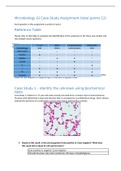
Each question in this assignment is worth 0.5 point Reference Table Please refer to this table to complete the identification of the unknowns in the three case studies and the multiple choice questions. TABLE 1.Results forbiochemical tests in E. coli, Vibrio, Campylobacter, and Salmonella. A plus sign (+) indicates a positive result for that organism, a negative sign (-) indicates a negative result. Case Study 1 – Identify the unknown using biochemical tests Case Study 1: Patient is a 17 year old male recently returned from a mission trip to Central America. Presents with abdominal cramps and diarrhea that is unresponsive to antidiarrheal drugs. Stool cultures indicate the presence of a prokaryote. A Gram stain shows pink bacillus colonies. 1. Basedonthisresult,isthemicroorganismGrampositiveorGramnegative?Whatdoesthis result tell us about its cell wallstructure? 2. What do these results mean in terms of this microorganism’s ability to fermentlactose? 3. What does this result tell us about cytochrome c oxidase in thisorganism? 4. What does this result tell us about the presence of ureaseenzyme? 5. Basedontheseresults,determineifthefollowingispositiveornegativeintheorganism. 6. Based on the above results, does this microorganism have the catalaseenzyme? 7. Basedonallthetestresultsaboveresultsandtheprovidedtable,whatmicroorganismisthis? Explain your reasoning in 1-2sentences. Case Study 2 Case Study 2: Patient is a 60 year old male recently returned from biking/camping expedition around Lake Michigan. Patient reports eating primarily at fast food restaurants during this week-long excursion. Presents with fever, nausea, abdominal cramps and diarrhea. Stool cultures indicate the presence of a prokaryote. A Gram stain shows pink helical-shaped colonies. 8. Based on this result, is the microorganism Gram positive or Gramnegative? 9. What do these results mean in terms of this microorganism’s ability to fermentlactose? 10. What does this result mean about the presence of cytochrome coxidase? 11. What does this result mean about the presence ofurease? 12. Basedontheseresults,determineifthefollowingispositiveornegativeintheorganism. 13. Based on the above results, does this microorganism have the catalaseenzyme? 14. Basedontheaboveresults,whatmicroorganismisthis?Explainyourreasoningin1-2 sentences. Case Study 3 Case Study 3 -- Patient is a 53 year old female. Presents with fever, nausea, abdominal cramps and watery, slightly cloudy appearance to diarrhea with no blood or foul odor. Cultures indicate the presence of a curved shaped prokaryote that is pink after Gram stain. 15. Based on this result, is the microorganism Gram positive or Gramnegative? 16. What do these results mean in terms of this microorganism’s ability to fermentlactose? 17. What does this result mean about the presence of cytochrome coxidase? 18. What does this result mean about the presence ofurease? 19. Basedontheseresults,determineifthefollowingispositiveornegativeintheorganism. 20. Based on the above results, does this microorganism have the catalaseenzyme? 21. Based on the above results, what microorganism isthis? Multiple Choice Questions Choose the best answer to each of the following questions. Type your answer in the box provdied. 22. Whatistheorganismthatisgramnegative,oxidasenegative,ureasenegative,andH2S negative? 23. Which of the following traits is characteristic of bacteria found in the GItract? 24. How can an E. coli infection be differentiated from a Salmonellainfection?
Información del documento
- Subido en
- 21 de junio de 2021
- Número de páginas
- 9
- Escrito en
- 2020/2021
- Tipo
- Otro
- Personaje
- Desconocido

