

EKG Interpretation (HCA) | ECG Rhythm
Strip Practice & Exam Prep Guide
Question 1
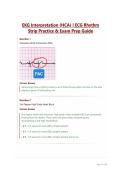
Premature Atrial Contraction (PAC)
Correct Answer
Atrial ectopy (not a rhythm) similar to an ill timed hiccup within the atria, or the atria
playing a game of interrupting cow.
Question 2
2nd Degree High Grade Heart Block
Correct Answer
2nd degree heart block becomes “high grade” when multiple QRS’s are consistently
missing from the rhythm. These ratios are given when interpreting and
documenting a 2nd High Grade Block:
• 2:1 - 2 P-waves for every QRS-complex present
• 3:1 - 3 P-waves for every QRS-complex present
• 4:1 - 4 P-waves for every QRS-complex present and so on…
Page 1 of 100
,Question 3
Atrial Rhythms & Associated Rates
Correct Answer
• A-Fib: Atria Rate >350 – 500; Ventricular Rate >220 – 240 ppm
• A-Flutter: Atrial Rate >250 – 450; Ventricular Rate >220 – 240 ppm
• Atrial Tachycardia: Atria > 220 – 240; Ventricular Rate = Atrial Rate (1:1 ratio)
• Supraventricular Tachycardia: >150 – 160 ppm, even upwards of 220 – 240 ppm;
Ventricular Rate = Atrial Rate (1:1 ratio)
• Wandering Atrial Pacemaker (WAP): Atrial Rate <100 ppm; Ventricular Rate =
Atrial Rate
• Multifocal Atrial Tachycardia (MAT): Atrial Rate >100 ppm; Ventricular Rate =
Atrial Rate
Question 4
Phases of cardiac cellular conduction
Correct Answer
Polarized- cells are charged with energy
Depolarized- cells are discharging energy and causing physical contraction
Repolarization- cells are recharging
Page 2 of 100
,Question 5
Junctional Bradycardia
Correct Answer
HR = 38
No apparent P-waves
Question 6
QT interval
Correct Answer
Refractory period
Measures from beginning of QRS to end of the T wave
Normally 0.44 seconds or half of the R-R interval (can change based on age and
gender)
The longer the QT, the greater chance of ventricular depolarization during
ventricular repolarization, resulting in chaotic and lethal rhythm such as Torsade's
Page 3 of 100
, Question 7
Absolute Refractory Period
Correct Answer
"Safe zone
Cells cannot be stimulated to conduct an electrical impulse, no matter how strong
Question 8
Automaticity
Correct Answer
•Ability of pacemaker cells to initiate electrical impulse independent of external
stimulation.
•Increased electrolytes decrease automaticity
•Decreased K+ and Ca++ in blood increase automaticity
Question 9
Lead Placement Prep
Correct Answer
Clean with soap and water if possible
Do not place on bony prominences if possible
If you need to shave, you need to shave!
Alcohol dries the skin AND electrode leading to low quality read
Page 4 of 100
Strip Practice & Exam Prep Guide
Question 1
Premature Atrial Contraction (PAC)
Correct Answer
Atrial ectopy (not a rhythm) similar to an ill timed hiccup within the atria, or the atria
playing a game of interrupting cow.
Question 2
2nd Degree High Grade Heart Block
Correct Answer
2nd degree heart block becomes “high grade” when multiple QRS’s are consistently
missing from the rhythm. These ratios are given when interpreting and
documenting a 2nd High Grade Block:
• 2:1 - 2 P-waves for every QRS-complex present
• 3:1 - 3 P-waves for every QRS-complex present
• 4:1 - 4 P-waves for every QRS-complex present and so on…
Page 1 of 100
,Question 3
Atrial Rhythms & Associated Rates
Correct Answer
• A-Fib: Atria Rate >350 – 500; Ventricular Rate >220 – 240 ppm
• A-Flutter: Atrial Rate >250 – 450; Ventricular Rate >220 – 240 ppm
• Atrial Tachycardia: Atria > 220 – 240; Ventricular Rate = Atrial Rate (1:1 ratio)
• Supraventricular Tachycardia: >150 – 160 ppm, even upwards of 220 – 240 ppm;
Ventricular Rate = Atrial Rate (1:1 ratio)
• Wandering Atrial Pacemaker (WAP): Atrial Rate <100 ppm; Ventricular Rate =
Atrial Rate
• Multifocal Atrial Tachycardia (MAT): Atrial Rate >100 ppm; Ventricular Rate =
Atrial Rate
Question 4
Phases of cardiac cellular conduction
Correct Answer
Polarized- cells are charged with energy
Depolarized- cells are discharging energy and causing physical contraction
Repolarization- cells are recharging
Page 2 of 100
,Question 5
Junctional Bradycardia
Correct Answer
HR = 38
No apparent P-waves
Question 6
QT interval
Correct Answer
Refractory period
Measures from beginning of QRS to end of the T wave
Normally 0.44 seconds or half of the R-R interval (can change based on age and
gender)
The longer the QT, the greater chance of ventricular depolarization during
ventricular repolarization, resulting in chaotic and lethal rhythm such as Torsade's
Page 3 of 100
, Question 7
Absolute Refractory Period
Correct Answer
"Safe zone
Cells cannot be stimulated to conduct an electrical impulse, no matter how strong
Question 8
Automaticity
Correct Answer
•Ability of pacemaker cells to initiate electrical impulse independent of external
stimulation.
•Increased electrolytes decrease automaticity
•Decreased K+ and Ca++ in blood increase automaticity
Question 9
Lead Placement Prep
Correct Answer
Clean with soap and water if possible
Do not place on bony prominences if possible
If you need to shave, you need to shave!
Alcohol dries the skin AND electrode leading to low quality read
Page 4 of 100

