NR602 Final Exam Study Guide
WEEK 5 Concepts:
Chapter 40: Gastrointestinal Disorders
»Dehydration
o Classification
o mild (<3% in older children and 5% in infants)
o moderate (6% in older children and 10% in infants)
o severe (9% or greater in older children and 15% or greater in infants)
o One of the most useful clinical signs of hydration is capillary refill time (CRT). Normal
CRT is less than 2 seconds. CRT, skin turgor, and tachypnea, considered together, are
most helpful in determining dehydration
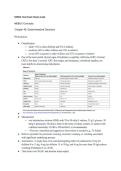
TABLE 401
Stages of Dehydration
Stages of Dehydration
Minimal or None (<3% Loss of Body Weight) __ Mild to Moderate (3%-3% Loss of Body Weight) Severe (>3% Loss of Body Weight)
Mental status Wellalert Normal fatigued o restiess, iitable Apathetic ethargic unconscious
Thirst Drinks normally; might refuse liquids Thirsty; eager todrink Drinks poorly; unable to drink
Heartrate Normal Normal to ncreased Tachycardic; bradycardicn severe cases
Quality of pulses | Normal Normal to decreased Weak,thready, or impalpable
Breathing Normal Normal fast Deep
Eyes Normal Slightly sunken Deeply sunken
Tears Present Decreased Absent
Mouth and tongue | Moist ory Parched
skinfold Instant recoll Recollin <25 Recoilin>25
Capillary refill Normal Prolonged Prolonged; minimal
Extremities Warm ool Cold; mottled; cyanotic
Urine output Normal to decreased Decreased Minimal
From Centers for Disease Control and Prevention (CDC). Guidelines for the Management of Acute Diarrhea After a Disaster; 2014.
@ hitpi//emergency.cdc gov/disasters/disease/diarrheaguidelinesasp. Accessed April 21, 2018.
e Management
o oral rehydration solution (ORS) with 70 to 90 mEq/L sodium, 25 g/L glucose, 20
mEq/L potassium, 30 mEq/L base (in the form of citrate, acetate, or lactate) with
a defined osmolarity of 240 to 300 mOsm/L is recommended.
o e If severe, immediate and aggressive intervention is needed (e.g., IV fluids)
e Refer to specialist for persistent vomiting, recurrent vomiting, or vomiting associated
with significant underlying process.
e Antiemetics: A single dose of an oral disintegrating tablet of ondansetron (2 mg for
children 8 to 15 kg, 4 mg for children 15 to 30 kg, and 8 mg for more than 30 kg) reduces
vomiting (Freedman et al., 2014).
o Treat fever over 38.20C and monitor urine output.
, o Refer if the child has a toxic appearance, severe dehydration, projectile vomiting,
abnormal examination, vomiting for greater than 12 hours, or vomiting of blood, bile, or
fecal matter, or decreased urine output to less than 1 mL/kg/h.
*Colic (signs and symptoms, treatment, etc)
o Colic is defined as crying for no apparent reason that lasts for 3 hours or more per day
and occurs 3 days or more per week in an otherwise healthy infant younger than 3 months
of age. Numerous randomized controlled trials (RCTs) over the years have demonstrated
mixed results with using probiotics to decrease crying times, with differences noted
between infants who are solely breastfed and those who are not.
e Treatment
o There is also some research that suggests specific strains of Lactobacillus may
help relieve infantile colic
» Appendicitis
e Appendicitis is inflammation of the appendix that leads to distention and ischemia that
can result in necrosis, perforation, and peritonitis or abscess formation.
e A scoring system may be helpful (Sayed et al., 2017). A score of 4 or less is highly
sensitive in the exclusion of the diagnosis of appendicitis:
o Nausea/emesis (1 point)
Anorexia (1 point)
O
Migration of pain to RLQ (1 point)
0
Low-grade fever (1 point)
0O
RLQ tenderness on light palpation (2 points)
0
Cough/percussion/heel tapping tenderness at RLQ (2 points)
0O
Leukocytosis (>10,000/mm3) (1 point)
0
o Left shift (>75% neutrophilia) (1 point)
o CT scan with contrast has the highest accuracy, especially in adolescents. CT scan
compared with ultrasound has higher sensitivity and specificity, is not operator
dependent, and may be more cost effective in preventing an unnecessary appendectomy.
An appendiceal diameter of greater than 6 mm is considered diagnostic (in both
ultrasound and CT scan).
e A surgical consultation for an appendectomy is needed.
*Foreign bodies - objects swallowed by a toddler/child
e Most foreign body (FB) ingestions are not serious; objects pass through the gut without
consequence.
, o Most ingestions of foreign bodies (FBs) occur in children between 6 months and 3 years
of age (80%).
o Esophageal FB:
o An initial episode of choking, gagging, and coughing.
o Excessive salivation; dysphagia; food refusal; emesis/hematemesis; or pain in the
neck, throat, or sternal notch areas may follow.
o Respiratory symptoms such as stridor, wheezing, cyanosis, or dyspnea may occur
if the esophageal body impinges on the larynx or tracheal wall.
o Children who have swallowed lithium batteries greater than or equal to a 20 mm
diameter are at greatest risk of problems due to battery ingestion Some patients
have documented severe erosion or ulceration in as little as 2 hours after
ingestion. Emergency endoscopic removal is essential.
e Abdominal FB
o Most ingested objects that reach the stomach pass through the remainder of the GI
tract without difficulty.
o Items greater than 5 cm in diameter or 2 cm in thickness tend to lodge in the
stomach and need to be retrieved.
o Thin objects longer than 10 cm may not make the duodenal sweep turn and also
need to be retrieved.
e Rectal FB
o Small blunt objects usually will pass spontaneously, but large or sharp objects
should be retrieved after sedation to relax the anal sphincter.
o A single frontal radiograph that includes the neck, chest, and entire abdomen is usually
sufficient to locate the object.
*Intussusception
o Intussusception involves a section of intestine being pulled antegrade into adjacent
intestine with the proximal bowel trapped in the distal segment.
o Most commonly occurs between 5 and 10 months of age and is also the most common
cause of intestinal obstruction in children 3 months to 6 years old; 80% of the cases occur
before 2 years of age.
o Diagnostic Triad
o Paroxysmal, episodic abdominal pain with vomiting every 5 to 30 minutes.
Vomiting is nonbilious initially. Some children do not have any pain.
o Screaming with drawing up of the legs with periods of calm, sleeping, or lethargy
between episodes.
o Stool, possibly diarrhea in nature, with blood (“currant jelly”).
e A sausage-like mass may be felt in the RUQ of the abdomen with emptiness in the RLQ
(Dance sign)
, o Ultrasound is the diagnostic test of choice for its high sensitivity and specificity,
pathology characterization, and lack of ionizing radiation.
e Emergency management and consultation with a pediatric radiologist and a pediatric
surgeon is recommended.
Chapter 41: Genitourinary Disorders
»Urinary tract infections (assessment, labs/diagnostics, treatment, etc)
o There are three kinds of UTI in children:
o (1) asymptomatic bacteriuria
m bacteria in the urine without other symptoms, is benign, and does not
cause renal injury.
o (2) cystitis
m an infection of the bladder that produces lower tract symptoms but does
not cause fever or renal injury.
o (3) pyelonephritis
m the most severe type of UTI involving the renal parenchyma or kidneys
and must be readily identified and treated because of the potential
irreversible renal damage.
o Young children may have limited or unusual symptoms; therefore, a high degree of
suspicion must be maintained to diagnose UTL.
e Diagnostics
o Bagged urine specimens, even after cleaning the external genitalia prior to
placement, produce a high incidence of false positive UA results due to
contamination and thus must not be used to determine UTL. If antimicrobial
therapy must be initiated due to an ill-appearing child, catheterization and urine
culture must be obtained prior to administering antibiotics.
o Older children who can void on command should be able to obtain a clean-catch
void. Having the female child sit with knees apart, feet supported, and torso
leaned forward while on the toilet separates the labia and decreases
contamination.
o Complete blood count (CBC) (elevated WBC count), erythrocyte sedimentation
rate (ESR), C-reactive protein (CRP), BUN, and creatinine should be done if the
child is younger than 1 year old, appears ill, or if pyelonephritis is suspected.
o Blood culture should be done if sepsis is suspected
e Treatment
o Use regional antibiotic resistance patterns and culture and sensitivity results when
choosing antibiotics. Short-term (3 to 5 days) antibiotics may be as effective in
treating non-febrile bladder infections as standard 7- to 10-day dosing with no
WEEK 5 Concepts:
Chapter 40: Gastrointestinal Disorders
»Dehydration
o Classification
o mild (<3% in older children and 5% in infants)
o moderate (6% in older children and 10% in infants)
o severe (9% or greater in older children and 15% or greater in infants)
o One of the most useful clinical signs of hydration is capillary refill time (CRT). Normal
CRT is less than 2 seconds. CRT, skin turgor, and tachypnea, considered together, are
most helpful in determining dehydration
TABLE 401
Stages of Dehydration
Stages of Dehydration
Minimal or None (<3% Loss of Body Weight) __ Mild to Moderate (3%-3% Loss of Body Weight) Severe (>3% Loss of Body Weight)
Mental status Wellalert Normal fatigued o restiess, iitable Apathetic ethargic unconscious
Thirst Drinks normally; might refuse liquids Thirsty; eager todrink Drinks poorly; unable to drink
Heartrate Normal Normal to ncreased Tachycardic; bradycardicn severe cases
Quality of pulses | Normal Normal to decreased Weak,thready, or impalpable
Breathing Normal Normal fast Deep
Eyes Normal Slightly sunken Deeply sunken
Tears Present Decreased Absent
Mouth and tongue | Moist ory Parched
skinfold Instant recoll Recollin <25 Recoilin>25
Capillary refill Normal Prolonged Prolonged; minimal
Extremities Warm ool Cold; mottled; cyanotic
Urine output Normal to decreased Decreased Minimal
From Centers for Disease Control and Prevention (CDC). Guidelines for the Management of Acute Diarrhea After a Disaster; 2014.
@ hitpi//emergency.cdc gov/disasters/disease/diarrheaguidelinesasp. Accessed April 21, 2018.
e Management
o oral rehydration solution (ORS) with 70 to 90 mEq/L sodium, 25 g/L glucose, 20
mEq/L potassium, 30 mEq/L base (in the form of citrate, acetate, or lactate) with
a defined osmolarity of 240 to 300 mOsm/L is recommended.
o e If severe, immediate and aggressive intervention is needed (e.g., IV fluids)
e Refer to specialist for persistent vomiting, recurrent vomiting, or vomiting associated
with significant underlying process.
e Antiemetics: A single dose of an oral disintegrating tablet of ondansetron (2 mg for
children 8 to 15 kg, 4 mg for children 15 to 30 kg, and 8 mg for more than 30 kg) reduces
vomiting (Freedman et al., 2014).
o Treat fever over 38.20C and monitor urine output.
, o Refer if the child has a toxic appearance, severe dehydration, projectile vomiting,
abnormal examination, vomiting for greater than 12 hours, or vomiting of blood, bile, or
fecal matter, or decreased urine output to less than 1 mL/kg/h.
*Colic (signs and symptoms, treatment, etc)
o Colic is defined as crying for no apparent reason that lasts for 3 hours or more per day
and occurs 3 days or more per week in an otherwise healthy infant younger than 3 months
of age. Numerous randomized controlled trials (RCTs) over the years have demonstrated
mixed results with using probiotics to decrease crying times, with differences noted
between infants who are solely breastfed and those who are not.
e Treatment
o There is also some research that suggests specific strains of Lactobacillus may
help relieve infantile colic
» Appendicitis
e Appendicitis is inflammation of the appendix that leads to distention and ischemia that
can result in necrosis, perforation, and peritonitis or abscess formation.
e A scoring system may be helpful (Sayed et al., 2017). A score of 4 or less is highly
sensitive in the exclusion of the diagnosis of appendicitis:
o Nausea/emesis (1 point)
Anorexia (1 point)
O
Migration of pain to RLQ (1 point)
0
Low-grade fever (1 point)
0O
RLQ tenderness on light palpation (2 points)
0
Cough/percussion/heel tapping tenderness at RLQ (2 points)
0O
Leukocytosis (>10,000/mm3) (1 point)
0
o Left shift (>75% neutrophilia) (1 point)
o CT scan with contrast has the highest accuracy, especially in adolescents. CT scan
compared with ultrasound has higher sensitivity and specificity, is not operator
dependent, and may be more cost effective in preventing an unnecessary appendectomy.
An appendiceal diameter of greater than 6 mm is considered diagnostic (in both
ultrasound and CT scan).
e A surgical consultation for an appendectomy is needed.
*Foreign bodies - objects swallowed by a toddler/child
e Most foreign body (FB) ingestions are not serious; objects pass through the gut without
consequence.
, o Most ingestions of foreign bodies (FBs) occur in children between 6 months and 3 years
of age (80%).
o Esophageal FB:
o An initial episode of choking, gagging, and coughing.
o Excessive salivation; dysphagia; food refusal; emesis/hematemesis; or pain in the
neck, throat, or sternal notch areas may follow.
o Respiratory symptoms such as stridor, wheezing, cyanosis, or dyspnea may occur
if the esophageal body impinges on the larynx or tracheal wall.
o Children who have swallowed lithium batteries greater than or equal to a 20 mm
diameter are at greatest risk of problems due to battery ingestion Some patients
have documented severe erosion or ulceration in as little as 2 hours after
ingestion. Emergency endoscopic removal is essential.
e Abdominal FB
o Most ingested objects that reach the stomach pass through the remainder of the GI
tract without difficulty.
o Items greater than 5 cm in diameter or 2 cm in thickness tend to lodge in the
stomach and need to be retrieved.
o Thin objects longer than 10 cm may not make the duodenal sweep turn and also
need to be retrieved.
e Rectal FB
o Small blunt objects usually will pass spontaneously, but large or sharp objects
should be retrieved after sedation to relax the anal sphincter.
o A single frontal radiograph that includes the neck, chest, and entire abdomen is usually
sufficient to locate the object.
*Intussusception
o Intussusception involves a section of intestine being pulled antegrade into adjacent
intestine with the proximal bowel trapped in the distal segment.
o Most commonly occurs between 5 and 10 months of age and is also the most common
cause of intestinal obstruction in children 3 months to 6 years old; 80% of the cases occur
before 2 years of age.
o Diagnostic Triad
o Paroxysmal, episodic abdominal pain with vomiting every 5 to 30 minutes.
Vomiting is nonbilious initially. Some children do not have any pain.
o Screaming with drawing up of the legs with periods of calm, sleeping, or lethargy
between episodes.
o Stool, possibly diarrhea in nature, with blood (“currant jelly”).
e A sausage-like mass may be felt in the RUQ of the abdomen with emptiness in the RLQ
(Dance sign)
, o Ultrasound is the diagnostic test of choice for its high sensitivity and specificity,
pathology characterization, and lack of ionizing radiation.
e Emergency management and consultation with a pediatric radiologist and a pediatric
surgeon is recommended.
Chapter 41: Genitourinary Disorders
»Urinary tract infections (assessment, labs/diagnostics, treatment, etc)
o There are three kinds of UTI in children:
o (1) asymptomatic bacteriuria
m bacteria in the urine without other symptoms, is benign, and does not
cause renal injury.
o (2) cystitis
m an infection of the bladder that produces lower tract symptoms but does
not cause fever or renal injury.
o (3) pyelonephritis
m the most severe type of UTI involving the renal parenchyma or kidneys
and must be readily identified and treated because of the potential
irreversible renal damage.
o Young children may have limited or unusual symptoms; therefore, a high degree of
suspicion must be maintained to diagnose UTL.
e Diagnostics
o Bagged urine specimens, even after cleaning the external genitalia prior to
placement, produce a high incidence of false positive UA results due to
contamination and thus must not be used to determine UTL. If antimicrobial
therapy must be initiated due to an ill-appearing child, catheterization and urine
culture must be obtained prior to administering antibiotics.
o Older children who can void on command should be able to obtain a clean-catch
void. Having the female child sit with knees apart, feet supported, and torso
leaned forward while on the toilet separates the labia and decreases
contamination.
o Complete blood count (CBC) (elevated WBC count), erythrocyte sedimentation
rate (ESR), C-reactive protein (CRP), BUN, and creatinine should be done if the
child is younger than 1 year old, appears ill, or if pyelonephritis is suspected.
o Blood culture should be done if sepsis is suspected
e Treatment
o Use regional antibiotic resistance patterns and culture and sensitivity results when
choosing antibiotics. Short-term (3 to 5 days) antibiotics may be as effective in
treating non-febrile bladder infections as standard 7- to 10-day dosing with no