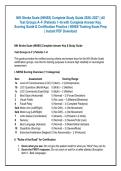
NIH Stroke Scale (NIHSS) Complete Study Guide 2026–2027 | All
Test Groups A–F (Patients 1–6) with Complete Answer Key,
Scoring Guide & Certification Practice | NIHSS Training Exam Prep
| Instant PDF Download
NIH Stroke Scale (NIHSS) Complete Answer Key & Study Guide
Test Groups A–F | Patients 1–6
This guide provides the verified scoring criteria and answer keys for the NIH Stroke Scale
certification groups. Use this for training purposes to ensure high reliability in neurological
assessment.
I. NIHSS Scoring Overview (11 Categories)
Item Assessment Scoring Range
1a Level of Consciousness (LOC) 0 (Alert) – 3 (Unresponsive)
1b LOC Questions (Month/Age) 0 (Both) – 2 (Neither)
1c LOC Commands (Eyes/Grip) 0 (Both) – 2 (Neither)
2 Best Gaze (Horizontal) 0 (Normal) – 2 (Forced Deviation)
3 Visual Fields 0 (No Loss) – 3 (Bilateral Blindness)
4 Facial Palsy 0 (Normal) – 3 (Complete Paralysis)
5a/b Motor Arm (Left/Right) 0 (No Drift) – 4 (No Movement)
6a/b Motor Leg (Left/Right) 0 (No Drift) – 4 (No Movement)
7 Limb Ataxia (Coordination) 0 (Absent) – 2 (Present in 2 limbs)
8 Sensory 0 (Normal) – 2 (Severe/Total Loss)
9 Best Language (Aphasia) 0 (Normal) – 3 (Mute/Global Aphasia)
10 Dysarthria (Slurring) 0 (Normal) – 2 (Severe/Mute)
11 Extinction/Inattention (Neglect) 0 (No Abnormality) – 2 (Profound)
II. "Rules of the Road" for Certification
1. Score what you see: Do not give the patient credit for what you "think" they can do.
2. Score the FIRST response: Do not coach or wait for a better attempt (Exception:
Item 9 - Best Language).
, 3. Do not coach: Use only standard instructions and gestures.
4. Aphasia vs. Dysarthria: If a patient is mute due to aphasia (Item 9), Item 10
(Dysarthria) is usually scored as a 2 (Severe).
5. Amputations: If a limb is missing, score the motor items as "Untestable" (some
systems use 0 or skip).
III. Consolidated Answer Keys (Patient 1–6)
Below are the verified scores for the standard training groups. Note: Scores may vary
slightly by institution if new video sets are used, but these represent the standard A–F
baseline.
Group A
Patient 1: 1a-0, 1b-2, 1c-1, 2-0, 3-2, 4-1, 5a-0, 5b-4, 6a-0, 6b-4, 7-1, 8-2, 9-2, 10-1,
11-1
Patient 2: 1a-0, 1b-2, 1c-0, 2-0, 3-0, 4-1, 5a-0, 5b-0, 6a-0, 6b-0, 7-0, 8-1, 9-2, 10-1,
11-0
Patient 3: 1a-0, 1b-0, 1c-0, 2-0, 3-0, 4-1, 5a-0, 5b-0, 6a-1, 6b-0, 7-1, 8-1, 9-0, 10-0,
11-0
Patient 4: 1a-3, 1b-2, 1c-2, 2-2, 3-2, 4-2, 5a-4, 5b-4, 6a-4, 6b-4, 7-0, 8-2, 9-3, 10-2,
11-2
Patient 5: 1a-0, 1b-0, 1c-0, 2-0, 3-0, 4-1, 5a-0, 5b-0, 6a-0, 6b-0, 7-0, 8-0, 9-0, 10-0,
11-0
Patient 6: 1a-0, 1b-1, 1c-0, 2-0, 3-0, 4-1, 5a-0, 5b-0, 6a-0, 6b-0, 7-0, 8-1, 9-0, 10-0,
11-0
Group B
Patient 1: 1a-0, 1b-1, 1c-0, 2-0, 3-0, 4-1, 5a-0, 5b-4, 6a-0, 6b-3, 7-0, 8-1, 9-1, 10-0,
11-1
Patient 2: 1a-0, 1b-1, 1c-0, 2-0, 3-0, 4-1, 5a-0, 5b-0, 6a-0, 6b-2, 7-0, 8-1, 9-0, 10-1,
11-0
Patient 3: 1a-0, 1b-1, 1c-0, 2-0, 3-0, 4-3, 5a-0, 5b-0, 6a-0, 6b-0, 7-0, 8-1, 9-2, 10-2,
11-1
Patient 4: 1a-0, 1b-0, 1c-0, 2-0, 3-0, 4-0, 5a-0, 5b-0, 6a-0, 6b-1, 7-0, 8-1, 9-0, 10-0,
11-0
Patient 5: 1a-0, 1b-0, 1c-0, 2-0, 3-0, 4-0, 5a-0, 5b-0, 6a-1, 6b-0, 7-1, 8-1, 9-0, 10-0,
11-1
Patient 6: 1a-0, 1b-0, 1c-0, 2-0, 3-0, 4-0, 5a-0, 5b-0, 6a-0, 6b-1, 7-0, 8-1, 9-0, 10-0,
11-0
Test Groups A–F (Patients 1–6) with Complete Answer Key,
Scoring Guide & Certification Practice | NIHSS Training Exam Prep
| Instant PDF Download
NIH Stroke Scale (NIHSS) Complete Answer Key & Study Guide
Test Groups A–F | Patients 1–6
This guide provides the verified scoring criteria and answer keys for the NIH Stroke Scale
certification groups. Use this for training purposes to ensure high reliability in neurological
assessment.
I. NIHSS Scoring Overview (11 Categories)
Item Assessment Scoring Range
1a Level of Consciousness (LOC) 0 (Alert) – 3 (Unresponsive)
1b LOC Questions (Month/Age) 0 (Both) – 2 (Neither)
1c LOC Commands (Eyes/Grip) 0 (Both) – 2 (Neither)
2 Best Gaze (Horizontal) 0 (Normal) – 2 (Forced Deviation)
3 Visual Fields 0 (No Loss) – 3 (Bilateral Blindness)
4 Facial Palsy 0 (Normal) – 3 (Complete Paralysis)
5a/b Motor Arm (Left/Right) 0 (No Drift) – 4 (No Movement)
6a/b Motor Leg (Left/Right) 0 (No Drift) – 4 (No Movement)
7 Limb Ataxia (Coordination) 0 (Absent) – 2 (Present in 2 limbs)
8 Sensory 0 (Normal) – 2 (Severe/Total Loss)
9 Best Language (Aphasia) 0 (Normal) – 3 (Mute/Global Aphasia)
10 Dysarthria (Slurring) 0 (Normal) – 2 (Severe/Mute)
11 Extinction/Inattention (Neglect) 0 (No Abnormality) – 2 (Profound)
II. "Rules of the Road" for Certification
1. Score what you see: Do not give the patient credit for what you "think" they can do.
2. Score the FIRST response: Do not coach or wait for a better attempt (Exception:
Item 9 - Best Language).
, 3. Do not coach: Use only standard instructions and gestures.
4. Aphasia vs. Dysarthria: If a patient is mute due to aphasia (Item 9), Item 10
(Dysarthria) is usually scored as a 2 (Severe).
5. Amputations: If a limb is missing, score the motor items as "Untestable" (some
systems use 0 or skip).
III. Consolidated Answer Keys (Patient 1–6)
Below are the verified scores for the standard training groups. Note: Scores may vary
slightly by institution if new video sets are used, but these represent the standard A–F
baseline.
Group A
Patient 1: 1a-0, 1b-2, 1c-1, 2-0, 3-2, 4-1, 5a-0, 5b-4, 6a-0, 6b-4, 7-1, 8-2, 9-2, 10-1,
11-1
Patient 2: 1a-0, 1b-2, 1c-0, 2-0, 3-0, 4-1, 5a-0, 5b-0, 6a-0, 6b-0, 7-0, 8-1, 9-2, 10-1,
11-0
Patient 3: 1a-0, 1b-0, 1c-0, 2-0, 3-0, 4-1, 5a-0, 5b-0, 6a-1, 6b-0, 7-1, 8-1, 9-0, 10-0,
11-0
Patient 4: 1a-3, 1b-2, 1c-2, 2-2, 3-2, 4-2, 5a-4, 5b-4, 6a-4, 6b-4, 7-0, 8-2, 9-3, 10-2,
11-2
Patient 5: 1a-0, 1b-0, 1c-0, 2-0, 3-0, 4-1, 5a-0, 5b-0, 6a-0, 6b-0, 7-0, 8-0, 9-0, 10-0,
11-0
Patient 6: 1a-0, 1b-1, 1c-0, 2-0, 3-0, 4-1, 5a-0, 5b-0, 6a-0, 6b-0, 7-0, 8-1, 9-0, 10-0,
11-0
Group B
Patient 1: 1a-0, 1b-1, 1c-0, 2-0, 3-0, 4-1, 5a-0, 5b-4, 6a-0, 6b-3, 7-0, 8-1, 9-1, 10-0,
11-1
Patient 2: 1a-0, 1b-1, 1c-0, 2-0, 3-0, 4-1, 5a-0, 5b-0, 6a-0, 6b-2, 7-0, 8-1, 9-0, 10-1,
11-0
Patient 3: 1a-0, 1b-1, 1c-0, 2-0, 3-0, 4-3, 5a-0, 5b-0, 6a-0, 6b-0, 7-0, 8-1, 9-2, 10-2,
11-1
Patient 4: 1a-0, 1b-0, 1c-0, 2-0, 3-0, 4-0, 5a-0, 5b-0, 6a-0, 6b-1, 7-0, 8-1, 9-0, 10-0,
11-0
Patient 5: 1a-0, 1b-0, 1c-0, 2-0, 3-0, 4-0, 5a-0, 5b-0, 6a-1, 6b-0, 7-1, 8-1, 9-0, 10-0,
11-1
Patient 6: 1a-0, 1b-0, 1c-0, 2-0, 3-0, 4-0, 5a-0, 5b-0, 6a-0, 6b-1, 7-0, 8-1, 9-0, 10-0,
11-0