

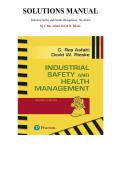
SOLUTIONS MANUAL
Industrial Safety and Health Management, 7th edition
by C Ray Asfahl, David W. Rieske
SC
O
R
EG
U
ID
ES
, Table of Content
The Safety and Health Manager
Development of the Safety and Health Function
Concepts of Hazard Avoidance
Impact of Federal Regulation
Information Systems
SC
Process Safety and Disaster Preparedness
Buildings and Facilities
Ergonomics
O
Health and Toxic Substances
R
Environmental Control and Noise
Flammable and Explosive Materials
EG
Personal Protection and First Aid
Fire Protection
Materials Handling and Storage
U
Machine Guarding
ID
Welding
Electrical Hazards
ES
Construction
,Chapter 1 1.1. Some standards are frequently cited because these standards cover (1)
areas in which industries are having difficulty complying, or (2) areas in
which enforcement agencies are giving a great deal of attention, or both.
1.2. Many aspects about the standards might be useful. The text emphasizes
the importance of the "why" behind the standards that do exist.
1.3. No. It is an unattainable goal. Such a strategy fails to recognize the need
for discrimination among hazards to be corrected.
1.4. (1) Hazards that are physically infeasible to correct.
SC
(2) Hazards that are physically feasible, but are economically infeasible, to
correct.
(3) Hazards that are physically feasible and economically feasible to
correct.
1.5. (1) Causes other more serious hazards to be overlooked while reacting to
O
less serious ones.
(2) Deteriorates credibility with top management.
1.6. A safety hazard is acute, causes or threatens to cause injuries, and is
R
usually more obvious than a health hazard.
A health hazard is chronic, causes or threatens to cause illness in the long
run, and is usually more subtle than a safety hazard.
EG
1.7. Some example safety hazards:
unguarded belts, pulleys, gears, saws, and punch presses; fires;
explosions; open platforms; defective ladders; welding near open
flammable or combustible materials; overloaded or defective
cranes, hoists, or slings; ungrounded electrical equipment; exposed
U
live electrical conductors.
Some example health hazards:
coal dust, cotton dust, chronic loud noise, welding fumes, asbestos,
vinyl chloride, lead fumes, mercury, manganese, cadmium.
ID
1.8. Some valid examples are spray paint, coal dust, benzene, and carbon
disulfide.
ES
1.9. Some valid examples are noise, welding, and radiation.
1.10. Health hazards are usually more subtle than safety hazards; the industrial
hygienist must look for "unseen" hazards.
1.11. Safety hazards may appear more grave, but there are probably many
health hazard-related illnesses and deaths which are not documented.
1.12. Work training, statistics, job placement, industrial relations.
.
1.13. A comprehensive safety and health program involves engineering, and
, placement of the function within the personnel department may restrict
authority too much.
1.14. This places the Safety and Health Manager in an adversarial position with
enforcement officials.
1.15. CPSC concentrates on the responsibility of the manufacturers of the
machines and equipment, whereas OSHA concentrates on the
responsibility of the employer who places the equipment into use in the
workplace.
SC
1.16. (NSC) National Safety Council
1.17. ANSI (American National Standards Institute)
Prepares voluntary standards for occupational safety and health among
other types of standards. OSHA adopted many ANSI standards early on,
invoking its temporary right to promulgate "national consensus standards."
O
1.18. OSHA is concerned with hazardous exposures to workers, i.e. worker
safety and health.
EPA is concerned with hazardous exposures to the public, particularly as
R
these hazards affect the earth, water, and atmosphere.
Many safety and health hazards inside the plant and outside are the
same, or are caused by the same chemical agents or physical factors.
EG
Thus a firm's compliance with both EPA and OSHA regulations are often
the responsibility of the same individual.
1.19. 1-800-35-NIOSH; the agency that responds is, obviously, NIOSH, the
National Institute for Occupational Safety and Health.
1.20. Passage of The Occupational Safety and Health Act of 1970, which
U
created the Occupational Safety and Health Administration (OSHA).
1.21. Prior to passage of the OSHA law occupational health seemed remote
ID
and not of a great deal of concern. Plant nurses were concerned with first
aid and physical examinations. After OSHA, occupational disease
prevention rose in importance.
ES
1.22 The Bhopal, India disaster in which the release of methyl isocyanate gas
killed 2500 civilians. This incident showed that dangerous working
conditions do not just impact the workers, but everyone around a facility.
1.23 Reductions in energy consumption, for example, can lower a firm’s bottom
line energy cost while decreasing its impact on the environment.
1.24 The four environmental issues addresses were global warming, green
engineering, petroleum conservation, and tobacco smoke.
1.25 Green engineering is focused on the reduction of carbon fuels, which in
turn directly impact global warming.
Industrial Safety and Health Management, 7th edition
by C Ray Asfahl, David W. Rieske
SC
O
R
EG
U
ID
ES
, Table of Content
The Safety and Health Manager
Development of the Safety and Health Function
Concepts of Hazard Avoidance
Impact of Federal Regulation
Information Systems
SC
Process Safety and Disaster Preparedness
Buildings and Facilities
Ergonomics
O
Health and Toxic Substances
R
Environmental Control and Noise
Flammable and Explosive Materials
EG
Personal Protection and First Aid
Fire Protection
Materials Handling and Storage
U
Machine Guarding
ID
Welding
Electrical Hazards
ES
Construction
,Chapter 1 1.1. Some standards are frequently cited because these standards cover (1)
areas in which industries are having difficulty complying, or (2) areas in
which enforcement agencies are giving a great deal of attention, or both.
1.2. Many aspects about the standards might be useful. The text emphasizes
the importance of the "why" behind the standards that do exist.
1.3. No. It is an unattainable goal. Such a strategy fails to recognize the need
for discrimination among hazards to be corrected.
1.4. (1) Hazards that are physically infeasible to correct.
SC
(2) Hazards that are physically feasible, but are economically infeasible, to
correct.
(3) Hazards that are physically feasible and economically feasible to
correct.
1.5. (1) Causes other more serious hazards to be overlooked while reacting to
O
less serious ones.
(2) Deteriorates credibility with top management.
1.6. A safety hazard is acute, causes or threatens to cause injuries, and is
R
usually more obvious than a health hazard.
A health hazard is chronic, causes or threatens to cause illness in the long
run, and is usually more subtle than a safety hazard.
EG
1.7. Some example safety hazards:
unguarded belts, pulleys, gears, saws, and punch presses; fires;
explosions; open platforms; defective ladders; welding near open
flammable or combustible materials; overloaded or defective
cranes, hoists, or slings; ungrounded electrical equipment; exposed
U
live electrical conductors.
Some example health hazards:
coal dust, cotton dust, chronic loud noise, welding fumes, asbestos,
vinyl chloride, lead fumes, mercury, manganese, cadmium.
ID
1.8. Some valid examples are spray paint, coal dust, benzene, and carbon
disulfide.
ES
1.9. Some valid examples are noise, welding, and radiation.
1.10. Health hazards are usually more subtle than safety hazards; the industrial
hygienist must look for "unseen" hazards.
1.11. Safety hazards may appear more grave, but there are probably many
health hazard-related illnesses and deaths which are not documented.
1.12. Work training, statistics, job placement, industrial relations.
.
1.13. A comprehensive safety and health program involves engineering, and
, placement of the function within the personnel department may restrict
authority too much.
1.14. This places the Safety and Health Manager in an adversarial position with
enforcement officials.
1.15. CPSC concentrates on the responsibility of the manufacturers of the
machines and equipment, whereas OSHA concentrates on the
responsibility of the employer who places the equipment into use in the
workplace.
SC
1.16. (NSC) National Safety Council
1.17. ANSI (American National Standards Institute)
Prepares voluntary standards for occupational safety and health among
other types of standards. OSHA adopted many ANSI standards early on,
invoking its temporary right to promulgate "national consensus standards."
O
1.18. OSHA is concerned with hazardous exposures to workers, i.e. worker
safety and health.
EPA is concerned with hazardous exposures to the public, particularly as
R
these hazards affect the earth, water, and atmosphere.
Many safety and health hazards inside the plant and outside are the
same, or are caused by the same chemical agents or physical factors.
EG
Thus a firm's compliance with both EPA and OSHA regulations are often
the responsibility of the same individual.
1.19. 1-800-35-NIOSH; the agency that responds is, obviously, NIOSH, the
National Institute for Occupational Safety and Health.
1.20. Passage of The Occupational Safety and Health Act of 1970, which
U
created the Occupational Safety and Health Administration (OSHA).
1.21. Prior to passage of the OSHA law occupational health seemed remote
ID
and not of a great deal of concern. Plant nurses were concerned with first
aid and physical examinations. After OSHA, occupational disease
prevention rose in importance.
ES
1.22 The Bhopal, India disaster in which the release of methyl isocyanate gas
killed 2500 civilians. This incident showed that dangerous working
conditions do not just impact the workers, but everyone around a facility.
1.23 Reductions in energy consumption, for example, can lower a firm’s bottom
line energy cost while decreasing its impact on the environment.
1.24 The four environmental issues addresses were global warming, green
engineering, petroleum conservation, and tobacco smoke.
1.25 Green engineering is focused on the reduction of carbon fuels, which in
turn directly impact global warming.

