WISEMAN STUDY SERIES
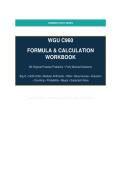
WGU C960
FORMULA & CALCULATION
WORKBOOK
60 Original Practice Problems • Fully Worked Solutions
Big-O • GCD/LCM • Modular Arithmetic • RSA • Recurrences • Induction
• Counting • Probability • Bayes • Expected Value
2026 EDITION | ORIGINAL OA-STYLE SKILL PRACTICE
,WGU C960 | FORMULA & CALCULATION WORKBOOK
Workbook Structure and Study Method
This workbook is designed for active calculation practice. Each unit contains a compact formula bank, three
worked examples, six independent practice problems, and a fully explained solution set. All questions are original
study exercises.
Recommended method
• Cover the solution before attempting a problem.
• Write the governing formula or rule first.
• Show substitutions and intermediate calculations.
• Check modular, probability, and counting answers for reasonableness.
• Mark missed problems and repeat them after 24 hours.
Master Formula Index
Area Core formulas
Big-O Consecutive costs add; nested costs multiply; retain dominant growth term
Number theory gcd·lcm=|ab|; Euclid: a=bq+r
Modular a≡b (mod m); inverse exists iff gcd(a,m)=1
RSA n=pq; φ=(p-1)(q-1); ed≡1 mod φ
Sequences Arithmetic and geometric term/sum formulas
Counting P(n,r), C(n,r), repeated-object permutations
Probability Complement, union, conditional, independence, Bayes
Random variables E(X), variance, binomial probability/mean/variance
Calculator note: A scientific calculator is useful for powers, combinations, logarithms, and decimal probability
calculations. Still write the mathematical setup so errors can be diagnosed.
Wiseman Study Series Page 2
,WGU C960 | FORMULA & CALCULATION WORKBOOK
1. Big-O and Algorithm Calculations
Measure how operation counts grow as n increases. Drop constants and lower-order terms only after forming the
complete count.
Formula Bank
Constant access: O(1) Single pass: O(n) Repeated halving/doubling: O(log n)
Divide-and-conquer sorting: O(n log n) Two full nested loops: O(n²) Three full nested loops:
O(n³)
Fully Worked Examples
Worked Example 1
Analyze: for i=1..n, then for j=1..n.
Solution: The loops are consecutive, not nested. T(n)=n+n=2n. Drop the constant 2: O(n).
Worked Example 2
Analyze: for i=1..n, for j=1..i.
Solution: T(n)=1+2+...+n=n(n+1)/2=(n²+n)/2. The dominant term is n², so O(n²).
Worked Example 3
A loop begins at 1 and doubles until it reaches n.
Solution: After k iterations the value is 2^k. Set 2^k≈n, so k≈log■n. Complexity: O(log n).
Independent Practice
Show every calculation. Do not use the solution pages until all six problems are attempted.
1. Simplify 8n³+4n²+100.
2. Find Big-O for three consecutive loops of sizes n, n², and log■n.
3. Find Big-O for an n-loop containing another n-loop.
4. Find Big-O for an n-loop containing a loop that doubles its index.
5. How many halvings reduce 1,024 items to 1?
6. Give best and worst cases for linear search.
Wiseman Study Series Page 3
, WGU C960 | FORMULA & CALCULATION WORKBOOK
Wiseman Study Series Page 4
WGU C960
FORMULA & CALCULATION
WORKBOOK
60 Original Practice Problems • Fully Worked Solutions
Big-O • GCD/LCM • Modular Arithmetic • RSA • Recurrences • Induction
• Counting • Probability • Bayes • Expected Value
2026 EDITION | ORIGINAL OA-STYLE SKILL PRACTICE
,WGU C960 | FORMULA & CALCULATION WORKBOOK
Workbook Structure and Study Method
This workbook is designed for active calculation practice. Each unit contains a compact formula bank, three
worked examples, six independent practice problems, and a fully explained solution set. All questions are original
study exercises.
Recommended method
• Cover the solution before attempting a problem.
• Write the governing formula or rule first.
• Show substitutions and intermediate calculations.
• Check modular, probability, and counting answers for reasonableness.
• Mark missed problems and repeat them after 24 hours.
Master Formula Index
Area Core formulas
Big-O Consecutive costs add; nested costs multiply; retain dominant growth term
Number theory gcd·lcm=|ab|; Euclid: a=bq+r
Modular a≡b (mod m); inverse exists iff gcd(a,m)=1
RSA n=pq; φ=(p-1)(q-1); ed≡1 mod φ
Sequences Arithmetic and geometric term/sum formulas
Counting P(n,r), C(n,r), repeated-object permutations
Probability Complement, union, conditional, independence, Bayes
Random variables E(X), variance, binomial probability/mean/variance
Calculator note: A scientific calculator is useful for powers, combinations, logarithms, and decimal probability
calculations. Still write the mathematical setup so errors can be diagnosed.
Wiseman Study Series Page 2
,WGU C960 | FORMULA & CALCULATION WORKBOOK
1. Big-O and Algorithm Calculations
Measure how operation counts grow as n increases. Drop constants and lower-order terms only after forming the
complete count.
Formula Bank
Constant access: O(1) Single pass: O(n) Repeated halving/doubling: O(log n)
Divide-and-conquer sorting: O(n log n) Two full nested loops: O(n²) Three full nested loops:
O(n³)
Fully Worked Examples
Worked Example 1
Analyze: for i=1..n, then for j=1..n.
Solution: The loops are consecutive, not nested. T(n)=n+n=2n. Drop the constant 2: O(n).
Worked Example 2
Analyze: for i=1..n, for j=1..i.
Solution: T(n)=1+2+...+n=n(n+1)/2=(n²+n)/2. The dominant term is n², so O(n²).
Worked Example 3
A loop begins at 1 and doubles until it reaches n.
Solution: After k iterations the value is 2^k. Set 2^k≈n, so k≈log■n. Complexity: O(log n).
Independent Practice
Show every calculation. Do not use the solution pages until all six problems are attempted.
1. Simplify 8n³+4n²+100.
2. Find Big-O for three consecutive loops of sizes n, n², and log■n.
3. Find Big-O for an n-loop containing another n-loop.
4. Find Big-O for an n-loop containing a loop that doubles its index.
5. How many halvings reduce 1,024 items to 1?
6. Give best and worst cases for linear search.
Wiseman Study Series Page 3
, WGU C960 | FORMULA & CALCULATION WORKBOOK
Wiseman Study Series Page 4