

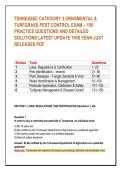
TENNESSEE CATEGORY 3 ORNAMENTAL &
TURFGRASS PEST CONTROL EXAM – 150
PRACTICE QUESTIONS AND DETAILED
SOLUTIONS LATEST UPDATE THIS YEAR-JUST
RELEASED.PDF
Section Topic Questions
1 Laws, Regulations & Certification 1–20
2 Pest Identification – Insects 21–50
3 Plant Diseases – Fungal, Bacterial & Viral 51–80
4 Weed Identification & Management 81–100
5 Pesticide Application, Calibration & Safety 101–130
6 Turfgrass Management & Disease Control 131–150
SECTION 1: LAWS, REGULATIONS, AND CERTIFICATION (Questions 1–20)
Question 1
In order to buy a restricted-use pesticide in Tennessee, an individual must:
A) Be 16 years old
B) Be certified by the Tennessee Department of Agriculture as a pesticide applicator
C) Be working under the supervision of a certified applicator
D) Meet all safety standards
Answer: B) Be certified by the Tennessee Department of Agriculture as a pesticide
applicator
Rationale: Tennessee law requires that anyone purchasing restricted-use pesticides must
,hold current certification from the Tennessee Department of Agriculture. Simply working
under supervision is not sufficient for purchase, though it may be sufficient for use under
direct supervision.
Question 2
According to FEPCA (amended FIFRA), in order to use a restricted-use pesticide, an
applicator:
A) Must be certified in all cases
B) Must be certified or working under the direct supervision of a certified applicator
C) Does not have to be certified but must attend pesticide safety training
D) May always work under the supervision of a certified applicator
Answer: B) Must be certified or working under the direct supervision of a certified
applicator
Rationale: The Federal Environmental Pesticide Control Act (FEPCA), which amended
FIFRA, requires that restricted-use pesticides can only be applied by certified applicators or
individuals working under the direct supervision of a certified applicator. The certified
applicator must be available to provide guidance and direction.
Question 3
Which of the following applicators must ALWAYS be certified in order to use a
restricted-use pesticide?
A) Farmer
B) Greenhouse operator
C) Nurseryman
D) Pest control technician working for a chartered company
Answer: D) Pest control technician working for a chartered company
Rationale: Commercial applicators working for a chartered pest control company must
always be certified to use restricted-use pesticides. Farmers, greenhouse operators, and
nurserymen may work under the supervision of a certified applicator in some circumstances.
Question 4
When does a private applicator become a commercial applicator?
,A) When he/she exchanges services for another private applicator
B) When he/she sprays for another individual and charges a fee
C) When he/she sprays within a greenhouse
D) When their income exceeds $25,000
Answer: B) When he/she sprays for another individual and charges a fee
Rationale: A private applicator becomes a commercial applicator when they provide
pesticide application services to others for compensation. This distinction is important
because commercial applicators are subject to different certification requirements and
regulations.
Question 5
The examination fee for a commercial applicator in Tennessee is:
A) $10.00
B) $15.00
C) $30.00
D) $50.00
*Answer: B) $15.00**
*Rationale: The Tennessee Department of Agriculture charges a $15.00 examination fee
for commercial pesticide applicator certification. Note that exam fees may change over time,
so always verify current fees with TDA.
Question 6
Commercial applicators may become recertified by:
A) Paying $15 annually
B) Sending an application to TDA
C) Earning a certain number of recertification points during the designated period
D) Attending a recertification meeting during the last year of the recertification period
Answer: C) Earning a certain number of recertification points during the designated
period
Rationale: Commercial applicators must earn recertification points through continuing
education activities during their certification period. This ensures that applicators stay
current with new regulations, products, and techniques.
, Question 7
Commercial applicators who violate any provision of FIFRA may be fined:
A) Civil penalty of $5,000 for each offense; Criminal penalty of $25,000 or one year in prison
B) Civil penalty of $1,000 for each offense; Criminal penalty of $5,000 or one year in prison
C) Civil penalty of $5,000 for each offense; Criminal penalty of $100,000
D) None of the above
Answer: A) Civil penalty of $5,000 for each offense; Criminal penalty of $25,000 or
one year in prison
Rationale: FIFRA violations carry significant penalties. Civil penalties can be up to $5,000
per offense, while criminal penalties can include fines of up to $25,000 and/or imprisonment
for up to one year.
Question 8
Commercial applicators must keep records of:
A) General-use pesticides only
B) Restricted-use pesticides only
C) Both general-use and restricted-use pesticides
D) Pesticides with skull and crossbones symbols only
Answer: C) Both general-use and restricted-use pesticides
Rationale: Applicators must maintain records of ALL pesticide applications, both general-
use and restricted-use. This documentation is essential for regulatory compliance and for
tracking treatment effectiveness.
Question 9
Records of pesticide application must be maintained for a period of:
A) One year
B) Two years
C) Three years
D) Five years
Answer: B) Two years
Rationale: Tennessee regulations require that pesticide application records be maintained
TURFGRASS PEST CONTROL EXAM – 150
PRACTICE QUESTIONS AND DETAILED
SOLUTIONS LATEST UPDATE THIS YEAR-JUST
RELEASED.PDF
Section Topic Questions
1 Laws, Regulations & Certification 1–20
2 Pest Identification – Insects 21–50
3 Plant Diseases – Fungal, Bacterial & Viral 51–80
4 Weed Identification & Management 81–100
5 Pesticide Application, Calibration & Safety 101–130
6 Turfgrass Management & Disease Control 131–150
SECTION 1: LAWS, REGULATIONS, AND CERTIFICATION (Questions 1–20)
Question 1
In order to buy a restricted-use pesticide in Tennessee, an individual must:
A) Be 16 years old
B) Be certified by the Tennessee Department of Agriculture as a pesticide applicator
C) Be working under the supervision of a certified applicator
D) Meet all safety standards
Answer: B) Be certified by the Tennessee Department of Agriculture as a pesticide
applicator
Rationale: Tennessee law requires that anyone purchasing restricted-use pesticides must
,hold current certification from the Tennessee Department of Agriculture. Simply working
under supervision is not sufficient for purchase, though it may be sufficient for use under
direct supervision.
Question 2
According to FEPCA (amended FIFRA), in order to use a restricted-use pesticide, an
applicator:
A) Must be certified in all cases
B) Must be certified or working under the direct supervision of a certified applicator
C) Does not have to be certified but must attend pesticide safety training
D) May always work under the supervision of a certified applicator
Answer: B) Must be certified or working under the direct supervision of a certified
applicator
Rationale: The Federal Environmental Pesticide Control Act (FEPCA), which amended
FIFRA, requires that restricted-use pesticides can only be applied by certified applicators or
individuals working under the direct supervision of a certified applicator. The certified
applicator must be available to provide guidance and direction.
Question 3
Which of the following applicators must ALWAYS be certified in order to use a
restricted-use pesticide?
A) Farmer
B) Greenhouse operator
C) Nurseryman
D) Pest control technician working for a chartered company
Answer: D) Pest control technician working for a chartered company
Rationale: Commercial applicators working for a chartered pest control company must
always be certified to use restricted-use pesticides. Farmers, greenhouse operators, and
nurserymen may work under the supervision of a certified applicator in some circumstances.
Question 4
When does a private applicator become a commercial applicator?
,A) When he/she exchanges services for another private applicator
B) When he/she sprays for another individual and charges a fee
C) When he/she sprays within a greenhouse
D) When their income exceeds $25,000
Answer: B) When he/she sprays for another individual and charges a fee
Rationale: A private applicator becomes a commercial applicator when they provide
pesticide application services to others for compensation. This distinction is important
because commercial applicators are subject to different certification requirements and
regulations.
Question 5
The examination fee for a commercial applicator in Tennessee is:
A) $10.00
B) $15.00
C) $30.00
D) $50.00
*Answer: B) $15.00**
*Rationale: The Tennessee Department of Agriculture charges a $15.00 examination fee
for commercial pesticide applicator certification. Note that exam fees may change over time,
so always verify current fees with TDA.
Question 6
Commercial applicators may become recertified by:
A) Paying $15 annually
B) Sending an application to TDA
C) Earning a certain number of recertification points during the designated period
D) Attending a recertification meeting during the last year of the recertification period
Answer: C) Earning a certain number of recertification points during the designated
period
Rationale: Commercial applicators must earn recertification points through continuing
education activities during their certification period. This ensures that applicators stay
current with new regulations, products, and techniques.
, Question 7
Commercial applicators who violate any provision of FIFRA may be fined:
A) Civil penalty of $5,000 for each offense; Criminal penalty of $25,000 or one year in prison
B) Civil penalty of $1,000 for each offense; Criminal penalty of $5,000 or one year in prison
C) Civil penalty of $5,000 for each offense; Criminal penalty of $100,000
D) None of the above
Answer: A) Civil penalty of $5,000 for each offense; Criminal penalty of $25,000 or
one year in prison
Rationale: FIFRA violations carry significant penalties. Civil penalties can be up to $5,000
per offense, while criminal penalties can include fines of up to $25,000 and/or imprisonment
for up to one year.
Question 8
Commercial applicators must keep records of:
A) General-use pesticides only
B) Restricted-use pesticides only
C) Both general-use and restricted-use pesticides
D) Pesticides with skull and crossbones symbols only
Answer: C) Both general-use and restricted-use pesticides
Rationale: Applicators must maintain records of ALL pesticide applications, both general-
use and restricted-use. This documentation is essential for regulatory compliance and for
tracking treatment effectiveness.
Question 9
Records of pesticide application must be maintained for a period of:
A) One year
B) Two years
C) Three years
D) Five years
Answer: B) Two years
Rationale: Tennessee regulations require that pesticide application records be maintained

