

CIPS L4M5 Commercial Negotiation 2026
Practice Exam
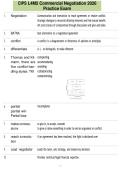
1. Negotiation Communication and interaction to reach agreement or resolve conflict.
Strategic dialogue to reconcile dittering interests and find mutual benefit.
Art and science of compromise through discussion and give-and-take
2. BATNA best alternative to a negotiated agreement
3. conflict A conflict is a disagreement or ditterence of opinions or principles
4. differentiate (v.) - to distinguish, to make ditterent
5. Thomas and Kil- competing
mann, there are accommodating
five conflict-han- avoiding
dling styles: TKI collaborating
compromising.
6. partial incomplete
partial win
Partial lose
7. make conces- to give in, to accept. concede
sionx to give or allow something in order to end an argument or conflict
8. reach a resolu- if an agreement has been reached, the fight is declared over
tion
9. Lead negotiator Leads the team, sets strategy, and makes key decisions
10. Provides technical/legal/financial expertise
, CIPS L4M5 Commercial Negotiation 2026
Practice Exam
SMEs ( subject
matter experts)
11. Analyst Collects and analyses data to support negotiation strategy
12. Team members Share knowledge, contribute to proposals or counterotters
13. Support staff Handle admin, meeting notes, and logistics for smooth operations
14. Collaborative (In- A win-win approach where both parties work together to find a mutually beneficial
tegrative) Ap- outcome.
proach Focus: Long-term relationship and shared interests.
Also called: Integrative negotiation
Typical in: Complex contracts, partnerships, supplier development
15. Distributive A win-lose or zero-sum approach where one party's gain is the other's loss.
(Competitive) Focus: Claiming value, not creating it.
Approach Also called: Competitive negotiation
Typical in: One-ott transactions, price-only negotiations
16. Distributive ap- A win-lose method where one party seeks to maximise its own gain at the other's
proach charac- expense.
teristics There is often a power imbalance; the stronger party dominates.
Minimal and untrusting; tactics like bluflng or manipulation may be used.
17. Collaborative ap- A win-win method where parties jointly solve problems and create value.
proach charac- Win-win (not zero-sum), with a focus on long-term mutual gain.
teristics It encourages openness, fair communication, and creative solutions.
18. the situation we Urgent or Critical Needs
consider using Ethical Issues
a win-lose ap- Supplier Performance Issues
proach Cost Pressures
, CIPS L4M5 Commercial Negotiation 2026
Practice Exam
19. Negotiation Separate People from the Problem
strategies Seek Common Ground
Explore Alternative Perspectives
Use Objective Criteria
Build Win-Win Outcomes
Seek Third-Party Assistance
20. Types of Power in Individual (Personal) Power
Negotiation Subject Matter Expertise - Deep technical knowledge or industry insight.
Excellent Communication Skills - Ability to persuade, clarify, and listen.
Delegated Authority - Having decision-making power from the organisation.
Organisational Power
Market Dominance - Leading position gives more control over terms.
Strong Reputation - A trusted or preferred brand is more influential.
Financial Strength - The ability to invest, scale, or walk away can shift bargaining
power.
21. Importance of InfluencePower allows a party to shape the negotiation process, agenda, and
Power in Com- outcomes, persuading others to align with their proposals.
mercial Negotia- LeverageUsing power to secure favourable terms or concessions; negotiating
tions from a strong position.
Bargaining PositionStronger parties have more options and can walk away from
bad deals, giving them advantage.
Relationship ManagementPower allows a party to assert boundaries and shape
long-term relationships.
Persuasion and CommunicationPower enhances the ability to clearly communi-
cate proposals, influencing the perception of the other party.
Risk MitigationPower enables better risk management through expertise and
informed decision-making, reducing the chance of deadlock.
22. Positional power refers to the power derived from one's formal role, status, or
access to resources within an organisation
, CIPS L4M5 Commercial Negotiation 2026
Practice Exam
Sources of indi-
vidual power: po-
sitional
23. Legitimate Pow- Power from formal authority or position, e.g. managers, team leaders, or those
er with delegated authority.
24. Reward Power Power based on the ability to otter rewards or incentives to influence behaviour
(e.g. bonuses, access to opportunities).
25. Coercive Power Power based on the ability to impose penalties or negative consequences to
enforce compliance.
26. Informational Power gained through control of valuable data or knowledge, used to shape
Power decisions, perceptions, or outcomes.
27. Sources of Indi- Personal power is derived from an individual's traits, skills, or reputation, rather
vidual Power - than formal authority. It includes expert power and referent power
Personal
28. Expert Power Influence gained from deep knowledge, expertise, or technical competence.
Recognised subject matter experts often guide discussions and steer decisions.
29. Referent Power Influence based on personal traits, charisma, trust, and relationship-building.
People follow because they respect or admire the individual. building rapport
30. respective individual strengths, skills, or advantages
strength
31. Sources of Infor- Publicly Available InformationData from internet, media, and social platforms to
mation in Negoti- assess a party's external status.
ation Company Profiles & Annual ReportsFormal business documents revealing financial
strength, market position, and priorities.
Buyer-led ResearchInternal research on trends, competitors, and benchmarks to
Practice Exam
1. Negotiation Communication and interaction to reach agreement or resolve conflict.
Strategic dialogue to reconcile dittering interests and find mutual benefit.
Art and science of compromise through discussion and give-and-take
2. BATNA best alternative to a negotiated agreement
3. conflict A conflict is a disagreement or ditterence of opinions or principles
4. differentiate (v.) - to distinguish, to make ditterent
5. Thomas and Kil- competing
mann, there are accommodating
five conflict-han- avoiding
dling styles: TKI collaborating
compromising.
6. partial incomplete
partial win
Partial lose
7. make conces- to give in, to accept. concede
sionx to give or allow something in order to end an argument or conflict
8. reach a resolu- if an agreement has been reached, the fight is declared over
tion
9. Lead negotiator Leads the team, sets strategy, and makes key decisions
10. Provides technical/legal/financial expertise
, CIPS L4M5 Commercial Negotiation 2026
Practice Exam
SMEs ( subject
matter experts)
11. Analyst Collects and analyses data to support negotiation strategy
12. Team members Share knowledge, contribute to proposals or counterotters
13. Support staff Handle admin, meeting notes, and logistics for smooth operations
14. Collaborative (In- A win-win approach where both parties work together to find a mutually beneficial
tegrative) Ap- outcome.
proach Focus: Long-term relationship and shared interests.
Also called: Integrative negotiation
Typical in: Complex contracts, partnerships, supplier development
15. Distributive A win-lose or zero-sum approach where one party's gain is the other's loss.
(Competitive) Focus: Claiming value, not creating it.
Approach Also called: Competitive negotiation
Typical in: One-ott transactions, price-only negotiations
16. Distributive ap- A win-lose method where one party seeks to maximise its own gain at the other's
proach charac- expense.
teristics There is often a power imbalance; the stronger party dominates.
Minimal and untrusting; tactics like bluflng or manipulation may be used.
17. Collaborative ap- A win-win method where parties jointly solve problems and create value.
proach charac- Win-win (not zero-sum), with a focus on long-term mutual gain.
teristics It encourages openness, fair communication, and creative solutions.
18. the situation we Urgent or Critical Needs
consider using Ethical Issues
a win-lose ap- Supplier Performance Issues
proach Cost Pressures
, CIPS L4M5 Commercial Negotiation 2026
Practice Exam
19. Negotiation Separate People from the Problem
strategies Seek Common Ground
Explore Alternative Perspectives
Use Objective Criteria
Build Win-Win Outcomes
Seek Third-Party Assistance
20. Types of Power in Individual (Personal) Power
Negotiation Subject Matter Expertise - Deep technical knowledge or industry insight.
Excellent Communication Skills - Ability to persuade, clarify, and listen.
Delegated Authority - Having decision-making power from the organisation.
Organisational Power
Market Dominance - Leading position gives more control over terms.
Strong Reputation - A trusted or preferred brand is more influential.
Financial Strength - The ability to invest, scale, or walk away can shift bargaining
power.
21. Importance of InfluencePower allows a party to shape the negotiation process, agenda, and
Power in Com- outcomes, persuading others to align with their proposals.
mercial Negotia- LeverageUsing power to secure favourable terms or concessions; negotiating
tions from a strong position.
Bargaining PositionStronger parties have more options and can walk away from
bad deals, giving them advantage.
Relationship ManagementPower allows a party to assert boundaries and shape
long-term relationships.
Persuasion and CommunicationPower enhances the ability to clearly communi-
cate proposals, influencing the perception of the other party.
Risk MitigationPower enables better risk management through expertise and
informed decision-making, reducing the chance of deadlock.
22. Positional power refers to the power derived from one's formal role, status, or
access to resources within an organisation
, CIPS L4M5 Commercial Negotiation 2026
Practice Exam
Sources of indi-
vidual power: po-
sitional
23. Legitimate Pow- Power from formal authority or position, e.g. managers, team leaders, or those
er with delegated authority.
24. Reward Power Power based on the ability to otter rewards or incentives to influence behaviour
(e.g. bonuses, access to opportunities).
25. Coercive Power Power based on the ability to impose penalties or negative consequences to
enforce compliance.
26. Informational Power gained through control of valuable data or knowledge, used to shape
Power decisions, perceptions, or outcomes.
27. Sources of Indi- Personal power is derived from an individual's traits, skills, or reputation, rather
vidual Power - than formal authority. It includes expert power and referent power
Personal
28. Expert Power Influence gained from deep knowledge, expertise, or technical competence.
Recognised subject matter experts often guide discussions and steer decisions.
29. Referent Power Influence based on personal traits, charisma, trust, and relationship-building.
People follow because they respect or admire the individual. building rapport
30. respective individual strengths, skills, or advantages
strength
31. Sources of Infor- Publicly Available InformationData from internet, media, and social platforms to
mation in Negoti- assess a party's external status.
ation Company Profiles & Annual ReportsFormal business documents revealing financial
strength, market position, and priorities.
Buyer-led ResearchInternal research on trends, competitors, and benchmarks to

