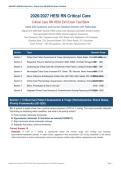
2026/2027 HESI RN Critical Care / Critical Care RN HESI Exit Exam Test Bank
2026/2027 HESI RN Critical Care
Critical Care RN HESI Exit Exam Test Bank
Latest 200 Questions and Correct Detailed Answers with Rationales
Aligned with 2026-2027 Elsevier HESI Critical Care Nursing Examination Content Outline
Next Generation NCLEX (NGN) Clinical Judgment Framework
Total Questions: 200 | Cognitive Levels: 25% Recall, 55% Application, 20% Analysis
Question Style: 75% Scenario-Based | 20% Direct Recall | 5% Calculation
Exam Format: ~120-180 questions, 120 minutes, Passing Score 70%
Section Topic Question Range
Section 1 Critical Care Patient Assessment & Triage (Hemodynamics, Shock States, PriorityQ1
Frameworks)
- Q30
Section 2 Respiratory Failure & Mechanical Ventilation (ABG, ARDS, Ventilator Management)
Q31 - Q55
Section 3 Cardiovascular Critical Care (MI, Arrhythmias, Heart Failure, Cardiac Emergencies)
Q56 - Q80
Section 4 Neurological Critical Care (Increased ICP, Stroke, TBI, Seizures, Neuro Assessment)
Q81 - Q105
Section 5 Renal, Endocrine & Multisystem Critical Care (AKI, DKA, HHS, Sepsis, DIC, MODS,
Q106Burns)
- Q135
Section 6 Critical Care Pharmacology (Vasopressors, Antiarrhythmics, Sedatives, Emergency
Q136Meds)
- Q165
Section 7 Ethics, Prioritization & End-of-Life Care Q166 - Q180
Section 8 Integrated Clinical Case Scenarios & Comprehensive Nursing Reasoning (NGNQ181
Style)- Q200
Section 1: Critical Care Patient Assessment & Triage (Hemodynamics, Shock States,
Priority Frameworks) (Q1-Q30)
Q1: A patient in septic shock has a central venous pressure (CVP) of 1 mmHg. The nurse correctly interprets
this finding as indicating which condition, and what is the priority action?
A. Fluid overload; administer furosemide
B. Hypovolemia; administer IV fluid bolus as ordered [CORRECT]
C. Right ventricular failure; administer inotrope
D. Adequate fluid status; continue monitoring
Correct Answer: B
Rationale: A CVP of 1 mmHg is significantly below the normal range (2-6 mmHg) and indicates
hypovolemia/inadequate preload. In septic shock, aggressive fluid resuscitation (30 mL/kg crystalloid) is the priority
initial intervention to restore intravascular volume and improve cardiac output before vasopressors are initiated.
Aligned with Elsevier HESI Critical Care Nursing Blueprint and NGN Framework Page 1
,2026/2027 HESI RN Critical Care / Critical Care RN HESI Exit Exam Test Bank
Q2: Which hemodynamic profile is most characteristic of cardiogenic shock?
A. Low cardiac index (<2.2), high PAWP (>18 mmHg), high SVR (>1,200 dynes/sec/cm5) [CORRECT]
B. Low cardiac index, low PAWP, low SVR
C. High cardiac index, low PAWP, low SVR
D. High cardiac index, high PAWP, low SVR
Correct Answer: A
Rationale: Cardiogenic shock results from pump failure, producing low cardiac output (low CI), fluid backing up into the
pulmonary circulation (high PAWP), and compensatory vasoconstriction (high SVR). This contrasts with septic shock
(low SVR, high CI in warm phase) and hypovolemic shock (low PAWP, low CO, high SVR).
Q3: A patient with septic shock has a MAP of 58 mmHg despite 30 mL/kg fluid resuscitation. Which
vasopressor should the nurse anticipate as first-line therapy?
A. Vasopressin
B. Norepinephrine (Levophed) [CORRECT]
C. Epinephrine
D. Phenylephrine
Correct Answer: B
Rationale: Norepinephrine is the first-line vasopressor for septic shock per Surviving Sepsis Campaign guidelines,
titrated to maintain MAP ≥65 mmHg. It provides potent alpha-adrenergic vasoconstriction with modest beta-1 effects,
improving MAP without excessive tachycardia. Vasopressin is added as a second agent if MAP remains inadequate.
Q4: A patient with a spinal cord injury at T4 develops hypotension (BP 80/40) and bradycardia (HR 45). Which
type of shock is most likely, and what is the underlying mechanism?
A. Hypovolemic shock from fluid loss
B. Neurogenic shock from loss of sympathetic tone below the injury level [CORRECT]
C. Septic shock from infection
D. Cardiogenic shock from myocardial injury
Correct Answer: B
Rationale: Neurogenic shock results from loss of sympathetic vasomotor tone below the level of spinal cord injury
(typically above T6), causing vasodilation, hypotension, and bradycardia (unopposed parasympathetic activity).
Treatment includes IV fluids and vasopressors (phenylephrine or norepinephrine); atropine may be needed for
symptomatic bradycardia.
Q5: Using the NCSBN Clinical Judgment Model, what is the priority action when a postoperative patient
suddenly develops a BP of 78/40, HR 130, and UOP of 10 mL/hr?
A. Administer antipyretic for potential infection
B. Assess for source of fluid/blood loss and administer IV fluid bolus [CORRECT]
C. Increase the morphine PCA dose for pain control
D. Reposition the patient to Trendelenburg and reassess
Correct Answer: B
Rationale: These findings indicate hypovolemic shock (likely hemorrhage or third-spacing) given the tachycardia,
hypotension, and oliguria. Priority is to identify the source of volume loss (assess surgical site, drains, hemoglobin) and
restore intravascular volume with isotonic crystalloid while preparing for blood transfusion if needed.
Aligned with Elsevier HESI Critical Care Nursing Blueprint and NGN Framework Page 2
,2026/2027 HESI RN Critical Care / Critical Care RN HESI Exit Exam Test Bank
Q6: Which assessment finding best differentiates septic shock (warm phase) from cardiogenic shock?
A. Both have warm, dry extremities
B. Septic shock has warm, flushed extremities; cardiogenic shock has cool, pale extremities [CORRECT]
C. Septic shock has cool, clammy extremities; cardiogenic shock has warm extremities
D. Both have cool, mottled extremities
Correct Answer: B
Rationale: Early septic shock (warm phase) features vasodilation with warm, flushed extremities, while cardiogenic
shock features vasoconstriction (compensatory) producing cool, pale, clammy extremities. As septic shock progresses
to the cold phase, extremities become cool due to poor perfusion, but this represents decompensation.
Q7: A patient with hypovolemic shock has the following hemodynamics: CVP 1 mmHg, PAWP 4 mmHg, CO
3.5 L/min, SVR 1,800 dynes/sec/cm5. The nurse anticipates which priority intervention?
A. Initiate norepinephrine infusion
B. Administer IV fluid bolus to restore preload [CORRECT]
C. Start dobutamine for inotropic support
D. Begin nitroprusside for afterload reduction
Correct Answer: B
Rationale: Low CVP and PAWP indicate inadequate preload (hypovolemia). The priority is fluid resuscitation to restore
intravascular volume, increase venous return, and improve cardiac output. Vasopressors and inotropes are not first-line
in hypovolemic shock because the pump and vasculature are intact; the problem is volume.
Q8: According to Maslow's hierarchy applied to critical care triage, which patient need takes the highest
priority?
A. Patient requests to see family before a procedure
B. Patient has SpO2 of 88% on room air [CORRECT]
C. Patient reports pain rated 8/10
D. Patient expresses fear about ICU stay
Correct Answer: B
Rationale: Maslow's hierarchy prioritizes physiologic needs (oxygenation) above safety, love/belonging, and
self-actualization. An SpO2 of 88% indicates hypoxemia, an immediate life threat requiring intervention before
addressing pain, fear, or family needs. ABCs always supersede psychosocial needs.
Q9: A nurse is caring for four patients. Using the ABC priority framework, which patient should the nurse
assess first?
A. Patient with a Foley catheter draining cloudy urine
B. Patient with new-onset wheezing and SpO2 90% on 2L NC [CORRECT]
C. Patient with a surgical wound requiring dressing change
D. Patient requesting pain medication for chronic back pain
Correct Answer: B
Rationale: Airway/breathing compromise (new wheezing with hypoxemia) is the highest priority per ABC framework.
Respiratory distress can rapidly progress to respiratory failure and requires immediate assessment and intervention
(bronchodilators, oxygen titration, possible steroid administration). Other patients are stable.
Aligned with Elsevier HESI Critical Care Nursing Blueprint and NGN Framework Page 3
, 2026/2027 HESI RN Critical Care / Critical Care RN HESI Exit Exam Test Bank
Q10: A patient's pulmonary artery wedge pressure (PAWP) is 22 mmHg. The nurse understands this value
indicates:
A. Hypovolemia requiring fluid bolus
B. Fluid overload or left ventricular failure; anticipate diuresis [CORRECT]
C. Normal left heart pressures
D. Increased pulmonary vascular resistance only
Correct Answer: B
Rationale: Normal PAWP is 8-12 mmHg. A PAWP of 22 mmHg indicates elevated left ventricular end-diastolic
pressure, seen in left heart failure or fluid overload. The nurse should anticipate diuretics (furosemide) and possibly
vasodilators to reduce preload and afterload. Values >18 mmHg correlate with pulmonary edema.
Q11: When calculating cardiac output, which formula is correct?
A. CO = SV × HR (stroke volume multiplied by heart rate) [CORRECT]
B. CO = SV ÷ HR
C. CO = HR ÷ SV
D. CO = MAP × TPR
Correct Answer: A
Rationale: Cardiac output (CO) equals stroke volume (SV) multiplied by heart rate (HR). Normal CO is 4-8 L/min.
Cardiac index (CI) is CO divided by body surface area, allowing comparison across different body sizes. CO is the
foundation of tissue oxygen delivery (DO2 = CO × CaO2 × 10).
Q12: A patient with septic shock has a cardiac index of 4.5 L/min/m² and SVR of 600 dynes/sec/cm5. The
nurse correctly identifies this as which phase of septic shock?
A. Cold phase (decompensated)
B. Warm phase (early/hyperdynamic) [CORRECT]
C. Recovery phase
D. Refractory phase
Correct Answer: B
Rationale: Early septic shock (warm phase) is characterized by high cardiac index (vasodilation reduces afterload,
increasing CO) and low SVR (massive vasodilation). As shock progresses to the cold phase, cardiac function declines
and CI drops while SVR may rise with compensatory vasoconstriction, signaling decompensation.
Q13: Which finding would the nurse expect in a patient with neurogenic shock?
A. Tachycardia and hypertension
B. Bradycardia and hypotension with warm, dry skin [CORRECT]
C. Tachycardia and hypotension with cool, clammy skin
D. Hypertension and bradycardia with mottled skin
Correct Answer: B
Rationale: Neurogenic shock (from spinal cord injury above T6) features loss of sympathetic tone causing vasodilation
(hypotension, warm dry skin) and unopposed vagal tone (bradycardia). This bradycardia differentiates neurogenic from
hypovolemic/cardiogenic shock, which produce reflex tachycardia.
Aligned with Elsevier HESI Critical Care Nursing Blueprint and NGN Framework Page 4
2026/2027 HESI RN Critical Care
Critical Care RN HESI Exit Exam Test Bank
Latest 200 Questions and Correct Detailed Answers with Rationales
Aligned with 2026-2027 Elsevier HESI Critical Care Nursing Examination Content Outline
Next Generation NCLEX (NGN) Clinical Judgment Framework
Total Questions: 200 | Cognitive Levels: 25% Recall, 55% Application, 20% Analysis
Question Style: 75% Scenario-Based | 20% Direct Recall | 5% Calculation
Exam Format: ~120-180 questions, 120 minutes, Passing Score 70%
Section Topic Question Range
Section 1 Critical Care Patient Assessment & Triage (Hemodynamics, Shock States, PriorityQ1
Frameworks)
- Q30
Section 2 Respiratory Failure & Mechanical Ventilation (ABG, ARDS, Ventilator Management)
Q31 - Q55
Section 3 Cardiovascular Critical Care (MI, Arrhythmias, Heart Failure, Cardiac Emergencies)
Q56 - Q80
Section 4 Neurological Critical Care (Increased ICP, Stroke, TBI, Seizures, Neuro Assessment)
Q81 - Q105
Section 5 Renal, Endocrine & Multisystem Critical Care (AKI, DKA, HHS, Sepsis, DIC, MODS,
Q106Burns)
- Q135
Section 6 Critical Care Pharmacology (Vasopressors, Antiarrhythmics, Sedatives, Emergency
Q136Meds)
- Q165
Section 7 Ethics, Prioritization & End-of-Life Care Q166 - Q180
Section 8 Integrated Clinical Case Scenarios & Comprehensive Nursing Reasoning (NGNQ181
Style)- Q200
Section 1: Critical Care Patient Assessment & Triage (Hemodynamics, Shock States,
Priority Frameworks) (Q1-Q30)
Q1: A patient in septic shock has a central venous pressure (CVP) of 1 mmHg. The nurse correctly interprets
this finding as indicating which condition, and what is the priority action?
A. Fluid overload; administer furosemide
B. Hypovolemia; administer IV fluid bolus as ordered [CORRECT]
C. Right ventricular failure; administer inotrope
D. Adequate fluid status; continue monitoring
Correct Answer: B
Rationale: A CVP of 1 mmHg is significantly below the normal range (2-6 mmHg) and indicates
hypovolemia/inadequate preload. In septic shock, aggressive fluid resuscitation (30 mL/kg crystalloid) is the priority
initial intervention to restore intravascular volume and improve cardiac output before vasopressors are initiated.
Aligned with Elsevier HESI Critical Care Nursing Blueprint and NGN Framework Page 1
,2026/2027 HESI RN Critical Care / Critical Care RN HESI Exit Exam Test Bank
Q2: Which hemodynamic profile is most characteristic of cardiogenic shock?
A. Low cardiac index (<2.2), high PAWP (>18 mmHg), high SVR (>1,200 dynes/sec/cm5) [CORRECT]
B. Low cardiac index, low PAWP, low SVR
C. High cardiac index, low PAWP, low SVR
D. High cardiac index, high PAWP, low SVR
Correct Answer: A
Rationale: Cardiogenic shock results from pump failure, producing low cardiac output (low CI), fluid backing up into the
pulmonary circulation (high PAWP), and compensatory vasoconstriction (high SVR). This contrasts with septic shock
(low SVR, high CI in warm phase) and hypovolemic shock (low PAWP, low CO, high SVR).
Q3: A patient with septic shock has a MAP of 58 mmHg despite 30 mL/kg fluid resuscitation. Which
vasopressor should the nurse anticipate as first-line therapy?
A. Vasopressin
B. Norepinephrine (Levophed) [CORRECT]
C. Epinephrine
D. Phenylephrine
Correct Answer: B
Rationale: Norepinephrine is the first-line vasopressor for septic shock per Surviving Sepsis Campaign guidelines,
titrated to maintain MAP ≥65 mmHg. It provides potent alpha-adrenergic vasoconstriction with modest beta-1 effects,
improving MAP without excessive tachycardia. Vasopressin is added as a second agent if MAP remains inadequate.
Q4: A patient with a spinal cord injury at T4 develops hypotension (BP 80/40) and bradycardia (HR 45). Which
type of shock is most likely, and what is the underlying mechanism?
A. Hypovolemic shock from fluid loss
B. Neurogenic shock from loss of sympathetic tone below the injury level [CORRECT]
C. Septic shock from infection
D. Cardiogenic shock from myocardial injury
Correct Answer: B
Rationale: Neurogenic shock results from loss of sympathetic vasomotor tone below the level of spinal cord injury
(typically above T6), causing vasodilation, hypotension, and bradycardia (unopposed parasympathetic activity).
Treatment includes IV fluids and vasopressors (phenylephrine or norepinephrine); atropine may be needed for
symptomatic bradycardia.
Q5: Using the NCSBN Clinical Judgment Model, what is the priority action when a postoperative patient
suddenly develops a BP of 78/40, HR 130, and UOP of 10 mL/hr?
A. Administer antipyretic for potential infection
B. Assess for source of fluid/blood loss and administer IV fluid bolus [CORRECT]
C. Increase the morphine PCA dose for pain control
D. Reposition the patient to Trendelenburg and reassess
Correct Answer: B
Rationale: These findings indicate hypovolemic shock (likely hemorrhage or third-spacing) given the tachycardia,
hypotension, and oliguria. Priority is to identify the source of volume loss (assess surgical site, drains, hemoglobin) and
restore intravascular volume with isotonic crystalloid while preparing for blood transfusion if needed.
Aligned with Elsevier HESI Critical Care Nursing Blueprint and NGN Framework Page 2
,2026/2027 HESI RN Critical Care / Critical Care RN HESI Exit Exam Test Bank
Q6: Which assessment finding best differentiates septic shock (warm phase) from cardiogenic shock?
A. Both have warm, dry extremities
B. Septic shock has warm, flushed extremities; cardiogenic shock has cool, pale extremities [CORRECT]
C. Septic shock has cool, clammy extremities; cardiogenic shock has warm extremities
D. Both have cool, mottled extremities
Correct Answer: B
Rationale: Early septic shock (warm phase) features vasodilation with warm, flushed extremities, while cardiogenic
shock features vasoconstriction (compensatory) producing cool, pale, clammy extremities. As septic shock progresses
to the cold phase, extremities become cool due to poor perfusion, but this represents decompensation.
Q7: A patient with hypovolemic shock has the following hemodynamics: CVP 1 mmHg, PAWP 4 mmHg, CO
3.5 L/min, SVR 1,800 dynes/sec/cm5. The nurse anticipates which priority intervention?
A. Initiate norepinephrine infusion
B. Administer IV fluid bolus to restore preload [CORRECT]
C. Start dobutamine for inotropic support
D. Begin nitroprusside for afterload reduction
Correct Answer: B
Rationale: Low CVP and PAWP indicate inadequate preload (hypovolemia). The priority is fluid resuscitation to restore
intravascular volume, increase venous return, and improve cardiac output. Vasopressors and inotropes are not first-line
in hypovolemic shock because the pump and vasculature are intact; the problem is volume.
Q8: According to Maslow's hierarchy applied to critical care triage, which patient need takes the highest
priority?
A. Patient requests to see family before a procedure
B. Patient has SpO2 of 88% on room air [CORRECT]
C. Patient reports pain rated 8/10
D. Patient expresses fear about ICU stay
Correct Answer: B
Rationale: Maslow's hierarchy prioritizes physiologic needs (oxygenation) above safety, love/belonging, and
self-actualization. An SpO2 of 88% indicates hypoxemia, an immediate life threat requiring intervention before
addressing pain, fear, or family needs. ABCs always supersede psychosocial needs.
Q9: A nurse is caring for four patients. Using the ABC priority framework, which patient should the nurse
assess first?
A. Patient with a Foley catheter draining cloudy urine
B. Patient with new-onset wheezing and SpO2 90% on 2L NC [CORRECT]
C. Patient with a surgical wound requiring dressing change
D. Patient requesting pain medication for chronic back pain
Correct Answer: B
Rationale: Airway/breathing compromise (new wheezing with hypoxemia) is the highest priority per ABC framework.
Respiratory distress can rapidly progress to respiratory failure and requires immediate assessment and intervention
(bronchodilators, oxygen titration, possible steroid administration). Other patients are stable.
Aligned with Elsevier HESI Critical Care Nursing Blueprint and NGN Framework Page 3
, 2026/2027 HESI RN Critical Care / Critical Care RN HESI Exit Exam Test Bank
Q10: A patient's pulmonary artery wedge pressure (PAWP) is 22 mmHg. The nurse understands this value
indicates:
A. Hypovolemia requiring fluid bolus
B. Fluid overload or left ventricular failure; anticipate diuresis [CORRECT]
C. Normal left heart pressures
D. Increased pulmonary vascular resistance only
Correct Answer: B
Rationale: Normal PAWP is 8-12 mmHg. A PAWP of 22 mmHg indicates elevated left ventricular end-diastolic
pressure, seen in left heart failure or fluid overload. The nurse should anticipate diuretics (furosemide) and possibly
vasodilators to reduce preload and afterload. Values >18 mmHg correlate with pulmonary edema.
Q11: When calculating cardiac output, which formula is correct?
A. CO = SV × HR (stroke volume multiplied by heart rate) [CORRECT]
B. CO = SV ÷ HR
C. CO = HR ÷ SV
D. CO = MAP × TPR
Correct Answer: A
Rationale: Cardiac output (CO) equals stroke volume (SV) multiplied by heart rate (HR). Normal CO is 4-8 L/min.
Cardiac index (CI) is CO divided by body surface area, allowing comparison across different body sizes. CO is the
foundation of tissue oxygen delivery (DO2 = CO × CaO2 × 10).
Q12: A patient with septic shock has a cardiac index of 4.5 L/min/m² and SVR of 600 dynes/sec/cm5. The
nurse correctly identifies this as which phase of septic shock?
A. Cold phase (decompensated)
B. Warm phase (early/hyperdynamic) [CORRECT]
C. Recovery phase
D. Refractory phase
Correct Answer: B
Rationale: Early septic shock (warm phase) is characterized by high cardiac index (vasodilation reduces afterload,
increasing CO) and low SVR (massive vasodilation). As shock progresses to the cold phase, cardiac function declines
and CI drops while SVR may rise with compensatory vasoconstriction, signaling decompensation.
Q13: Which finding would the nurse expect in a patient with neurogenic shock?
A. Tachycardia and hypertension
B. Bradycardia and hypotension with warm, dry skin [CORRECT]
C. Tachycardia and hypotension with cool, clammy skin
D. Hypertension and bradycardia with mottled skin
Correct Answer: B
Rationale: Neurogenic shock (from spinal cord injury above T6) features loss of sympathetic tone causing vasodilation
(hypotension, warm dry skin) and unopposed vagal tone (bradycardia). This bradycardia differentiates neurogenic from
hypovolemic/cardiogenic shock, which produce reflex tachycardia.
Aligned with Elsevier HESI Critical Care Nursing Blueprint and NGN Framework Page 4