
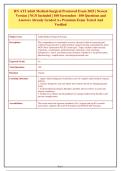
RN ATI Adult Medical-Surgical Proctored Exam 2025 | Newest
Version | NGN Included | 100 Screenshot - 100 Questions and
Answers Already Graded A+ Premium Exam Tested And
Verified
Subject Area Adult Medical-Surgical Nursing
Description This comprehensive examination assesses advanced clinical reasoning and
evidence-based practice in adult medical-surgical nursing, integrating the latest
NGN (Next Generation NCLEX) item types. Topics include cardiovascular,
respiratory, neurological, gastrointestinal, endocrine, renal, oncology,
perioperative, shock, and multisystem disorders. Emphasis is on prioritization,
pharmacology, complications, and interprofessional care.
Expected Grade A+
Total Questions 100
Duration 3 hours
Learning Outcomes 1. Apply clinical judgment to prioritize care for complex adult medical-surgical
patients.
2. Analyze diagnostic data and adjust interventions based on changing patient
status.
3. Evaluate pharmacological therapies and their adverse effects in acute and
chronic conditions.
4. Synthesize evidence-based guidelines to manage multisystem disorders and
prevent complications.
Accreditation This exam meets the rigorous standards of Ivy League and top R1 research
universities, aligned with AACN Essentials and NCLEX-RN test plan.
Page 1
,1. A patient with acute respiratory distress syndrome is on volume-controlled
ventilation. Plateau pressure is 32 cm H2O, and PEEP is 10 cm H2O. Which
intervention is most appropriate to reduce the risk of ventilator-induced lung
injury?
A. Increase PEEP to 15 cm H2O
B. Switch to pressure-controlled ventilation
C. Decrease tidal volume to 4 mL/kg predicted body weight
D. Increase respiratory rate to 25 breaths/min
Answer: C. Decrease tidal volume to 4 mL/kg predicted body weight
Lung-protective ventilation with low tidal volumes (4-6 mL/kg PBW) reduces
volutrauma and barotrauma. Plateau pressure >30 cm H2O indicates overdistension;
decreasing tidal volume is the primary intervention. Increasing PEEP may improve
oxygenation but does not directly address high plateau pressure. Pressure-controlled
ventilation may not lower plateau pressure if tidal volume is not reduced. Increasing
respiratory rate compensates for minute ventilation but does not reduce injury.
2. A patient with septic shock has a mean arterial pressure of 58 mm Hg despite fluid
resuscitation. Norepinephrine is infusing at 20 mcg/min. Which hemodynamic
parameter best indicates the need for additional vasopressor therapy?
A. Central venous pressure 12 mm Hg
B. Cardiac index 2.8 L/min/m2
C. Systemic vascular resistance index 1200 dyn-sec-cm-5/m2
D. Mixed venous oxygen saturation 65%
Answer: C. Systemic vascular resistance index 1200 dyn-sec-cm-5/m2
In septic shock, low SVR is the hallmark. An SVR index <1400 dyn-sec-cm-5/m2
indicates vasodilation; a value of 1200 suggests ongoing vasoplegia, supporting
additional vasopressor. CVP 12 mm Hg and CI 2.8 are adequate. SvO2 65% is
acceptable. The low MAP despite adequate CI and CVP points to low SVR, so further
vasopressor is indicated.
Page 2
,3. A patient with chronic kidney disease stage 4 develops hyperkalemia (6.8 mEq/L)
and ECG shows peaked T waves. Which sequence of interventions is most
appropriate?
A. IV calcium gluconate, followed by IV insulin with dextrose, then sodium polystyrene
sulfonate
B. IV insulin with dextrose, then IV calcium gluconate, then hemodialysis
C. Sodium polystyrene sulfonate orally, then IV calcium gluconate, then IV insulin with
dextrose
D. Hemodialysis immediately, then IV calcium gluconate, then IV insulin with dextrose
Answer: A. IV calcium gluconate, followed by IV insulin with dextrose, then
sodium polystyrene sulfonate
For life-threatening hyperkalemia with ECG changes, IV calcium gluconate is given
first to stabilize the cardiac membrane. Then insulin with dextrose shifts potassium
intracellularly. Sodium polystyrene sulfonate (or patiromer) is a slower method to
remove potassium from the body. Hemodialysis is definitive but not immediately
available; calcium and insulin are temporizing. Option A follows the correct sequence:
stabilize, shift, remove.
4. A patient with diabetic ketoacidosis has an initial serum potassium of 5.2 mEq/L.
After starting insulin infusion, the nurse monitors for which electrolyte
abnormality?
A. Hyperkalemia due to insulin-induced potassium release
B. Hypokalemia due to insulin-driven intracellular shift
C. Hyperphosphatemia due to cellular uptake
D. Hypocalcemia due to alkalosis from bicarbonate therapy
Answer: B. Hypokalemia due to insulin-driven intracellular shift
Insulin promotes cellular uptake of potassium along with glucose. In DKA, total body
potassium is depleted despite initial high serum levels. As insulin is given, potassium
shifts intracellularly, leading to hypokalemia if not replaced. Hyperkalemia is not
caused by insulin; it resolves with insulin. Hyperphosphatemia and hypocalcemia are
less common and not directly insulin-related.
Page 3
, 5. A patient in the ICU develops new-onset atrial fibrillation with rapid ventricular
response (heart rate 150 bpm). Blood pressure is 90/60 mm Hg, and the patient is
asymptomatic. Which intervention should the nurse question?
A. IV diltiazem bolus
B. Synchronized cardioversion at 100 J
C. IV amiodarone infusion
D. IV metoprolol 5 mg
Answer: B. Synchronized cardioversion at 100 J
Synchronized cardioversion is indicated for unstable atrial fibrillation with
hypotension, chest pain, or heart failure. This patient is asymptomatic with borderline
low BP but not unstable (no altered mental status, chest pain, etc.). Rate control with
diltiazem, amiodarone, or metoprolol is appropriate. Cardioversion is not first-line for
stable atrial fibrillation and requires sedation; questioning it is correct.
6. A patient with cirrhosis and ascites is on spironolactone 100 mg daily. The nurse
notes a serum sodium of 128 mEq/L and urine sodium of 10 mEq/L. Which
assessment is most important?
A. Assess for signs of hypervolemia
B. Assess for signs of hepatic encephalopathy
C. Assess for signs of hypokalemia
D. Assess for signs of hyperkalemia
Answer: B. Assess for signs of hepatic encephalopathy
Hyponatremia in cirrhosis indicates water retention from decreased solute; urine
sodium <10 suggests effective hypovolemia (hepatorenal physiology). Rapid correction
can cause osmotic demyelination. However, the most immediate risk is that
hyponatremia can precipitate or worsen hepatic encephalopathy. Spironolactone is
potassium-sparing, so hyperkalemia is a risk, but hyponatremia's neurological impact
is more critical. Hypovolemia is present, not hypervolemia.
Page 4
Version | NGN Included | 100 Screenshot - 100 Questions and
Answers Already Graded A+ Premium Exam Tested And
Verified
Subject Area Adult Medical-Surgical Nursing
Description This comprehensive examination assesses advanced clinical reasoning and
evidence-based practice in adult medical-surgical nursing, integrating the latest
NGN (Next Generation NCLEX) item types. Topics include cardiovascular,
respiratory, neurological, gastrointestinal, endocrine, renal, oncology,
perioperative, shock, and multisystem disorders. Emphasis is on prioritization,
pharmacology, complications, and interprofessional care.
Expected Grade A+
Total Questions 100
Duration 3 hours
Learning Outcomes 1. Apply clinical judgment to prioritize care for complex adult medical-surgical
patients.
2. Analyze diagnostic data and adjust interventions based on changing patient
status.
3. Evaluate pharmacological therapies and their adverse effects in acute and
chronic conditions.
4. Synthesize evidence-based guidelines to manage multisystem disorders and
prevent complications.
Accreditation This exam meets the rigorous standards of Ivy League and top R1 research
universities, aligned with AACN Essentials and NCLEX-RN test plan.
Page 1
,1. A patient with acute respiratory distress syndrome is on volume-controlled
ventilation. Plateau pressure is 32 cm H2O, and PEEP is 10 cm H2O. Which
intervention is most appropriate to reduce the risk of ventilator-induced lung
injury?
A. Increase PEEP to 15 cm H2O
B. Switch to pressure-controlled ventilation
C. Decrease tidal volume to 4 mL/kg predicted body weight
D. Increase respiratory rate to 25 breaths/min
Answer: C. Decrease tidal volume to 4 mL/kg predicted body weight
Lung-protective ventilation with low tidal volumes (4-6 mL/kg PBW) reduces
volutrauma and barotrauma. Plateau pressure >30 cm H2O indicates overdistension;
decreasing tidal volume is the primary intervention. Increasing PEEP may improve
oxygenation but does not directly address high plateau pressure. Pressure-controlled
ventilation may not lower plateau pressure if tidal volume is not reduced. Increasing
respiratory rate compensates for minute ventilation but does not reduce injury.
2. A patient with septic shock has a mean arterial pressure of 58 mm Hg despite fluid
resuscitation. Norepinephrine is infusing at 20 mcg/min. Which hemodynamic
parameter best indicates the need for additional vasopressor therapy?
A. Central venous pressure 12 mm Hg
B. Cardiac index 2.8 L/min/m2
C. Systemic vascular resistance index 1200 dyn-sec-cm-5/m2
D. Mixed venous oxygen saturation 65%
Answer: C. Systemic vascular resistance index 1200 dyn-sec-cm-5/m2
In septic shock, low SVR is the hallmark. An SVR index <1400 dyn-sec-cm-5/m2
indicates vasodilation; a value of 1200 suggests ongoing vasoplegia, supporting
additional vasopressor. CVP 12 mm Hg and CI 2.8 are adequate. SvO2 65% is
acceptable. The low MAP despite adequate CI and CVP points to low SVR, so further
vasopressor is indicated.
Page 2
,3. A patient with chronic kidney disease stage 4 develops hyperkalemia (6.8 mEq/L)
and ECG shows peaked T waves. Which sequence of interventions is most
appropriate?
A. IV calcium gluconate, followed by IV insulin with dextrose, then sodium polystyrene
sulfonate
B. IV insulin with dextrose, then IV calcium gluconate, then hemodialysis
C. Sodium polystyrene sulfonate orally, then IV calcium gluconate, then IV insulin with
dextrose
D. Hemodialysis immediately, then IV calcium gluconate, then IV insulin with dextrose
Answer: A. IV calcium gluconate, followed by IV insulin with dextrose, then
sodium polystyrene sulfonate
For life-threatening hyperkalemia with ECG changes, IV calcium gluconate is given
first to stabilize the cardiac membrane. Then insulin with dextrose shifts potassium
intracellularly. Sodium polystyrene sulfonate (or patiromer) is a slower method to
remove potassium from the body. Hemodialysis is definitive but not immediately
available; calcium and insulin are temporizing. Option A follows the correct sequence:
stabilize, shift, remove.
4. A patient with diabetic ketoacidosis has an initial serum potassium of 5.2 mEq/L.
After starting insulin infusion, the nurse monitors for which electrolyte
abnormality?
A. Hyperkalemia due to insulin-induced potassium release
B. Hypokalemia due to insulin-driven intracellular shift
C. Hyperphosphatemia due to cellular uptake
D. Hypocalcemia due to alkalosis from bicarbonate therapy
Answer: B. Hypokalemia due to insulin-driven intracellular shift
Insulin promotes cellular uptake of potassium along with glucose. In DKA, total body
potassium is depleted despite initial high serum levels. As insulin is given, potassium
shifts intracellularly, leading to hypokalemia if not replaced. Hyperkalemia is not
caused by insulin; it resolves with insulin. Hyperphosphatemia and hypocalcemia are
less common and not directly insulin-related.
Page 3
, 5. A patient in the ICU develops new-onset atrial fibrillation with rapid ventricular
response (heart rate 150 bpm). Blood pressure is 90/60 mm Hg, and the patient is
asymptomatic. Which intervention should the nurse question?
A. IV diltiazem bolus
B. Synchronized cardioversion at 100 J
C. IV amiodarone infusion
D. IV metoprolol 5 mg
Answer: B. Synchronized cardioversion at 100 J
Synchronized cardioversion is indicated for unstable atrial fibrillation with
hypotension, chest pain, or heart failure. This patient is asymptomatic with borderline
low BP but not unstable (no altered mental status, chest pain, etc.). Rate control with
diltiazem, amiodarone, or metoprolol is appropriate. Cardioversion is not first-line for
stable atrial fibrillation and requires sedation; questioning it is correct.
6. A patient with cirrhosis and ascites is on spironolactone 100 mg daily. The nurse
notes a serum sodium of 128 mEq/L and urine sodium of 10 mEq/L. Which
assessment is most important?
A. Assess for signs of hypervolemia
B. Assess for signs of hepatic encephalopathy
C. Assess for signs of hypokalemia
D. Assess for signs of hyperkalemia
Answer: B. Assess for signs of hepatic encephalopathy
Hyponatremia in cirrhosis indicates water retention from decreased solute; urine
sodium <10 suggests effective hypovolemia (hepatorenal physiology). Rapid correction
can cause osmotic demyelination. However, the most immediate risk is that
hyponatremia can precipitate or worsen hepatic encephalopathy. Spironolactone is
potassium-sparing, so hyperkalemia is a risk, but hyponatremia's neurological impact
is more critical. Hypovolemia is present, not hypervolemia.
Page 4

