

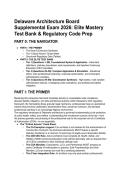
Delaware Architecture Board
Supplemental Exam 2026: Elite Mastery
Test Bank & Regulatory Code Prep
PART 0: THE NAVIGATOR
● PART I: THE PRIMER
○ The Hook & Executive Synthesis
○ The "Critical Axioms" Cheat Sheet
○ Structured Regulatory Data (Tables)
● PART II: THE ELITE TEST BANK
○ Tier 1 (Questions 1–28): Foundational Syntax & Application - Hard-deck
definitions, statutory boundaries, seal requirements, and baseline Continuing
Education (CEU) mandates.
○ Tier 2 (Questions 29–58): Complex Application & Simulation - Situational
ethics, inter-jurisdictional reciprocity, corporate authorization, and mid-project
administrative variables.
○ Tier 3 (Questions 59–88): Grandmaster Synthesis - High-stakes, multi-variable
administrative failures, overlapping code exemptions, and professional liability
mitigation.
PART I: THE PRIMER
Mastering this exhaustive test bank translates directly to unassailable code compliance,
absolute liability mitigation, and elite architectural practice within Delaware's strict regulatory
framework. By internalizing these granular legal mechanics, professionals forge an operational
intuition that prevents catastrophic administrative fines, preserves licensure, and elevates
professional standing in an increasingly litigious environment.
The regulatory landscape of Delaware architecture is governed fundamentally by the protection
of public health, safety, and welfare. Understanding the mechanical nuances of the law—from
the precise geometry and phrasing of the professional seal to the corporate veil of a Certificate
of Authorization (COA)—is non-negotiable.
● The "Critical Axioms" Cheat Sheet:
○ The CA Exemption Legend: If an architect is not retained for the Administration of
Construction Contracts, the technical submissions MUST feature a specific
statutory disclaimer in a minimum 12-point type to legally sever observation liability.
○ The 24/8 CEU Rule: Active architects must complete 24 Health, Safety, and
Welfare (HSW) Continuing Education Units (CEUs) biennially, with an absolute floor
of 8 CEUs completed in each individual calendar year.
○ The COA Mandate: Corporations, LLCs, and Partnerships MUST possess an
active Certificate of Authorization to practice; Sole Proprietorships and Sole
Member LLCs are exempt but must file a certifying statement.
○ The 5-Year Integration Rule: An architect may only seal another professional's
, work if they comprehensively review and integrate it, retaining absolute
documentation of this technical review for a minimum of five years.
○ The Occupancy/Cost Exemptions: Farm buildings are exempt only if human
occupancy is strictly under 10 persons. Other structures are exempt if the
construction cost is under $25,000 AND the work does not impact structural
life-safety systems.
Structured Regulatory Data
The following tables synthesize Delaware's statutory thresholds, providing a rapid-reference
baseline for the complex simulations in the test bank.
Structural Exemption Category Statutory Limit / Threshold Crucial Caveat
Agricultural / Farm Buildings Max 9 Occupants Exemption voided if designed
for 10 or more persons.
Residential Dwellings Single and Two-Family Must be detached; appurtenant
outbuildings are also exempt.
General Building Alterations Costing under $25,000 Exemption instantly voided if
structural safety features are
altered.
Administrative Fines & Penalties Statutory Maximum Penalty
First Offense (General Violation) $5,000 civil penalty
Second / Subsequent Offense $10,000 civil penalty per offense
Violation of Cease & Desist Order $100 to $1,000 per day of continued violation
License Reciprocity Pathways Core Prerequisite
Option 1 Current active NCARB Certificate
Option 2 License in good standing elsewhere for at least
13 years
Option 3 License in good standing for 5 years +
NAAB-accredited degree
PART II: THE ELITE TEST BANK
Tier 1: Foundational Syntax & Application
Q1: An architect prepares technical submissions for a new Delaware commercial facility. Based
on the principles of 24 Del. Admin. Code 300, which phrase MUST be included in the design of
the architect's professional seal? A) Licensed Professional Architect--State of Delaware B)
Registered Architect--State of Delaware C) Board Certified Architect--Delaware D) Professional
Design Practitioner--State of Delaware
● The Answer: B (Registered Architect--State of Delaware)
● Distractor Analysis:
○ A is incorrect: The statute dictates the precise word "Registered", not the generic
"Licensed Professional".
○ C is incorrect: Board certification is a clinical/medical concept, lacking statutory
basis in Delaware architectural law.
, ○ D is incorrect: This is a fabricated, non-statutory title.
The Mentor's Analysis: Regulatory compliance begins with strict adherence to mandated visual
and textual formats. Deviating from the statutory phrasing invalidates the seal's legal authority.
Professional/Academic Intuition: Never improvise legal nomenclature; utilize the exact
statutory seal text.
Q2: An architect wishes to utilize an electronic seal for a final submission. Under Delaware
rules, what condition IMMEDIATELY invalidates an electronic seal and signature? A) The
document is compressed into a ZIP file format. B) The electronic seal graphic is stored remotely
on a cloud server. C) Any data in the linked document is changed after the seal is applied. D)
The digital signature is rendered in blue instead of black ink.
● The Answer: C (Any data in the linked document is changed after the seal is applied.)
● Distractor Analysis:
○ A is incorrect: File compression does not inherently alter the cryptographic data
linkage.
○ B is incorrect: Cloud storage is permitted if the professional maintains direct and
sole control over the application.
○ D is incorrect: Color is not the statutory trigger for invalidation; data integrity is the
sole trigger.
The Mentor's Analysis: Digital seals rely on rigid cryptographic linkages to prevent unauthorized
post-design alterations by clients or contractors. Professional/Academic Intuition: A digital seal
is a fragile lock; any downstream data mutation breaks the chain of evidence.
Q3: A Delaware architect is hired strictly to produce design documents and is intentionally
excluded from the Administration of Construction Contracts. What action is MOST
APPROPRIATE prior to submitting the final technical submissions? A) Apply a red "DRAFT
ONLY" watermark across all pages. B) Obtain a notarized liability waiver from the client. C) Add
a specific statutory legend near the seal in minimum 12-point type. D) Submit the drawings
without a signature traversing the seal.
● The Answer: C (Add a specific statutory legend near the seal in minimum 12-point type.)
● Distractor Analysis:
○ A is incorrect: "Draft" watermarks do not satisfy the legal requirement for CA
exemption notification on final submissions.
○ B is incorrect: Private waivers do not replace public regulatory notifications required
by the state Board.
○ D is incorrect: Unsigned seals are legally invalid and constitute a severe
administrative failure.
The Mentor's Analysis: The Board requires explicit public notification when an architect's
oversight ends at the drawing board to prevent implied liability during physical construction.
Professional/Academic Intuition: Sever your observation liability with the mandatory
12-point statutory legend.
Q4: To maintain an active Delaware license, how many total Continuing Education Units (CEUs)
must an architect complete during the biennial renewal cycle? A) 12 CEUs B) 18 CEUs C) 24
CEUs D) 36 CEUs
● The Answer: C (24 CEUs)
● Distractor Analysis:
○ A is incorrect: 12 is the AIA annual requirement for HSW, not the Delaware biennial
statutory total.
○ B is incorrect: 18 is the AIA total annual membership requirement, not the state
licensure requirement.
, ○ D is incorrect: This is a common requirement for other professions (like engineering
in some states), but architecture requires 24.
The Mentor's Analysis: Licensure renewal relies on a strict 24-hour biennial benchmark focused
entirely on public safety. Professional/Academic Intuition: Memorize the 24-hour biennial hard
deck for license preservation.
Q5: An architect completes 24 CEUs in December of the final renewal year. Based on the
principles of Delaware CEU compliance, will the Board approve this renewal? A) Yes, because
the total 24-hour requirement was met before the deadline. B) No, because Delaware requires a
minimum of 8 CEUs in each individual calendar year. C) Yes, provided the courses were
exclusively AIA-approved. D) No, because all CEUs must be completed in the first year of the
cycle.
● The Answer: B (No, because Delaware requires a minimum of 8 CEUs in each individual
calendar year.)
● Distractor Analysis:
○ A is incorrect: Cramming violates the minimum annual pacing rule explicitly outlined
in the statute.
○ C is incorrect: AIA approval does not override the Board's chronological pacing
mandate.
○ D is incorrect: CEUs can be spread across both years, provided the minimum
8-hour floor is met annually.
The Mentor's Analysis: Delaware explicitly prevents educational cramming by enforcing an
annual floor, ensuring continuous engagement with safety standards. Professional/Academic
Intuition: You cannot bank zero hours in year one; always hit the 8-hour annual floor.
Q6: Under Delaware corporate practice laws, which of the following business structures MUST
obtain a Certificate of Authorization (COA) to legally practice architecture? A) A Sole
Proprietorship. B) A Sole Member Limited Liability Company. C) A Limited Liability Partnership
(LLP). D) A freelance architectural drafter working under a registered architect.
● The Answer: C (A Limited Liability Partnership (LLP).)
● Distractor Analysis:
○ A is incorrect: Sole Proprietorships are explicitly exempt from the COA requirement.
○ B is incorrect: Sole Member LLCs are treated identically to Sole Proprietorships
regarding COA exemptions.
○ D is incorrect: Subordinate drafters are not business entities offering independent
professional services to the public.
The Mentor's Analysis: The Board regulates complex corporate veils (LLPs, LLCs, Corps)
through the COA to ensure accountability remains tethered to a licensed human.
Professional/Academic Intuition: If the entity shields multiple owners, it requires a
Certificate of Authorization.
Q7: A farmer hires a contractor to build a new agricultural storage barn. It is designed to be
occupied by 8 farmhands. Based on the principles of 24 Del. Admin. Code 300, does this
structure require an architect's seal? A) Yes, because it is an agricultural workspace. B) No,
because farm buildings designed for fewer than 10 persons are exempt. C) Yes, because
agricultural buildings inherently pose high life-safety risks. D) No, because all agricultural
structures are unconditionally exempt regardless of occupancy.
● The Answer: B (No, because farm buildings designed for fewer than 10 persons are
exempt.)
● Distractor Analysis:
○ A is incorrect: Workspace status is superseded by the specific agricultural
Supplemental Exam 2026: Elite Mastery
Test Bank & Regulatory Code Prep
PART 0: THE NAVIGATOR
● PART I: THE PRIMER
○ The Hook & Executive Synthesis
○ The "Critical Axioms" Cheat Sheet
○ Structured Regulatory Data (Tables)
● PART II: THE ELITE TEST BANK
○ Tier 1 (Questions 1–28): Foundational Syntax & Application - Hard-deck
definitions, statutory boundaries, seal requirements, and baseline Continuing
Education (CEU) mandates.
○ Tier 2 (Questions 29–58): Complex Application & Simulation - Situational
ethics, inter-jurisdictional reciprocity, corporate authorization, and mid-project
administrative variables.
○ Tier 3 (Questions 59–88): Grandmaster Synthesis - High-stakes, multi-variable
administrative failures, overlapping code exemptions, and professional liability
mitigation.
PART I: THE PRIMER
Mastering this exhaustive test bank translates directly to unassailable code compliance,
absolute liability mitigation, and elite architectural practice within Delaware's strict regulatory
framework. By internalizing these granular legal mechanics, professionals forge an operational
intuition that prevents catastrophic administrative fines, preserves licensure, and elevates
professional standing in an increasingly litigious environment.
The regulatory landscape of Delaware architecture is governed fundamentally by the protection
of public health, safety, and welfare. Understanding the mechanical nuances of the law—from
the precise geometry and phrasing of the professional seal to the corporate veil of a Certificate
of Authorization (COA)—is non-negotiable.
● The "Critical Axioms" Cheat Sheet:
○ The CA Exemption Legend: If an architect is not retained for the Administration of
Construction Contracts, the technical submissions MUST feature a specific
statutory disclaimer in a minimum 12-point type to legally sever observation liability.
○ The 24/8 CEU Rule: Active architects must complete 24 Health, Safety, and
Welfare (HSW) Continuing Education Units (CEUs) biennially, with an absolute floor
of 8 CEUs completed in each individual calendar year.
○ The COA Mandate: Corporations, LLCs, and Partnerships MUST possess an
active Certificate of Authorization to practice; Sole Proprietorships and Sole
Member LLCs are exempt but must file a certifying statement.
○ The 5-Year Integration Rule: An architect may only seal another professional's
, work if they comprehensively review and integrate it, retaining absolute
documentation of this technical review for a minimum of five years.
○ The Occupancy/Cost Exemptions: Farm buildings are exempt only if human
occupancy is strictly under 10 persons. Other structures are exempt if the
construction cost is under $25,000 AND the work does not impact structural
life-safety systems.
Structured Regulatory Data
The following tables synthesize Delaware's statutory thresholds, providing a rapid-reference
baseline for the complex simulations in the test bank.
Structural Exemption Category Statutory Limit / Threshold Crucial Caveat
Agricultural / Farm Buildings Max 9 Occupants Exemption voided if designed
for 10 or more persons.
Residential Dwellings Single and Two-Family Must be detached; appurtenant
outbuildings are also exempt.
General Building Alterations Costing under $25,000 Exemption instantly voided if
structural safety features are
altered.
Administrative Fines & Penalties Statutory Maximum Penalty
First Offense (General Violation) $5,000 civil penalty
Second / Subsequent Offense $10,000 civil penalty per offense
Violation of Cease & Desist Order $100 to $1,000 per day of continued violation
License Reciprocity Pathways Core Prerequisite
Option 1 Current active NCARB Certificate
Option 2 License in good standing elsewhere for at least
13 years
Option 3 License in good standing for 5 years +
NAAB-accredited degree
PART II: THE ELITE TEST BANK
Tier 1: Foundational Syntax & Application
Q1: An architect prepares technical submissions for a new Delaware commercial facility. Based
on the principles of 24 Del. Admin. Code 300, which phrase MUST be included in the design of
the architect's professional seal? A) Licensed Professional Architect--State of Delaware B)
Registered Architect--State of Delaware C) Board Certified Architect--Delaware D) Professional
Design Practitioner--State of Delaware
● The Answer: B (Registered Architect--State of Delaware)
● Distractor Analysis:
○ A is incorrect: The statute dictates the precise word "Registered", not the generic
"Licensed Professional".
○ C is incorrect: Board certification is a clinical/medical concept, lacking statutory
basis in Delaware architectural law.
, ○ D is incorrect: This is a fabricated, non-statutory title.
The Mentor's Analysis: Regulatory compliance begins with strict adherence to mandated visual
and textual formats. Deviating from the statutory phrasing invalidates the seal's legal authority.
Professional/Academic Intuition: Never improvise legal nomenclature; utilize the exact
statutory seal text.
Q2: An architect wishes to utilize an electronic seal for a final submission. Under Delaware
rules, what condition IMMEDIATELY invalidates an electronic seal and signature? A) The
document is compressed into a ZIP file format. B) The electronic seal graphic is stored remotely
on a cloud server. C) Any data in the linked document is changed after the seal is applied. D)
The digital signature is rendered in blue instead of black ink.
● The Answer: C (Any data in the linked document is changed after the seal is applied.)
● Distractor Analysis:
○ A is incorrect: File compression does not inherently alter the cryptographic data
linkage.
○ B is incorrect: Cloud storage is permitted if the professional maintains direct and
sole control over the application.
○ D is incorrect: Color is not the statutory trigger for invalidation; data integrity is the
sole trigger.
The Mentor's Analysis: Digital seals rely on rigid cryptographic linkages to prevent unauthorized
post-design alterations by clients or contractors. Professional/Academic Intuition: A digital seal
is a fragile lock; any downstream data mutation breaks the chain of evidence.
Q3: A Delaware architect is hired strictly to produce design documents and is intentionally
excluded from the Administration of Construction Contracts. What action is MOST
APPROPRIATE prior to submitting the final technical submissions? A) Apply a red "DRAFT
ONLY" watermark across all pages. B) Obtain a notarized liability waiver from the client. C) Add
a specific statutory legend near the seal in minimum 12-point type. D) Submit the drawings
without a signature traversing the seal.
● The Answer: C (Add a specific statutory legend near the seal in minimum 12-point type.)
● Distractor Analysis:
○ A is incorrect: "Draft" watermarks do not satisfy the legal requirement for CA
exemption notification on final submissions.
○ B is incorrect: Private waivers do not replace public regulatory notifications required
by the state Board.
○ D is incorrect: Unsigned seals are legally invalid and constitute a severe
administrative failure.
The Mentor's Analysis: The Board requires explicit public notification when an architect's
oversight ends at the drawing board to prevent implied liability during physical construction.
Professional/Academic Intuition: Sever your observation liability with the mandatory
12-point statutory legend.
Q4: To maintain an active Delaware license, how many total Continuing Education Units (CEUs)
must an architect complete during the biennial renewal cycle? A) 12 CEUs B) 18 CEUs C) 24
CEUs D) 36 CEUs
● The Answer: C (24 CEUs)
● Distractor Analysis:
○ A is incorrect: 12 is the AIA annual requirement for HSW, not the Delaware biennial
statutory total.
○ B is incorrect: 18 is the AIA total annual membership requirement, not the state
licensure requirement.
, ○ D is incorrect: This is a common requirement for other professions (like engineering
in some states), but architecture requires 24.
The Mentor's Analysis: Licensure renewal relies on a strict 24-hour biennial benchmark focused
entirely on public safety. Professional/Academic Intuition: Memorize the 24-hour biennial hard
deck for license preservation.
Q5: An architect completes 24 CEUs in December of the final renewal year. Based on the
principles of Delaware CEU compliance, will the Board approve this renewal? A) Yes, because
the total 24-hour requirement was met before the deadline. B) No, because Delaware requires a
minimum of 8 CEUs in each individual calendar year. C) Yes, provided the courses were
exclusively AIA-approved. D) No, because all CEUs must be completed in the first year of the
cycle.
● The Answer: B (No, because Delaware requires a minimum of 8 CEUs in each individual
calendar year.)
● Distractor Analysis:
○ A is incorrect: Cramming violates the minimum annual pacing rule explicitly outlined
in the statute.
○ C is incorrect: AIA approval does not override the Board's chronological pacing
mandate.
○ D is incorrect: CEUs can be spread across both years, provided the minimum
8-hour floor is met annually.
The Mentor's Analysis: Delaware explicitly prevents educational cramming by enforcing an
annual floor, ensuring continuous engagement with safety standards. Professional/Academic
Intuition: You cannot bank zero hours in year one; always hit the 8-hour annual floor.
Q6: Under Delaware corporate practice laws, which of the following business structures MUST
obtain a Certificate of Authorization (COA) to legally practice architecture? A) A Sole
Proprietorship. B) A Sole Member Limited Liability Company. C) A Limited Liability Partnership
(LLP). D) A freelance architectural drafter working under a registered architect.
● The Answer: C (A Limited Liability Partnership (LLP).)
● Distractor Analysis:
○ A is incorrect: Sole Proprietorships are explicitly exempt from the COA requirement.
○ B is incorrect: Sole Member LLCs are treated identically to Sole Proprietorships
regarding COA exemptions.
○ D is incorrect: Subordinate drafters are not business entities offering independent
professional services to the public.
The Mentor's Analysis: The Board regulates complex corporate veils (LLPs, LLCs, Corps)
through the COA to ensure accountability remains tethered to a licensed human.
Professional/Academic Intuition: If the entity shields multiple owners, it requires a
Certificate of Authorization.
Q7: A farmer hires a contractor to build a new agricultural storage barn. It is designed to be
occupied by 8 farmhands. Based on the principles of 24 Del. Admin. Code 300, does this
structure require an architect's seal? A) Yes, because it is an agricultural workspace. B) No,
because farm buildings designed for fewer than 10 persons are exempt. C) Yes, because
agricultural buildings inherently pose high life-safety risks. D) No, because all agricultural
structures are unconditionally exempt regardless of occupancy.
● The Answer: B (No, because farm buildings designed for fewer than 10 persons are
exempt.)
● Distractor Analysis:
○ A is incorrect: Workspace status is superseded by the specific agricultural

