

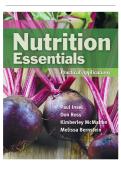
, TESTBANK FOR Nutrition Essentials First Edition Insel
Important Notes
The file includes the complete test bank, organized chapter by chapter.
A sample of selected pages has been provided for preview.
All available appendices and Excel files (if included in the original resources) are
provided.
Quizzes, Midterm and final exams are included (if available in the original resources).
We continuously update our files to ensure you receive the latest and most accurate
editions.
New editions are added regularly – stay connected for updates!
⚠️Note on Answer Keys: If the answer key is not included within the chapter
questions, you will find the complete answers and solutions at the end of each
chapter.
✅ Why Buy From Us?
📚 Complete & organized chapter-by-chapter – no missing content, no guessing.
⚡ Instant digital delivery – get your file the moment you pay, no waiting.
📅 Always up to date – we track new editions so you always get the latest version.
💬 Friendly support – real humans ready to help, anytime you need us.
🔒 Safe & secure – thousands of satisfied students trust us every semester.
🛡️Our Guarantees
💰 Money-Back Guarantee: Not satisfied? We offer a full refund – no questions asked.
🔄 Wrong File? No Problem: Contact us and we will replace it immediately with the
correct version, free of charge.
⏰ 24/7 Support: We are always here – reach out anytime and expect a fast response.
,Nutrition Essentials: Practical Applications, First Edition
Paul Insel, Don Ross, Kimberley McMahon, Melissa Bernstein
Chapter Quizzes
Chapter 01 - Quiz
Multiple Choice
1. The sale of gluten-free products in the United States is rising each year due to the increased diagnosis
of celiac disease and the belief that eliminating gluten from the diet will treat other conditions. This
practice is best described as an example of which sensory influence or personal preference?
A) Food and diet trends
B) Economics
C) Religion
D) Availability
Ans: A
Complexity: Moderate
Ahead: Why Do We Eat the Way We Do?
Subject: Chapter 1
Title: Food Choices: Nutrients and Nourishment
2. Which of the following is a sensory influence that determines a person’s food preferences?
A) Diet trends that exist at a given time
B) Texture of food that a person likes
C) Culture to which a person belongs
D) Genetic predisposition of a person
Ans: B
Complexity: Easy
Ahead: Why Do We Eat the Way We Do?
Subject: Chapter 1
Title: Food Choices: Nutrients and Nourishment
3. As people from other cultures immigrate to new lands, they will adopt new behaviors consistent with
their new homes; however, the last thing to change is generally:
A) comfort foods.
B) food habits.
C) expectations about food.
D) taste sensitivities.
Ans: B
Complexity: Moderate
Ahead: Why Do We Eat the Way We Do?
Subject: Chapter 1
Title: Food Choices: Nutrients and Nourishment
4. A 19-year-old boy avoids rice pudding because once when he was a child, he got sick after eating it.
This practice of avoiding a certain food because you think it will make you sick is best described as which
sensory influence?
Copyright © 2024 Jones & Bartlett Learning, LLC, an Ascend Learning Company
,Nutrition Essentials: Practical Applications, First Edition
Paul Insel, Don Ross, Kimberley McMahon, Melissa Bernstein
Chapter Quizzes
A) Nutrition and health beliefs
B) Social factors
C) Food and diet trends
D) Comfort/discomfort foods
Ans: D
Complexity: Moderate
Ahead: Why Do We Eat the Way We Do?
Subject: Chapter 1
Title: Food Choices: Nutrients and Nourishment
5. Unwillingness to try new foods is a characteristic most likely seen in which of the following age groups?
A) Infants ages 3 months to 1 year old
B) Children ages 2 years to 3 years old
C) Adults ages 13 years to 18 years old
D) Adults ages 30 to 35 years old
Ans: B
Complexity: Easy
Ahead: Why Do We Eat the Way We Do?
Subject: Chapter 1
Title: Food Choices: Nutrients and Nourishment
6. Nutrients are defined as the chemicals:
A) found in all plants that are needed for prevention of disease.
B) in foods that are needed for normal body functions.
C) that provide energy to the body.
D) that must be consumed in equal amounts daily.
Ans: B
Complexity: Easy
Ahead: Introducing the Nutrients
Subject: Chapter 1
Title: Food Choices: Nutrients and Nourishment
7. The __________ model shows how individual factors, environmental settings, and various sections of
influence overlap to form health decisions for an individual.
A) health belief
B) transtheoretical
C) community action
D) social-ecological
Ans: D
Complexity: Moderate
Ahead: Why Do We Eat the Way We Do?
Subject: Chapter 1
Title: Food Choices: Nutrients and Nourishment
8. An essential nutrient is a chemical that:
A) the body can only make if given enough kilocalories.
B) can only be made in the body of the person who eats healthfully.
C) is found only in plant foods.
Copyright © 2024 Jones & Bartlett Learning, LLC, an Ascend Learning Company
,Nutrition Essentials: Practical Applications, First Edition
Paul Insel, Don Ross, Kimberley McMahon, Melissa Bernstein
Chapter Quizzes
D) must be consumed in the diet because the body cannot make it in sufficient quantity.
Ans: D
Complexity: Easy
Ahead: Introducing the Nutrients
Subject: Chapter 1
Title: Food Choices: Nutrients and Nourishment
9. Except for _______, all of the following are organic compounds that regulate body processes and
contribute to cell and body structure.
A) vitamins
B) minerals
C) lipids
D) proteins
Ans: B
Complexity: Moderate
Ahead: Introducing the Nutrients
Subject: Chapter 1
Title: Food Choices: Nutrients and Nourishment
10. Carbohydrate contain ___ calories per gram.
A) 0
B) 4
C) 7
D) 9
Ans: B
Complexity: Easy
Ahead: Introducing the Nutrients
Subject: Chapter 1
Title: Food Choices: Nutrients and Nourishment
11. Which of the following is the best way to describe how vitamins contribute to supplying energy from
foods that we eat?
A) Vitamins contribute 4 kilocalories per gram.
B) Vitamins contribute 9 kilocalories per gram.
C) They provide the starting material for making many hormones.
D) They have vital roles in extracting energy from carbohydrate, fat, and protein.
Ans: D
Complexity: Moderate
Ahead: Introducing the Nutrients
Subject: Chapter 1
Title: Food Choices: Nutrients and Nourishment
12. _________ are organic compounds that function as the building blocks of protein.
A) Vitamins
B) Minerals
C) Amino acids
D) Macronutrients
Ans: C
Copyright © 2024 Jones & Bartlett Learning, LLC, an Ascend Learning Company
,Nutrition Essentials: Practical Applications, First Edition
Paul Insel, Don Ross, Kimberley McMahon, Melissa Bernstein
Chapter Quizzes
Complexity: Easy
Ahead: Introducing the Nutrients
Subject: Chapter 1
Title: Food Choices: Nutrients and Nourishment
13. Which of the following is not considered to be a nutrient?
A) Kilocalories
B) Protein
C) Lipids
D) Water
Ans: A
Complexity: Easy
Ahead: Introducing the Nutrients
Subject: Chapter 1
Title: Food Choices: Nutrients and Nourishment
14. Phytochemicals in foods may reduce the risk of certain diseases by:
A) their antioxidant activity.
B) altering the structure of proteins in liver and kidney tissue.
C) stimulating the excretion of carcinogens and toxic cofactors.
D) increasing the production of intestinal and pancreatic enzymes.
Ans: A
Complexity: Easy
Ahead: Introducing the Nutrients
Subject: Chapter 1
Title: Food Choices: Nutrients and Nourishment
15. Consuming 275 grams of carbohydrate provides what percentage of calories from carbohydrate in a 2,000
kcal diet?
A) 25
B) 40
C) 55
D) 60
Ans: C
Complexity: Difficult
Ahead: Introducing the Nutrients
Subject: Chapter 1
Title: Food Choices: Nutrients and Nourishment
16. How many kilocalories are in 7 grams of protein?
A) 28
B) 49
C) 63
D) 77
Ans: A
Complexity: Moderate
Ahead: Introducing the Nutrients
Subject: Chapter 1
Copyright © 2024 Jones & Bartlett Learning, LLC, an Ascend Learning Company
,Nutrition Essentials: Practical Applications, First Edition
Paul Insel, Don Ross, Kimberley McMahon, Melissa Bernstein
Chapter Quizzes
Title: Food Choices: Nutrients and Nourishment
17. How many grams of protein are in a product that supplies 160 kilocalories from protein?
A) 20
B) 30
C) 35
D) 40
Ans: D
Complexity: Moderate
Ahead: Introducing the Nutrients
Subject: Chapter 1
Title: Food Choices: Nutrients and Nourishment
18. Protein can supply:
A) more energy per gram than carbohydrates.
B) more energy per gram than lipids.
C) the same amount of energy per gram as carbohydrates.
D) less energy per gram than carbohydrates.
Ans: C
Complexity: Moderate
Ahead: Introducing the Nutrients
Subject: Chapter 1
Title: Food Choices: Nutrients and Nourishment
19. Amino acids are different from other building blocks of nutrients because they:
A) contribute the most concentrated energy.
B) contain only double-bonded carbon–hydrogen groups.
C) contain the element nitrogen.
D) are completely digested in the stomach.
Ans: C
Complexity: Easy
Ahead: Introducing the Nutrients
Subject: Chapter 1
Title: Food Choices: Nutrients and Nourishment
20. Which nutrients provide the starting material for making many of the hormones in our bodies?
A) Vitamins
B) Minerals
C) Lipids
D) Proteins
Ans: C
Complexity: Easy
Ahead: Introducing the Nutrients
Subject: Chapter 1
Title: Food Choices: Nutrients and Nourishment
Copyright © 2024 Jones & Bartlett Learning, LLC, an Ascend Learning Company
,Nutrition Essentials: Practical Applications, First Edition
Paul Insel, Don Ross, Kimberley McMahon, Melissa Bernstein
Chapter Quizzes
21. If a food label identifies the total number of kilocalories in a bowl of cereal as 140 and the carbohydrate
kilocalories as 100, what is the approximate percentage of energy supplied by carbohydrates?
A) 40
B) 50
C) 60
D) 70
Ans: D
Complexity: Difficult
Ahead: Introducing the Nutrients
Subject: Chapter 1
Title: Food Choices: Nutrients and Nourishment
22. If a single honey-glazed doughnut contains 50 grams of carbohydrate, 10 grams of protein, and 20
grams of fat, what is the energy contained by the doughnut?
A) 450 kcal
B) 350 kcal
C) 320 kcal
D) 420 kcal
Ans: D
Complexity: Difficult
Ahead: Introducing the Nutrients
Subject: Chapter 1
Title: Food Choices: Nutrients and Nourishment
23. If you eat a diet with 2,000 kilocalories and 45 percent of those calories come from protein, about how
many grams of protein did you eat?
A) 100
B) 128
C) 200
D) 225
Ans: D
Complexity: Moderate
Ahead: Introducing the Nutrients
Subject: Chapter 1
Title: Food Choices: Nutrients and Nourishment
24. A patient is on a 2,000-kcal diet but is meeting only 80 percent of his total energy need. Which of the
following food items could provide adequate kcal for the remaining 20 percent?
A) Food item A (20 grams of fat, 20 grams of carbohydrate, and 35 grams of protein)
B) Food item B (10 grams of fat, 20 grams of carbohydrate, and 35 grams of protein)
C) Food item C (20 grams of fat, 10 grams of carbohydrate, and 35 grams of protein)
D) Food item D (20 grams of fat, 20 grams of carbohydrate, and 25 grams of protein)
Ans: A
Complexity: Difficult
Ahead: Introducing the Nutrients
Subject: Chapter 1
Title: Food Choices: Nutrients and Nourishment
Copyright © 2024 Jones & Bartlett Learning, LLC, an Ascend Learning Company
,Nutrition Essentials: Practical Applications, First Edition
Paul Insel, Don Ross, Kimberley McMahon, Melissa Bernstein
Chapter Quizzes
25. A meal that contains 4 grams of fat, 3 grams of protein, and 3 grams of carbohydrate will provide
______ calories.
A) 50
B) 60
C) 70
D) 80
Ans: B
Complexity: Difficult
Ahead: Introducing the Nutrients
Subject: Chapter 1
Title: Food Choices: Nutrients and Nourishment
26. Phytochemicals are:
A) usually found in all types of food.
B) a group of vitamins that participate in metabolic reactions.
C) all the micronutrients listed in the DRI.
D) substances in plants that may reduce the risk of some chronic diseases.
Ans: D
Complexity: Easy
Ahead: Introducing the Nutrients
Subject: Chapter 1
Title: Food Choices: Nutrients and Nourishment
27. Fat-soluble vitamins:
A) are more likely to be stored in larger quantities than water-soluble vitamins.
B) have very limited roles.
C) are usually involved in some way with the pathways for energy metabolism.
D) are safe to be consumed in large quantities.
Ans: A
Complexity: Moderate
Ahead: Introducing the Nutrients
Subject: Chapter 1
Title: Food Choices: Nutrients and Nourishment
28. Which of the following statements is true about nutrients and food?
A) Each food usually supplies one type of nutrient.
B) Macronutrients are mostly found in solid foods.
C) Most foods contain mixtures of many nutrients.
D) Each nutrient is best absorbed if eaten alone.
Ans: C
Complexity: Moderate
Ahead: Introducing the Nutrients
Subject: Chapter 1
Title: Food Choices: Nutrients and Nourishment
29. Current physical activity guidelines recommend that children and adolescents are physically active for:
A) 30 minutes each day.
B) 60 minutes or more 3 days of the week.
Copyright © 2024 Jones & Bartlett Learning, LLC, an Ascend Learning Company
, Nutrition Essentials: Practical Applications, First Edition
Paul Insel, Don Ross, Kimberley McMahon, Melissa Bernstein
Chapter Quizzes
C) 60 minutes or more each day.
D) 90 minutes 3 days of the week.
Ans: C
Complexity: Easy
Ahead: Introducing the Nutrients
Subject: Chapter 1
Title: Food Choices: Nutrients and Nourishment
30. Peer review of research articles is best described as:
A) objective analysis of the research topic that is conducted by a research team that is different from the
original research team.
B) objective analysis of research that is similar to the subjects in the original research.
C) scientists who have expert knowledge of the subject critically reviewing the original research findings.
D) a step that increases the change of low-quality research being published.
Ans: C
Complexity: Moderate
Ahead: From Research Study to Headline
Subject: Chapter 1
Title: Food Choices: Nutrients and Nourishment
Copyright © 2024 Jones & Bartlett Learning, LLC, an Ascend Learning Company
Important Notes
The file includes the complete test bank, organized chapter by chapter.
A sample of selected pages has been provided for preview.
All available appendices and Excel files (if included in the original resources) are
provided.
Quizzes, Midterm and final exams are included (if available in the original resources).
We continuously update our files to ensure you receive the latest and most accurate
editions.
New editions are added regularly – stay connected for updates!
⚠️Note on Answer Keys: If the answer key is not included within the chapter
questions, you will find the complete answers and solutions at the end of each
chapter.
✅ Why Buy From Us?
📚 Complete & organized chapter-by-chapter – no missing content, no guessing.
⚡ Instant digital delivery – get your file the moment you pay, no waiting.
📅 Always up to date – we track new editions so you always get the latest version.
💬 Friendly support – real humans ready to help, anytime you need us.
🔒 Safe & secure – thousands of satisfied students trust us every semester.
🛡️Our Guarantees
💰 Money-Back Guarantee: Not satisfied? We offer a full refund – no questions asked.
🔄 Wrong File? No Problem: Contact us and we will replace it immediately with the
correct version, free of charge.
⏰ 24/7 Support: We are always here – reach out anytime and expect a fast response.
,Nutrition Essentials: Practical Applications, First Edition
Paul Insel, Don Ross, Kimberley McMahon, Melissa Bernstein
Chapter Quizzes
Chapter 01 - Quiz
Multiple Choice
1. The sale of gluten-free products in the United States is rising each year due to the increased diagnosis
of celiac disease and the belief that eliminating gluten from the diet will treat other conditions. This
practice is best described as an example of which sensory influence or personal preference?
A) Food and diet trends
B) Economics
C) Religion
D) Availability
Ans: A
Complexity: Moderate
Ahead: Why Do We Eat the Way We Do?
Subject: Chapter 1
Title: Food Choices: Nutrients and Nourishment
2. Which of the following is a sensory influence that determines a person’s food preferences?
A) Diet trends that exist at a given time
B) Texture of food that a person likes
C) Culture to which a person belongs
D) Genetic predisposition of a person
Ans: B
Complexity: Easy
Ahead: Why Do We Eat the Way We Do?
Subject: Chapter 1
Title: Food Choices: Nutrients and Nourishment
3. As people from other cultures immigrate to new lands, they will adopt new behaviors consistent with
their new homes; however, the last thing to change is generally:
A) comfort foods.
B) food habits.
C) expectations about food.
D) taste sensitivities.
Ans: B
Complexity: Moderate
Ahead: Why Do We Eat the Way We Do?
Subject: Chapter 1
Title: Food Choices: Nutrients and Nourishment
4. A 19-year-old boy avoids rice pudding because once when he was a child, he got sick after eating it.
This practice of avoiding a certain food because you think it will make you sick is best described as which
sensory influence?
Copyright © 2024 Jones & Bartlett Learning, LLC, an Ascend Learning Company
,Nutrition Essentials: Practical Applications, First Edition
Paul Insel, Don Ross, Kimberley McMahon, Melissa Bernstein
Chapter Quizzes
A) Nutrition and health beliefs
B) Social factors
C) Food and diet trends
D) Comfort/discomfort foods
Ans: D
Complexity: Moderate
Ahead: Why Do We Eat the Way We Do?
Subject: Chapter 1
Title: Food Choices: Nutrients and Nourishment
5. Unwillingness to try new foods is a characteristic most likely seen in which of the following age groups?
A) Infants ages 3 months to 1 year old
B) Children ages 2 years to 3 years old
C) Adults ages 13 years to 18 years old
D) Adults ages 30 to 35 years old
Ans: B
Complexity: Easy
Ahead: Why Do We Eat the Way We Do?
Subject: Chapter 1
Title: Food Choices: Nutrients and Nourishment
6. Nutrients are defined as the chemicals:
A) found in all plants that are needed for prevention of disease.
B) in foods that are needed for normal body functions.
C) that provide energy to the body.
D) that must be consumed in equal amounts daily.
Ans: B
Complexity: Easy
Ahead: Introducing the Nutrients
Subject: Chapter 1
Title: Food Choices: Nutrients and Nourishment
7. The __________ model shows how individual factors, environmental settings, and various sections of
influence overlap to form health decisions for an individual.
A) health belief
B) transtheoretical
C) community action
D) social-ecological
Ans: D
Complexity: Moderate
Ahead: Why Do We Eat the Way We Do?
Subject: Chapter 1
Title: Food Choices: Nutrients and Nourishment
8. An essential nutrient is a chemical that:
A) the body can only make if given enough kilocalories.
B) can only be made in the body of the person who eats healthfully.
C) is found only in plant foods.
Copyright © 2024 Jones & Bartlett Learning, LLC, an Ascend Learning Company
,Nutrition Essentials: Practical Applications, First Edition
Paul Insel, Don Ross, Kimberley McMahon, Melissa Bernstein
Chapter Quizzes
D) must be consumed in the diet because the body cannot make it in sufficient quantity.
Ans: D
Complexity: Easy
Ahead: Introducing the Nutrients
Subject: Chapter 1
Title: Food Choices: Nutrients and Nourishment
9. Except for _______, all of the following are organic compounds that regulate body processes and
contribute to cell and body structure.
A) vitamins
B) minerals
C) lipids
D) proteins
Ans: B
Complexity: Moderate
Ahead: Introducing the Nutrients
Subject: Chapter 1
Title: Food Choices: Nutrients and Nourishment
10. Carbohydrate contain ___ calories per gram.
A) 0
B) 4
C) 7
D) 9
Ans: B
Complexity: Easy
Ahead: Introducing the Nutrients
Subject: Chapter 1
Title: Food Choices: Nutrients and Nourishment
11. Which of the following is the best way to describe how vitamins contribute to supplying energy from
foods that we eat?
A) Vitamins contribute 4 kilocalories per gram.
B) Vitamins contribute 9 kilocalories per gram.
C) They provide the starting material for making many hormones.
D) They have vital roles in extracting energy from carbohydrate, fat, and protein.
Ans: D
Complexity: Moderate
Ahead: Introducing the Nutrients
Subject: Chapter 1
Title: Food Choices: Nutrients and Nourishment
12. _________ are organic compounds that function as the building blocks of protein.
A) Vitamins
B) Minerals
C) Amino acids
D) Macronutrients
Ans: C
Copyright © 2024 Jones & Bartlett Learning, LLC, an Ascend Learning Company
,Nutrition Essentials: Practical Applications, First Edition
Paul Insel, Don Ross, Kimberley McMahon, Melissa Bernstein
Chapter Quizzes
Complexity: Easy
Ahead: Introducing the Nutrients
Subject: Chapter 1
Title: Food Choices: Nutrients and Nourishment
13. Which of the following is not considered to be a nutrient?
A) Kilocalories
B) Protein
C) Lipids
D) Water
Ans: A
Complexity: Easy
Ahead: Introducing the Nutrients
Subject: Chapter 1
Title: Food Choices: Nutrients and Nourishment
14. Phytochemicals in foods may reduce the risk of certain diseases by:
A) their antioxidant activity.
B) altering the structure of proteins in liver and kidney tissue.
C) stimulating the excretion of carcinogens and toxic cofactors.
D) increasing the production of intestinal and pancreatic enzymes.
Ans: A
Complexity: Easy
Ahead: Introducing the Nutrients
Subject: Chapter 1
Title: Food Choices: Nutrients and Nourishment
15. Consuming 275 grams of carbohydrate provides what percentage of calories from carbohydrate in a 2,000
kcal diet?
A) 25
B) 40
C) 55
D) 60
Ans: C
Complexity: Difficult
Ahead: Introducing the Nutrients
Subject: Chapter 1
Title: Food Choices: Nutrients and Nourishment
16. How many kilocalories are in 7 grams of protein?
A) 28
B) 49
C) 63
D) 77
Ans: A
Complexity: Moderate
Ahead: Introducing the Nutrients
Subject: Chapter 1
Copyright © 2024 Jones & Bartlett Learning, LLC, an Ascend Learning Company
,Nutrition Essentials: Practical Applications, First Edition
Paul Insel, Don Ross, Kimberley McMahon, Melissa Bernstein
Chapter Quizzes
Title: Food Choices: Nutrients and Nourishment
17. How many grams of protein are in a product that supplies 160 kilocalories from protein?
A) 20
B) 30
C) 35
D) 40
Ans: D
Complexity: Moderate
Ahead: Introducing the Nutrients
Subject: Chapter 1
Title: Food Choices: Nutrients and Nourishment
18. Protein can supply:
A) more energy per gram than carbohydrates.
B) more energy per gram than lipids.
C) the same amount of energy per gram as carbohydrates.
D) less energy per gram than carbohydrates.
Ans: C
Complexity: Moderate
Ahead: Introducing the Nutrients
Subject: Chapter 1
Title: Food Choices: Nutrients and Nourishment
19. Amino acids are different from other building blocks of nutrients because they:
A) contribute the most concentrated energy.
B) contain only double-bonded carbon–hydrogen groups.
C) contain the element nitrogen.
D) are completely digested in the stomach.
Ans: C
Complexity: Easy
Ahead: Introducing the Nutrients
Subject: Chapter 1
Title: Food Choices: Nutrients and Nourishment
20. Which nutrients provide the starting material for making many of the hormones in our bodies?
A) Vitamins
B) Minerals
C) Lipids
D) Proteins
Ans: C
Complexity: Easy
Ahead: Introducing the Nutrients
Subject: Chapter 1
Title: Food Choices: Nutrients and Nourishment
Copyright © 2024 Jones & Bartlett Learning, LLC, an Ascend Learning Company
,Nutrition Essentials: Practical Applications, First Edition
Paul Insel, Don Ross, Kimberley McMahon, Melissa Bernstein
Chapter Quizzes
21. If a food label identifies the total number of kilocalories in a bowl of cereal as 140 and the carbohydrate
kilocalories as 100, what is the approximate percentage of energy supplied by carbohydrates?
A) 40
B) 50
C) 60
D) 70
Ans: D
Complexity: Difficult
Ahead: Introducing the Nutrients
Subject: Chapter 1
Title: Food Choices: Nutrients and Nourishment
22. If a single honey-glazed doughnut contains 50 grams of carbohydrate, 10 grams of protein, and 20
grams of fat, what is the energy contained by the doughnut?
A) 450 kcal
B) 350 kcal
C) 320 kcal
D) 420 kcal
Ans: D
Complexity: Difficult
Ahead: Introducing the Nutrients
Subject: Chapter 1
Title: Food Choices: Nutrients and Nourishment
23. If you eat a diet with 2,000 kilocalories and 45 percent of those calories come from protein, about how
many grams of protein did you eat?
A) 100
B) 128
C) 200
D) 225
Ans: D
Complexity: Moderate
Ahead: Introducing the Nutrients
Subject: Chapter 1
Title: Food Choices: Nutrients and Nourishment
24. A patient is on a 2,000-kcal diet but is meeting only 80 percent of his total energy need. Which of the
following food items could provide adequate kcal for the remaining 20 percent?
A) Food item A (20 grams of fat, 20 grams of carbohydrate, and 35 grams of protein)
B) Food item B (10 grams of fat, 20 grams of carbohydrate, and 35 grams of protein)
C) Food item C (20 grams of fat, 10 grams of carbohydrate, and 35 grams of protein)
D) Food item D (20 grams of fat, 20 grams of carbohydrate, and 25 grams of protein)
Ans: A
Complexity: Difficult
Ahead: Introducing the Nutrients
Subject: Chapter 1
Title: Food Choices: Nutrients and Nourishment
Copyright © 2024 Jones & Bartlett Learning, LLC, an Ascend Learning Company
,Nutrition Essentials: Practical Applications, First Edition
Paul Insel, Don Ross, Kimberley McMahon, Melissa Bernstein
Chapter Quizzes
25. A meal that contains 4 grams of fat, 3 grams of protein, and 3 grams of carbohydrate will provide
______ calories.
A) 50
B) 60
C) 70
D) 80
Ans: B
Complexity: Difficult
Ahead: Introducing the Nutrients
Subject: Chapter 1
Title: Food Choices: Nutrients and Nourishment
26. Phytochemicals are:
A) usually found in all types of food.
B) a group of vitamins that participate in metabolic reactions.
C) all the micronutrients listed in the DRI.
D) substances in plants that may reduce the risk of some chronic diseases.
Ans: D
Complexity: Easy
Ahead: Introducing the Nutrients
Subject: Chapter 1
Title: Food Choices: Nutrients and Nourishment
27. Fat-soluble vitamins:
A) are more likely to be stored in larger quantities than water-soluble vitamins.
B) have very limited roles.
C) are usually involved in some way with the pathways for energy metabolism.
D) are safe to be consumed in large quantities.
Ans: A
Complexity: Moderate
Ahead: Introducing the Nutrients
Subject: Chapter 1
Title: Food Choices: Nutrients and Nourishment
28. Which of the following statements is true about nutrients and food?
A) Each food usually supplies one type of nutrient.
B) Macronutrients are mostly found in solid foods.
C) Most foods contain mixtures of many nutrients.
D) Each nutrient is best absorbed if eaten alone.
Ans: C
Complexity: Moderate
Ahead: Introducing the Nutrients
Subject: Chapter 1
Title: Food Choices: Nutrients and Nourishment
29. Current physical activity guidelines recommend that children and adolescents are physically active for:
A) 30 minutes each day.
B) 60 minutes or more 3 days of the week.
Copyright © 2024 Jones & Bartlett Learning, LLC, an Ascend Learning Company
, Nutrition Essentials: Practical Applications, First Edition
Paul Insel, Don Ross, Kimberley McMahon, Melissa Bernstein
Chapter Quizzes
C) 60 minutes or more each day.
D) 90 minutes 3 days of the week.
Ans: C
Complexity: Easy
Ahead: Introducing the Nutrients
Subject: Chapter 1
Title: Food Choices: Nutrients and Nourishment
30. Peer review of research articles is best described as:
A) objective analysis of the research topic that is conducted by a research team that is different from the
original research team.
B) objective analysis of research that is similar to the subjects in the original research.
C) scientists who have expert knowledge of the subject critically reviewing the original research findings.
D) a step that increases the change of low-quality research being published.
Ans: C
Complexity: Moderate
Ahead: From Research Study to Headline
Subject: Chapter 1
Title: Food Choices: Nutrients and Nourishment
Copyright © 2024 Jones & Bartlett Learning, LLC, an Ascend Learning Company

