

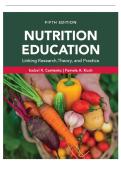
, TESTBANK FOR Nutrition Education Fifth Edition Contento
Important Notes
The file includes the complete test bank, organized chapter by chapter.
A sample of selected pages has been provided for preview.
All available appendices and Excel files (if included in the original resources) are
provided.
Quizzes, Midterm and final exams are included (if available in the original resources).
We continuously update our files to ensure you receive the latest and most accurate
editions.
New editions are added regularly – stay connected for updates!
⚠️Note on Answer Keys: If the answer key is not included within the chapter
questions, you will find the complete answers and solutions at the end of each
chapter.
✅ Why Buy From Us?
📚 Complete & organized chapter-by-chapter – no missing content, no guessing.
⚡ Instant digital delivery – get your file the moment you pay, no waiting.
📅 Always up to date – we track new editions so you always get the latest version.
💬 Friendly support – real humans ready to help, anytime you need us.
🔒 Safe & secure – thousands of satisfied students trust us every semester.
🛡️Our Guarantees
💰 Money-Back Guarantee: Not satisfied? We offer a full refund – no questions asked.
🔄 Wrong File? No Problem: Contact us and we will replace it immediately with the
correct version, free of charge.
⏰ 24/7 Support: We are always here – reach out anytime and expect a fast response.
,Import Settings:
Base Settings: Brownstone Default
Information Field: Complexity
Information Field: Ahead
Information Field: Subject
Information Field: Title
Highest Answer Letter: D
Multiple Keywords in Same Paragraph: No
NAS ISBN13: XXXXXXXXXXXXX, add to Ahead, Title tags
Chapter: Chapter 01 - Testbank
Multiple Choice
1. Nutrition education and health promotion are related in the following ways, except:
A) nutrition education includes other food issues besides health impacts.
B) health promotion focuses on other issues besides food issues.
C) health promotion is a subset of nutrition education.
D) nutrition education can focus on increasing availability and accessibility of food.
Ans: C
Complexity: Moderate
Ahead: The Challenge of Educating People About Eating Well
Subject: Chapter 1
Title: Nutrition Education for Today's Complex World
2. This book focuses on the tasks of the vast majority of nutrition educators, which does not include which
of the following?
A) Engaging in activities and coalitions with others to support the public’s ability to eat healthfully
B) Developing accompanying materials and activities
C) Providing site-based, in-person educational activities with groups
D) Working in a lab pipetting blood samples
Ans: D
Complexity: Moderate
Ahead: What Do Nutrition Educators Do? Settings, Audiences, and Scope for Nutrition Education
Subject: Chapter 1
Title: Nutrition Education for Today's Complex World
3. Nutrition education involves a combination of educational strategies. These could include all the
following, except:
A) policy activities related to food and nutrition.
B) participation in coalitions to change the food environment.
C) strategies to foster growth, development, and change.
D) changes in food assistance programs administration.
Ans: D
Ahead:
Complexity: Moderate
,Ahead: A Contemporary Definition of Nutrition Education
Subject: Chapter 1
Title: Nutrition Education for Today's Complex World
4. Nutrition education for the public can include all of the following, except:
A) engaging in food policy activities.
B) discouraging people from eating for reasons other than health if they so choose.
C) enhancing motivation.
D) assisting people to take food or nutrition-related action.
Ans: B
Ahead:
Complexity: Moderate
Ahead: A Contemporary Definition of Nutrition Education
Subject: Chapter 1
Title: Nutrition Education for Today's Complex World
5. Dietary interventions are often integrated with interventions directed at the following other health-
related behaviors, except:
A) increased physical activity.
B) smoking cessation.
C) blood pressure control.
D) computer programming skills.
Ans: D
Complexity: Moderate
Ahead: Why Nutrition Education?
Subject: Chapter 1
Title: Nutrition Education for Today's Complex World
6. Which of the following is not a life-stage group?
A) College students
B) Asian Americans
C) Pregnant and lactating women
D) Preschool children
Ans: B
Ahead:
Complexity: Easy
Ahead: What Do Nutrition Educators Do? Settings, Audiences, and Scope for Nutrition Education
Subject: Chapter 1
Title: Nutrition Education for Today's Complex World
7. With respect to an elementary school child, the term gatekeepers likely refers to all of the following,
except:
A) the Supplemental Food and Nutrition Program (SNAP).
B) a child’s mother who purchases and prepares food.
C) the child’s twin sister.
D) the foodservice manager at the child’s school.
Ans: C
Ahead:
,Complexity: Moderate
Ahead: What Do Nutrition Educators Do? Settings, Audiences, and Scope for Nutrition Education
Subject: Chapter 1
Title: Nutrition Education for Today's Complex World
8. What is the name of the diet-related governmental document that provides recommendations for
implementing national strategies to improve health and reduce disease?
A) Dietary Guidelines for Americans
B) Food Guide Pyramid
C) MyPlate
D) The National Guidelines
Ans: A
Ahead:
Complexity: Easy
Ahead: The Challenge of Educating People About Eating Well
Subject: Chapter 1
Title: Nutrition Education for Today's Complex World
9. Nutrition education can participate in all of the following, except:
A) influencing policymakers.
B) enhancing motivation.
C) facilitating voluntary dietary change.
D) developing healthy food products.
Ans: D
Ahead:
Complexity: Moderate
Ahead: A Contemporary Definition of Nutrition Education
Subject: Chapter 1
Title: Nutrition Education for Today's Complex World
10. The eating patterns of individuals may differ because:
A) their culture dictates foods different from other cultures.
B) their families serve foods different from other families.
C) they have unique experiences with food.
D) their social and cultural environment emphasizes certain foods.
Ans: C
Ahead:
Complexity: Moderate
Ahead: The Challenge of Educating People About Eating Well
Subject: Chapter 1
Title: Nutrition Education for Today's Complex World
11. “Arguing skillfully” about food and nutrition might include all the following, except:
A) presenting the benefits of taking action through group sessions.
B) food tastings for tasty healthful fruits and vegetables.
C) messages on grocery bags.
D) teaching knife skills.
Ans: D
,Complexity: Moderate
Ahead: A Contemporary Definition of Nutrition Education
Subject: Chapter 1
Title: Nutrition Education for Today's Complex World
12. Studies designed to examine the effectiveness of nutrition education have found all of the following,
except:
A) nutrition education has been shown to improve eating patterns.
B) nutrition education can be cost-effective.
C) nutrition education usually helps people make major dietary changes quickly.
D) nutrition education often does not achieve across-the-board successes on all criteria of effectiveness.
Ans: C
Ahead:
Complexity: Moderate
Ahead: Nutrition Education Effectiveness
Subject: Chapter 1
Title: Nutrition Education for Today's Complex World
13. Which of the following is a potential audience for nutrition education?
A) A college football team
B) Older adults in a nursing facility
C) Media personnel
D) All of these are correct.
Ans: D
Ahead:
Complexity: Moderate
Ahead: What Do Nutrition Educators Do? Settings, Audiences, and Scope for Nutrition Education
Subject: Chapter 1
Title: Nutrition Education for Today's Complex World
14. Which of the following would not represent the notion of sensory-specific satiety?
A) Sally ate a lot of casserole for dinner, but she still had room for ice cream for dessert.
B) After eating the same lunch for 2 weeks in a row, Max decided to change up his routine.
C) Sarah liked the new CSA because it gave her new fruits and vegetables to try every week.
D) Julie boasted she never got tired of potatoes; she ate them morning, noon, and night.
Ans: D
Ahead:
Complexity: Moderate
Ahead: The Challenge of Educating People About Eating Well
Subject: Chapter 1
Title: Nutrition Education for Today's Complex World
15. The “omnivore’s dilemma” is:
A) the dilemma of having to choose between danger and distaste for foods.
B) the dilemma of having to choose from so many different foods.
C) the need to seek variety in choosing foods.
D) the dilemma between choosing food variety to meet nutritional needs and possible dangerous
consequences.
,Ans: D
Ahead:
Complexity: Easy
Ahead: The Challenge of Educating People About Eating Well
Subject: Chapter 1
Title: Nutrition Education for Today’s Complex World
16. Which of the following is not part of the social structure and cultural environment that affects our food
choices?
A) Family origins
B) Influence of cultural practices
C) Food availability
D) Organizational membership
Ans: C
Ahead:
Complexity: Moderate
Ahead: The Challenge of Educating People About Eating Well
Subject: Chapter 1
Title: Nutrition Education for Today’s Complex World
17. Which of the following are part of the economic environment?
A) Household structure, price, income, time use
B) Price, income, time use, transportation
C) Salary, taste, food availability, food accessibility
D) Income, food availability, taste, transportation
Ans: A
Ahead:
Complexity: Moderate
Ahead: The Challenge of Educating People About Eating Well
Subject: Chapter 1
Title: Nutrition Education for Today’s Complex World
18. Why is focusing on specific behavior-change goals more effective than providing general nutrition
information?
A) It allows for individualized diet plans to be created.
B) It helps motivate people by providing clear actions to take, leading to more successful outcomes.
C) It eliminates the need for environmental support.
D) It simplifies complex nutrition science for people.
Ans: B
Complexity: Moderate
Ahead:
Ahead: Meeting the Challenges for Nutrition Education
Subject: Chapter 1
Title: Nutrition Education for Today’s Complex World
19. Use of rewards by parents, daycare staff, or teachers can have which of the following effects?
A) When food is used as a reward for an activity, the activity will be liked more.
B) When dessert is used to reward children to eat their vegetables, children will come to like the
,vegetables.
C) When food is used as a reward for an activity, the food will be liked more.
D) When food is used as a reward for an activity, the liking for the food will decrease.
Ans: C
Ahead:
Complexity: Moderate
Ahead: The Challenge of Educating People About Eating Well
Subject: Chapter 1
Title: Nutrition Education for Today’s Complex World
20. Which of the following would be the best strategy for promoting environmental supports for behavior
change in a community?
A) Creating public awareness about general health and nutrition topics
B) Focusing only on motivating individuals without considering their environment
C) Encouraging people to make all food-related decisions on their own
D) Partnering with local institutions and businesses to make healthy food more accessible
Ans: D
Complexity: Moderate
Ahead: Meeting the Challenges for Nutrition Education
Subject: Chapter 1
Title: Nutrition Education for Today’s Complex World
21. Personal factors influencing our food choices include which of the following?
A) Expected outcomes of taking action, skills, social structures
B) Values, skills, family of origin
C) Values, expected outcomes of taking action, social norms
D) Cultural norms, social structures, values
Ans: C
Ahead:
Complexity: Moderate
Ahead: The Challenge of Educating People About Eating Well
Subject: Chapter 1
Title: Nutrition Education for Today’s Complex World
22. Interpersonal factors influencing our food choices include which of the following?
A) Social networks, families, shopping practices
B) Peers, families, social structures
C) Attitudes, social networks, peers
D) Social networks, peers, friends
Ans: D
Ahead:
Complexity: Moderate
Ahead: The Challenge of Educating People About Eating Well
Subject: Chapter 1
Title: Nutrition Education for Today’s Complex World
23. What taste is associated with umami?
A) The subtleness of tofu in Japanese cuisine
,B) The brothiness of soup or the meatiness in mushrooms
C) The taste of seaweed and hajiki
D) Umami is not officially a distinct taste.
Ans: B
Ahead:
Complexity: Easy
Ahead: The Challenge of Educating People About Eating Well
Subject: Chapter 1
Title: Nutrition Education for Today’s Complex World
24. Which of the following is not a person-related factor?
A) Social structures
B) Cultural practices
C) Sensory-specific satiety
D) Perceptions and beliefs
Ans: C
Ahead:
Complexity: Moderate
Ahead: The Challenge of Educating People About Eating Well
Subject: Chapter 1
Title: Nutrition Education for Today’s Complex World
25. Which of the following is a conditioned aversion?
A) An adult no longer eats rice pudding because his parents always gave him pudding when he was sick
as a child.
B) A child will not try jicama because it is an unfamiliar food.
C) An adult enjoys ice cream because he remembers eating it at his birthday parties.
D) None of these is correct.
E) All of these are correct.
Ans: A
Ahead:
Complexity: Moderate
Ahead: The Challenge of Educating People About Eating Well
Subject: Chapter 1
Title: Nutrition Education for Today’s Complex World
26. Which of the following is not a motivation to reject food according to Rozin and Fallon?
A) Sensory-affected beliefs that can lead to distaste
B) Anticipated consequences about possible harmful outcomes
C) Ideas about the nature of the food that can lead to disgust
D) All of these are motivations for food rejection.
Ans: D
Ahead:
Complexity: Moderate
Ahead: The Challenge of Educating People About Eating Well
Subject: Chapter 1
Title: Nutrition Education for Today’s Complex World
, 27. Associative conditioning, when it comes to food, refers to:
A) learning from the positive or negative consequences people experience from eating a food.
B) learning about the associations between nutrients and health.
C) the biological consequences of eating certain foods.
D) the conditions under which food is served.
Ans: A
Ahead:
Complexity: Moderate
Ahead: The Challenge of Educating People About Eating Well
Subject: Chapter 1
Title: Nutrition Education for Today’s Complex World
28. Nutrition education programs focus on changing all the following, except
A) cultural practices of communities.
B) preferences for healthful foods.
C) perceptions and attitudes toward foods.
D) accessibility of healthful foods.
Ans: A
Complexity: Moderate
Ahead: The Challenge of Educating People About Eating Well
Subject: Chapter 1
Title: Nutrition Education for Today’s Complex World
29. Preferences for most foods we eat on a daily basis are based primarily on:
A) biological factors.
B) learning through repeated experience with food.
C) what parents insisted that we eat as children.
D) what teachers in schools taught us to eat.
Ans: B
Ahead:
Complexity: Easy
Ahead: The Challenge of Educating People About Eating Well
Subject: Chapter 1
Title: Nutrition Education for Today’s Complex World
30. Which of the following is not an example of a place where nutrition education can be provided?
A) Elementary schools
B) An automobile company
C) A hospital
D) All of these are viable options for nutrition education.
Ans: D
Ahead:
Complexity: Moderate
Ahead: What Do Nutrition Educators Do? Settings, Audiences, and Scope for Nutrition Education
Subject: Chapter 1
Title: Nutrition Education for Today's Complex World
31. Processed food products are often engineered with which of the following nutrients?
Important Notes
The file includes the complete test bank, organized chapter by chapter.
A sample of selected pages has been provided for preview.
All available appendices and Excel files (if included in the original resources) are
provided.
Quizzes, Midterm and final exams are included (if available in the original resources).
We continuously update our files to ensure you receive the latest and most accurate
editions.
New editions are added regularly – stay connected for updates!
⚠️Note on Answer Keys: If the answer key is not included within the chapter
questions, you will find the complete answers and solutions at the end of each
chapter.
✅ Why Buy From Us?
📚 Complete & organized chapter-by-chapter – no missing content, no guessing.
⚡ Instant digital delivery – get your file the moment you pay, no waiting.
📅 Always up to date – we track new editions so you always get the latest version.
💬 Friendly support – real humans ready to help, anytime you need us.
🔒 Safe & secure – thousands of satisfied students trust us every semester.
🛡️Our Guarantees
💰 Money-Back Guarantee: Not satisfied? We offer a full refund – no questions asked.
🔄 Wrong File? No Problem: Contact us and we will replace it immediately with the
correct version, free of charge.
⏰ 24/7 Support: We are always here – reach out anytime and expect a fast response.
,Import Settings:
Base Settings: Brownstone Default
Information Field: Complexity
Information Field: Ahead
Information Field: Subject
Information Field: Title
Highest Answer Letter: D
Multiple Keywords in Same Paragraph: No
NAS ISBN13: XXXXXXXXXXXXX, add to Ahead, Title tags
Chapter: Chapter 01 - Testbank
Multiple Choice
1. Nutrition education and health promotion are related in the following ways, except:
A) nutrition education includes other food issues besides health impacts.
B) health promotion focuses on other issues besides food issues.
C) health promotion is a subset of nutrition education.
D) nutrition education can focus on increasing availability and accessibility of food.
Ans: C
Complexity: Moderate
Ahead: The Challenge of Educating People About Eating Well
Subject: Chapter 1
Title: Nutrition Education for Today's Complex World
2. This book focuses on the tasks of the vast majority of nutrition educators, which does not include which
of the following?
A) Engaging in activities and coalitions with others to support the public’s ability to eat healthfully
B) Developing accompanying materials and activities
C) Providing site-based, in-person educational activities with groups
D) Working in a lab pipetting blood samples
Ans: D
Complexity: Moderate
Ahead: What Do Nutrition Educators Do? Settings, Audiences, and Scope for Nutrition Education
Subject: Chapter 1
Title: Nutrition Education for Today's Complex World
3. Nutrition education involves a combination of educational strategies. These could include all the
following, except:
A) policy activities related to food and nutrition.
B) participation in coalitions to change the food environment.
C) strategies to foster growth, development, and change.
D) changes in food assistance programs administration.
Ans: D
Ahead:
Complexity: Moderate
,Ahead: A Contemporary Definition of Nutrition Education
Subject: Chapter 1
Title: Nutrition Education for Today's Complex World
4. Nutrition education for the public can include all of the following, except:
A) engaging in food policy activities.
B) discouraging people from eating for reasons other than health if they so choose.
C) enhancing motivation.
D) assisting people to take food or nutrition-related action.
Ans: B
Ahead:
Complexity: Moderate
Ahead: A Contemporary Definition of Nutrition Education
Subject: Chapter 1
Title: Nutrition Education for Today's Complex World
5. Dietary interventions are often integrated with interventions directed at the following other health-
related behaviors, except:
A) increased physical activity.
B) smoking cessation.
C) blood pressure control.
D) computer programming skills.
Ans: D
Complexity: Moderate
Ahead: Why Nutrition Education?
Subject: Chapter 1
Title: Nutrition Education for Today's Complex World
6. Which of the following is not a life-stage group?
A) College students
B) Asian Americans
C) Pregnant and lactating women
D) Preschool children
Ans: B
Ahead:
Complexity: Easy
Ahead: What Do Nutrition Educators Do? Settings, Audiences, and Scope for Nutrition Education
Subject: Chapter 1
Title: Nutrition Education for Today's Complex World
7. With respect to an elementary school child, the term gatekeepers likely refers to all of the following,
except:
A) the Supplemental Food and Nutrition Program (SNAP).
B) a child’s mother who purchases and prepares food.
C) the child’s twin sister.
D) the foodservice manager at the child’s school.
Ans: C
Ahead:
,Complexity: Moderate
Ahead: What Do Nutrition Educators Do? Settings, Audiences, and Scope for Nutrition Education
Subject: Chapter 1
Title: Nutrition Education for Today's Complex World
8. What is the name of the diet-related governmental document that provides recommendations for
implementing national strategies to improve health and reduce disease?
A) Dietary Guidelines for Americans
B) Food Guide Pyramid
C) MyPlate
D) The National Guidelines
Ans: A
Ahead:
Complexity: Easy
Ahead: The Challenge of Educating People About Eating Well
Subject: Chapter 1
Title: Nutrition Education for Today's Complex World
9. Nutrition education can participate in all of the following, except:
A) influencing policymakers.
B) enhancing motivation.
C) facilitating voluntary dietary change.
D) developing healthy food products.
Ans: D
Ahead:
Complexity: Moderate
Ahead: A Contemporary Definition of Nutrition Education
Subject: Chapter 1
Title: Nutrition Education for Today's Complex World
10. The eating patterns of individuals may differ because:
A) their culture dictates foods different from other cultures.
B) their families serve foods different from other families.
C) they have unique experiences with food.
D) their social and cultural environment emphasizes certain foods.
Ans: C
Ahead:
Complexity: Moderate
Ahead: The Challenge of Educating People About Eating Well
Subject: Chapter 1
Title: Nutrition Education for Today's Complex World
11. “Arguing skillfully” about food and nutrition might include all the following, except:
A) presenting the benefits of taking action through group sessions.
B) food tastings for tasty healthful fruits and vegetables.
C) messages on grocery bags.
D) teaching knife skills.
Ans: D
,Complexity: Moderate
Ahead: A Contemporary Definition of Nutrition Education
Subject: Chapter 1
Title: Nutrition Education for Today's Complex World
12. Studies designed to examine the effectiveness of nutrition education have found all of the following,
except:
A) nutrition education has been shown to improve eating patterns.
B) nutrition education can be cost-effective.
C) nutrition education usually helps people make major dietary changes quickly.
D) nutrition education often does not achieve across-the-board successes on all criteria of effectiveness.
Ans: C
Ahead:
Complexity: Moderate
Ahead: Nutrition Education Effectiveness
Subject: Chapter 1
Title: Nutrition Education for Today's Complex World
13. Which of the following is a potential audience for nutrition education?
A) A college football team
B) Older adults in a nursing facility
C) Media personnel
D) All of these are correct.
Ans: D
Ahead:
Complexity: Moderate
Ahead: What Do Nutrition Educators Do? Settings, Audiences, and Scope for Nutrition Education
Subject: Chapter 1
Title: Nutrition Education for Today's Complex World
14. Which of the following would not represent the notion of sensory-specific satiety?
A) Sally ate a lot of casserole for dinner, but she still had room for ice cream for dessert.
B) After eating the same lunch for 2 weeks in a row, Max decided to change up his routine.
C) Sarah liked the new CSA because it gave her new fruits and vegetables to try every week.
D) Julie boasted she never got tired of potatoes; she ate them morning, noon, and night.
Ans: D
Ahead:
Complexity: Moderate
Ahead: The Challenge of Educating People About Eating Well
Subject: Chapter 1
Title: Nutrition Education for Today's Complex World
15. The “omnivore’s dilemma” is:
A) the dilemma of having to choose between danger and distaste for foods.
B) the dilemma of having to choose from so many different foods.
C) the need to seek variety in choosing foods.
D) the dilemma between choosing food variety to meet nutritional needs and possible dangerous
consequences.
,Ans: D
Ahead:
Complexity: Easy
Ahead: The Challenge of Educating People About Eating Well
Subject: Chapter 1
Title: Nutrition Education for Today’s Complex World
16. Which of the following is not part of the social structure and cultural environment that affects our food
choices?
A) Family origins
B) Influence of cultural practices
C) Food availability
D) Organizational membership
Ans: C
Ahead:
Complexity: Moderate
Ahead: The Challenge of Educating People About Eating Well
Subject: Chapter 1
Title: Nutrition Education for Today’s Complex World
17. Which of the following are part of the economic environment?
A) Household structure, price, income, time use
B) Price, income, time use, transportation
C) Salary, taste, food availability, food accessibility
D) Income, food availability, taste, transportation
Ans: A
Ahead:
Complexity: Moderate
Ahead: The Challenge of Educating People About Eating Well
Subject: Chapter 1
Title: Nutrition Education for Today’s Complex World
18. Why is focusing on specific behavior-change goals more effective than providing general nutrition
information?
A) It allows for individualized diet plans to be created.
B) It helps motivate people by providing clear actions to take, leading to more successful outcomes.
C) It eliminates the need for environmental support.
D) It simplifies complex nutrition science for people.
Ans: B
Complexity: Moderate
Ahead:
Ahead: Meeting the Challenges for Nutrition Education
Subject: Chapter 1
Title: Nutrition Education for Today’s Complex World
19. Use of rewards by parents, daycare staff, or teachers can have which of the following effects?
A) When food is used as a reward for an activity, the activity will be liked more.
B) When dessert is used to reward children to eat their vegetables, children will come to like the
,vegetables.
C) When food is used as a reward for an activity, the food will be liked more.
D) When food is used as a reward for an activity, the liking for the food will decrease.
Ans: C
Ahead:
Complexity: Moderate
Ahead: The Challenge of Educating People About Eating Well
Subject: Chapter 1
Title: Nutrition Education for Today’s Complex World
20. Which of the following would be the best strategy for promoting environmental supports for behavior
change in a community?
A) Creating public awareness about general health and nutrition topics
B) Focusing only on motivating individuals without considering their environment
C) Encouraging people to make all food-related decisions on their own
D) Partnering with local institutions and businesses to make healthy food more accessible
Ans: D
Complexity: Moderate
Ahead: Meeting the Challenges for Nutrition Education
Subject: Chapter 1
Title: Nutrition Education for Today’s Complex World
21. Personal factors influencing our food choices include which of the following?
A) Expected outcomes of taking action, skills, social structures
B) Values, skills, family of origin
C) Values, expected outcomes of taking action, social norms
D) Cultural norms, social structures, values
Ans: C
Ahead:
Complexity: Moderate
Ahead: The Challenge of Educating People About Eating Well
Subject: Chapter 1
Title: Nutrition Education for Today’s Complex World
22. Interpersonal factors influencing our food choices include which of the following?
A) Social networks, families, shopping practices
B) Peers, families, social structures
C) Attitudes, social networks, peers
D) Social networks, peers, friends
Ans: D
Ahead:
Complexity: Moderate
Ahead: The Challenge of Educating People About Eating Well
Subject: Chapter 1
Title: Nutrition Education for Today’s Complex World
23. What taste is associated with umami?
A) The subtleness of tofu in Japanese cuisine
,B) The brothiness of soup or the meatiness in mushrooms
C) The taste of seaweed and hajiki
D) Umami is not officially a distinct taste.
Ans: B
Ahead:
Complexity: Easy
Ahead: The Challenge of Educating People About Eating Well
Subject: Chapter 1
Title: Nutrition Education for Today’s Complex World
24. Which of the following is not a person-related factor?
A) Social structures
B) Cultural practices
C) Sensory-specific satiety
D) Perceptions and beliefs
Ans: C
Ahead:
Complexity: Moderate
Ahead: The Challenge of Educating People About Eating Well
Subject: Chapter 1
Title: Nutrition Education for Today’s Complex World
25. Which of the following is a conditioned aversion?
A) An adult no longer eats rice pudding because his parents always gave him pudding when he was sick
as a child.
B) A child will not try jicama because it is an unfamiliar food.
C) An adult enjoys ice cream because he remembers eating it at his birthday parties.
D) None of these is correct.
E) All of these are correct.
Ans: A
Ahead:
Complexity: Moderate
Ahead: The Challenge of Educating People About Eating Well
Subject: Chapter 1
Title: Nutrition Education for Today’s Complex World
26. Which of the following is not a motivation to reject food according to Rozin and Fallon?
A) Sensory-affected beliefs that can lead to distaste
B) Anticipated consequences about possible harmful outcomes
C) Ideas about the nature of the food that can lead to disgust
D) All of these are motivations for food rejection.
Ans: D
Ahead:
Complexity: Moderate
Ahead: The Challenge of Educating People About Eating Well
Subject: Chapter 1
Title: Nutrition Education for Today’s Complex World
, 27. Associative conditioning, when it comes to food, refers to:
A) learning from the positive or negative consequences people experience from eating a food.
B) learning about the associations between nutrients and health.
C) the biological consequences of eating certain foods.
D) the conditions under which food is served.
Ans: A
Ahead:
Complexity: Moderate
Ahead: The Challenge of Educating People About Eating Well
Subject: Chapter 1
Title: Nutrition Education for Today’s Complex World
28. Nutrition education programs focus on changing all the following, except
A) cultural practices of communities.
B) preferences for healthful foods.
C) perceptions and attitudes toward foods.
D) accessibility of healthful foods.
Ans: A
Complexity: Moderate
Ahead: The Challenge of Educating People About Eating Well
Subject: Chapter 1
Title: Nutrition Education for Today’s Complex World
29. Preferences for most foods we eat on a daily basis are based primarily on:
A) biological factors.
B) learning through repeated experience with food.
C) what parents insisted that we eat as children.
D) what teachers in schools taught us to eat.
Ans: B
Ahead:
Complexity: Easy
Ahead: The Challenge of Educating People About Eating Well
Subject: Chapter 1
Title: Nutrition Education for Today’s Complex World
30. Which of the following is not an example of a place where nutrition education can be provided?
A) Elementary schools
B) An automobile company
C) A hospital
D) All of these are viable options for nutrition education.
Ans: D
Ahead:
Complexity: Moderate
Ahead: What Do Nutrition Educators Do? Settings, Audiences, and Scope for Nutrition Education
Subject: Chapter 1
Title: Nutrition Education for Today's Complex World
31. Processed food products are often engineered with which of the following nutrients?

