Mathematical Finance II (6CCM338A) spring 2026
Homework Problems 6CCM338A- Week 9
On the Keats page “Tutorial 9: Suggestion” section, please indicate two questions from below which
you would like to be covered in the next tutorial (please finish this by Friday night, the week before).
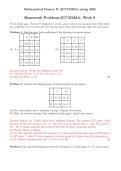
Problem 1. Find the pure Nash equilibrium if the following two-person games.
I II III
X Y Z
i 6,6 4,7 1,2
a 6, 6 8, 20 0, 8
(a). A = ii 9,3 4,1 6,2 , (b).
b 10, 0 5, 5 2, 8
iii 8,5 5,4 6,6
c 8, 0 20, 0 4, 4
iv 4,4 8,5 4,3
Example solution. We use the definition of pure NE.
(a). The pure NE are: (ii, I), (iii, III) and (iv, II).
(b).The pure NE is: (c, Z).
Problem 2. Consider the following game in matrix form with two players.
C D
A 10, 16 14, 24
B 15, 20 6, 12
(a) Does either player have a dominant strategy? Explain your answer.
(b) What are the pure strategy Nash equilibria of this game? Justify your answer.
Example solution. (a). Neither player has a dominant strategy. For example, if P1 plays A and
P2 plays D then P1’s payoff is 14(> 6). But if P1 plays B and P2 plays C, then P1’s payoff is
15(> 10). A similar argument shows that P2 also does not have a dominant strategy.
(b).The two NE are as follows.
(B, C): If P1 plays B, then P2’s best response is C with a payoff of 20 rather than 12 if P2 played
D; if P2 plays C, then P1’s best response is B with a payoff of 15 rather than 10 if (s)he plays A.
(A, D): Similar reasoning shows that (A, D) is a pure NE.
Problem 3. By repeated elimination reduce the following 5 × 5 matrix game to 1 × 1 matrix game.
Homework Problems 6CCM338A- Week 9
On the Keats page “Tutorial 9: Suggestion” section, please indicate two questions from below which
you would like to be covered in the next tutorial (please finish this by Friday night, the week before).
Problem 1. Find the pure Nash equilibrium if the following two-person games.
I II III
X Y Z
i 6,6 4,7 1,2
a 6, 6 8, 20 0, 8
(a). A = ii 9,3 4,1 6,2 , (b).
b 10, 0 5, 5 2, 8
iii 8,5 5,4 6,6
c 8, 0 20, 0 4, 4
iv 4,4 8,5 4,3
Example solution. We use the definition of pure NE.
(a). The pure NE are: (ii, I), (iii, III) and (iv, II).
(b).The pure NE is: (c, Z).
Problem 2. Consider the following game in matrix form with two players.
C D
A 10, 16 14, 24
B 15, 20 6, 12
(a) Does either player have a dominant strategy? Explain your answer.
(b) What are the pure strategy Nash equilibria of this game? Justify your answer.
Example solution. (a). Neither player has a dominant strategy. For example, if P1 plays A and
P2 plays D then P1’s payoff is 14(> 6). But if P1 plays B and P2 plays C, then P1’s payoff is
15(> 10). A similar argument shows that P2 also does not have a dominant strategy.
(b).The two NE are as follows.
(B, C): If P1 plays B, then P2’s best response is C with a payoff of 20 rather than 12 if P2 played
D; if P2 plays C, then P1’s best response is B with a payoff of 15 rather than 10 if (s)he plays A.
(A, D): Similar reasoning shows that (A, D) is a pure NE.
Problem 3. By repeated elimination reduce the following 5 × 5 matrix game to 1 × 1 matrix game.