

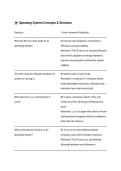
💻 Operating System Concepts & Structure
Question Correct Answer & Rationale
What are the four main goals of an B) Execute user programs, convenience,
operating system? efficiency, security/stability .
Rationale: The OS acts as a resource allocator
and control program to manage hardware,
execute user programs, and ensure system
stability .
The CPU mode bit indicates whether the B) Kernel mode or User mode .
system is running in: Rationale: A mode bit of 0 indicates Kernel
mode (privileged instructions allowed), and 1
indicates User mode (restricted) .
What does the less command do in B) It views command output or files one
Linux? screen at a time, allowing scrolling up and
down .
Rationale: less is a pager that allows forward
and backward navigation without loading the
entire file into memory .
What is the primary function of an B) To act as an intermediary between
operating system? computer users and computer resources .
Rationale: The OS acts as a "go-between,"
allowing hardware and software to
, communicate and managing system
resources .
⚙️ Process Management, Scheduling & Concurrency
Question Correct Answer & Rationale
A process is currently being executed by C) Running .
the CPU. Which state is it in? Rationale: The "Running" state means the
process instructions are currently being
processed by the CPU core .
A process is waiting for an I/O operation D) Waiting .
to complete. Which state does it enter? Rationale: While waiting for a resource, the
process is moved to the "Waiting" (or Blocked)
state .
In Round-Robin scheduling, how is the B) As a circular queue .
ready queue treated? Rationale: Round-Robin uses a time quantum;
each process gets the CPU for one quantum
and then moves to the back of the circular
FIFO queue .
Which scheduling algorithm suffers from C) First-Come, First-Served (FCFS) .
the "convoy effect," where short Rationale: FCFS is non-preemptive. A long
processes get stuck behind a long one? CPU-bound process can cause all shorter
processes to wait, leading to low device
utilization .
Question Correct Answer & Rationale
What are the four main goals of an B) Execute user programs, convenience,
operating system? efficiency, security/stability .
Rationale: The OS acts as a resource allocator
and control program to manage hardware,
execute user programs, and ensure system
stability .
The CPU mode bit indicates whether the B) Kernel mode or User mode .
system is running in: Rationale: A mode bit of 0 indicates Kernel
mode (privileged instructions allowed), and 1
indicates User mode (restricted) .
What does the less command do in B) It views command output or files one
Linux? screen at a time, allowing scrolling up and
down .
Rationale: less is a pager that allows forward
and backward navigation without loading the
entire file into memory .
What is the primary function of an B) To act as an intermediary between
operating system? computer users and computer resources .
Rationale: The OS acts as a "go-between,"
allowing hardware and software to
, communicate and managing system
resources .
⚙️ Process Management, Scheduling & Concurrency
Question Correct Answer & Rationale
A process is currently being executed by C) Running .
the CPU. Which state is it in? Rationale: The "Running" state means the
process instructions are currently being
processed by the CPU core .
A process is waiting for an I/O operation D) Waiting .
to complete. Which state does it enter? Rationale: While waiting for a resource, the
process is moved to the "Waiting" (or Blocked)
state .
In Round-Robin scheduling, how is the B) As a circular queue .
ready queue treated? Rationale: Round-Robin uses a time quantum;
each process gets the CPU for one quantum
and then moves to the back of the circular
FIFO queue .
Which scheduling algorithm suffers from C) First-Come, First-Served (FCFS) .
the "convoy effect," where short Rationale: FCFS is non-preemptive. A long
processes get stuck behind a long one? CPU-bound process can cause all shorter
processes to wait, leading to low device
utilization .


